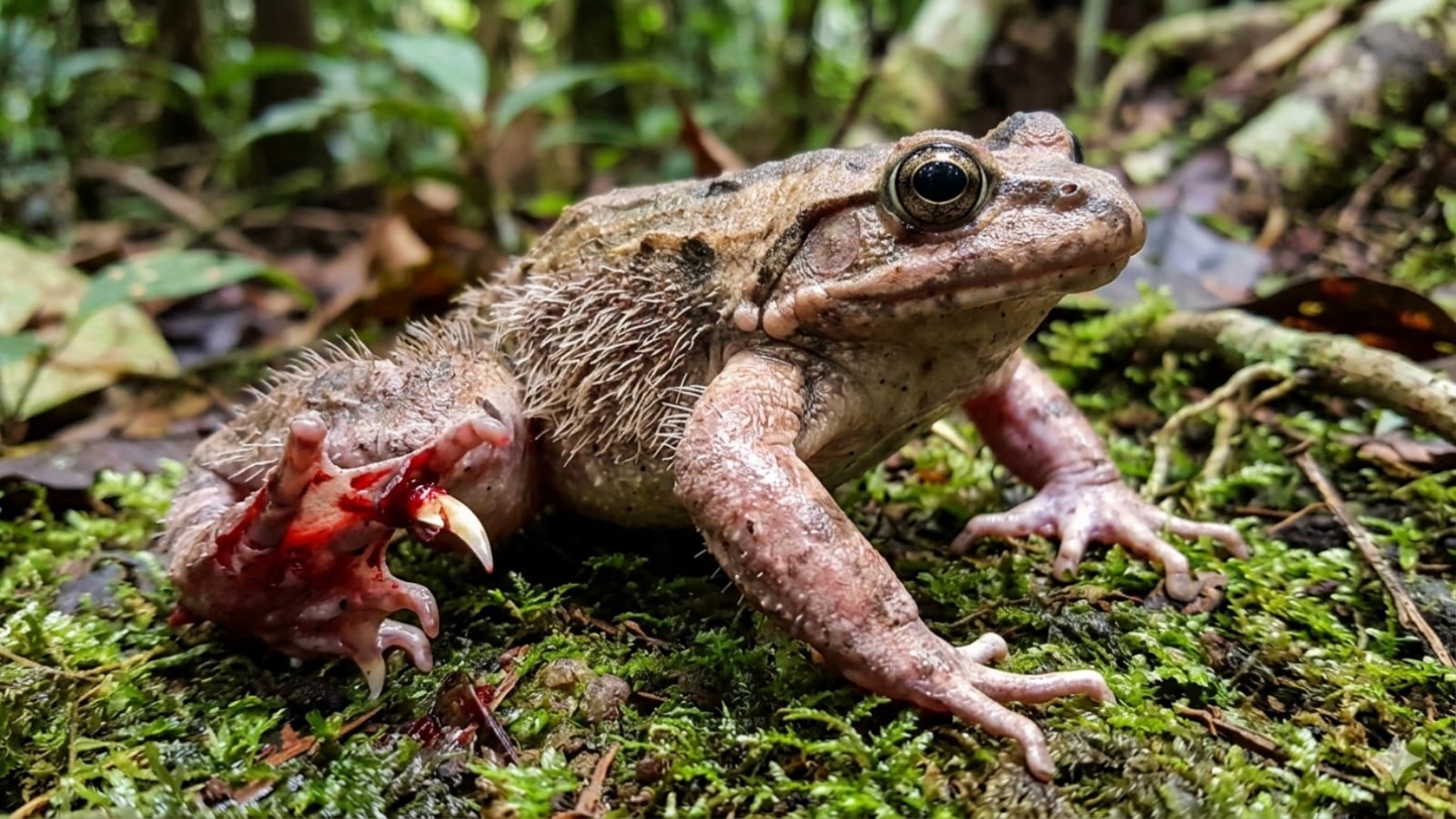

The natural world abounds with unusual survival strategies, some of which may seem almost too extraordinary to be true. Among these is a remarkable frog species that intentionally fractures its own bones as a means of self-defense.
Introducing the Hairy frog, a unique amphibian native to Central Africa, distinguished by one of the most peculiar defense mechanisms observed in animals. At first, it may appear to be a typical frog, but its behavior in the face of danger is nothing short of astonishing.
In contrast to many frogs that depend on blending into their surroundings or fleeing quickly, the hairy frog adopts a far more drastic approach. When it feels threatened, it breaks the bones in its toes on purpose. These fractured bones then pierce through the skin, creating sharp, claw-like structures that serve as formidable weapons against potential predators.
Perhaps even more intriguing is the fact that these claws are not a permanent feature. Researchers suggest that the frog is capable of retracting them once the threat has subsided, with the injured tissue gradually healing over time. While the precise biological mechanisms behind this remarkable recovery are still being examined, this ability to heal from self-inflicted wounds highlights the uniqueness of the species.
This unusual behavior has led to the frog being nicknamed the “Wolverine frog,” a reference to the comic book character known for his retractable claws.
Despite its name, the hairy frog does not possess actual hair. During the mating season, male hairy frogs develop fine, hair-like filaments on their bodies. These features enhance oxygen absorption, which is particularly beneficial when the male is responsible for guarding eggs in water for prolonged periods.
This adaptation allows the male to remain submerged for longer durations without needing to surface frequently, thus improving its chances of safeguarding its young from predators.
Scientists propose that the claw-producing mechanism, which involves breaking bones, has evolved as a last-resort strategy for survival—employed only when escape is not feasible. Though it may seem extreme, such adaptations can be crucial for survival in the wild.
The hairy frog serves as a powerful reminder that evolution can take harsh and unexpected turns. Sometimes, the fight for survival requires sacrifices that may involve even breaking one’s own bones.