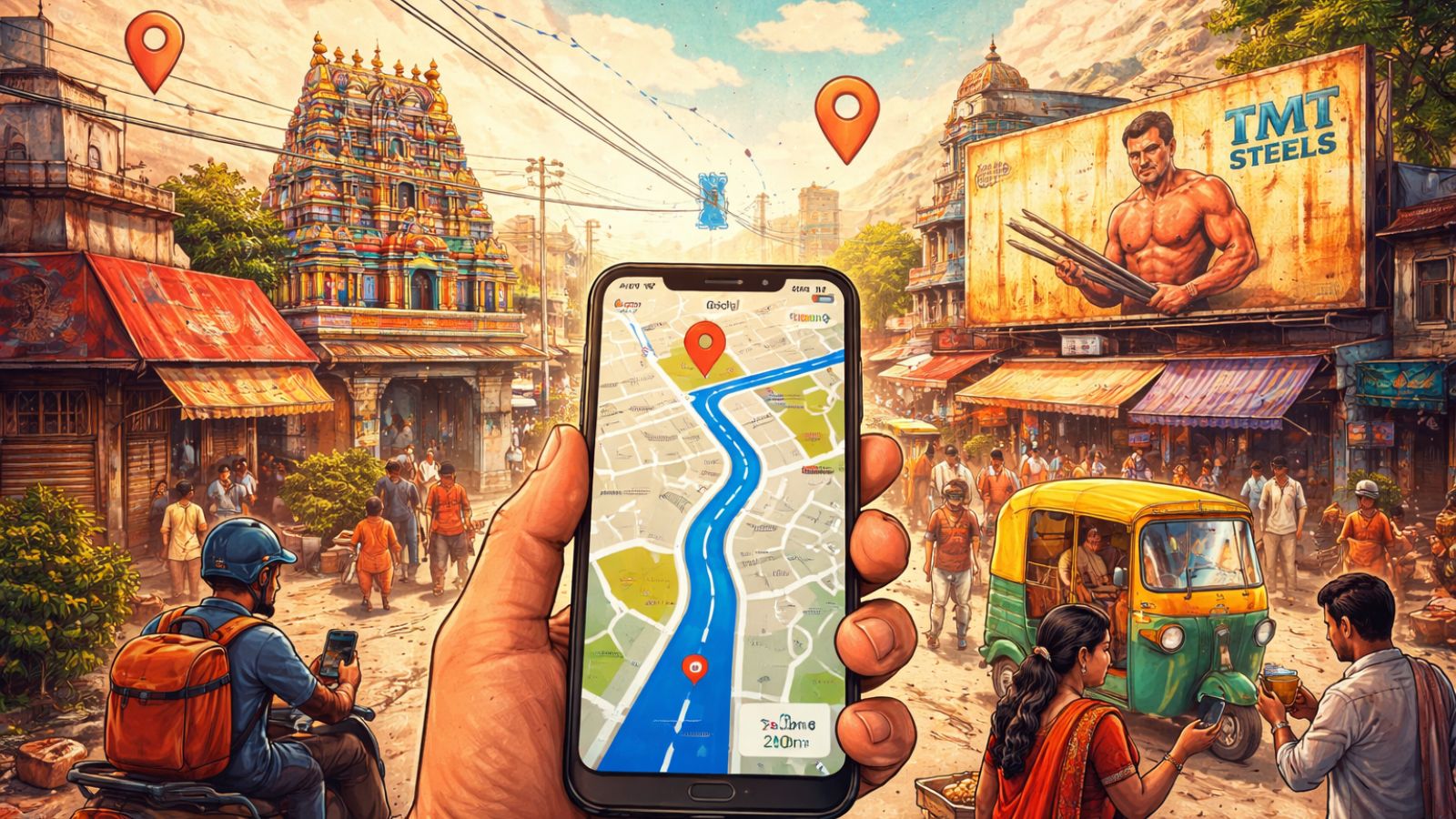

Upon entering a destination into a smartphone, a unique form of digital forgetfulness takes hold. The act of navigation shifts from a broad awareness of the surroundings to a focus on a blue line on the screen, as we place our trust in a disembodied voice to guide us through the bustling streets of India.
This reliance on digital navigation causes us to overlook the rich tapestry of our environment, substituting vibrant, hand-painted landmarks for mere coordinates. Consequently, we begin to lose our sense of actual location.
We often justify our use of Google Maps by claiming we have poor directional skills; however, research indicates that this may not be the case. A study conducted by Louisa Dahmani and Dr. Veronique Bohbot tracked drivers over three years and found that those who heavily relied on the GPS saw a significant decline in their ability to create mental maps. By opting for the less mentally taxing choice of GPS navigation, they effectively allowed the hippocampus, the brain’s mapping center, to weaken from lack of use.
My own sense of direction was honed in Kannur, Kerala, where navigating was a matter of visual literacy rather than street names. My grandparents’ home lacked a digital pin but was characterized by its ambiance, scent, and a prominent hand-painted advertisement for TMT Steels. This large mural, with its faded industrial yellow hue, served as my guiding star; spotting a muscular figure wielding a steel rod indicated that I was nearing home.
There is an inherent humanity in navigating through sensory cues rather than calculations. Upon relocating to Chennai, my reference points changed, yet the principle remained unchanged. Directions became a vivid narrative: “Look for the temple adorned with a blue and pink gopuram? Take that road.” It was an unmistakable destination. The gopuram stood out amidst the chaos of traffic, compelling one to pause and appreciate how the evening light illuminated its vibrant colors, encouraging mindfulness.
However, my next move to Noida presented a stark contrast, as the city seemed designed by individuals with a penchant for organization and numbers. Here, landmarks are lost in the maze of urban design. Navigating Noida is a sterile experience, where one high-rise is indistinguishable from another. Gone are the colorful gopurams; only numbers and sectors remain, reminiscent of a lottery rather than a community. In this environment, Google Maps becomes essential for survival. Without a functioning phone, one risks becoming lost in a sea of identical buildings.
This disorientation aligns with urban planner Kevin Lynch’s concerns. In his seminal work, ‘The Image of the City,’ he emphasized the importance of a city being ‘legible’ for its residents. He argued that individuals should be able to recognize and mentally organize their surroundings into a coherent structure. Lynch identified landmarks as critical components for urban living, asserting that the fear of being lost stems from a lack of orientation, while a clear mental map provides emotional security. When cities are stripped of their unique features, as Lynch suggested, we create environments that are difficult for the human spirit to inhabit. While contemporary urban planners may have failed to meet Lynch’s criteria for legibility, digital navigation systems also have their shortcomings, particularly regarding the last mile in Indian cities.
Currently residing in a secluded area of Delhi, I find that digital mapping struggles to accurately guide me. Here, the app encounters challenges, as food delivery workers often find themselves circling aimlessly on their tracking screens, confused by the layout of the narrow alley behind my residence.
“Madam, location galat dikha raha hai,” a driver might say, translating to, “Ma’am, the location is wrong.” In these moments, I revert to traditional navigation methods: “Bhaiya, Gurudwara dikh raha hai? Bas wahi ruk jao. Main bahar aa rahi hoon,” asking them to stop at a nearby Gurudwara. It highlights a return to a world where community landmarks—the temple, mosque, or local chai shop—become the vital points of reference, much like my TMT Steels mural did in my childhood.
This dependence on technology has sparked nostalgia for a part of myself that feels distant. At seven, I once invited a friend over during a time when smartphones were nonexistent, relying instead on landline telephones and handwritten notes. I vividly recall sitting at my desk, meticulously crafting a map in my notebook, detailing the school bus stop, a palm tree, and even a mischievous cat that frequented the neighborhood trash bins.
While that map may not have been practical for navigation, the act of creating it fostered a deep connection to my surroundings. Understanding one’s environment requires awareness of the imperfections—the potholes, peeling paint, and familiar scents of local shops. It formed a mental archive of my life.
Today, however, we prioritize efficiency in our journeys, aiming to travel from Point A to Point B with minimal hassle, often disregarding the meaningful experiences along the way. We no longer acknowledge the markers that indicate our progress or the painted advertisements reflective of local culture. We simply await the vibration in our pockets signaling the next turn.
While we may be enhancing our efficiency, I worry that we are sacrificing our innate ability to navigate and connect with our surroundings. In ceasing to seek out landmarks, we risk losing our sense of belonging to the places we traverse. Instead, we become mere visitors in our own cities, guided by algorithms that know the distance to our homes but fail to recognize the essence of our lived experiences.