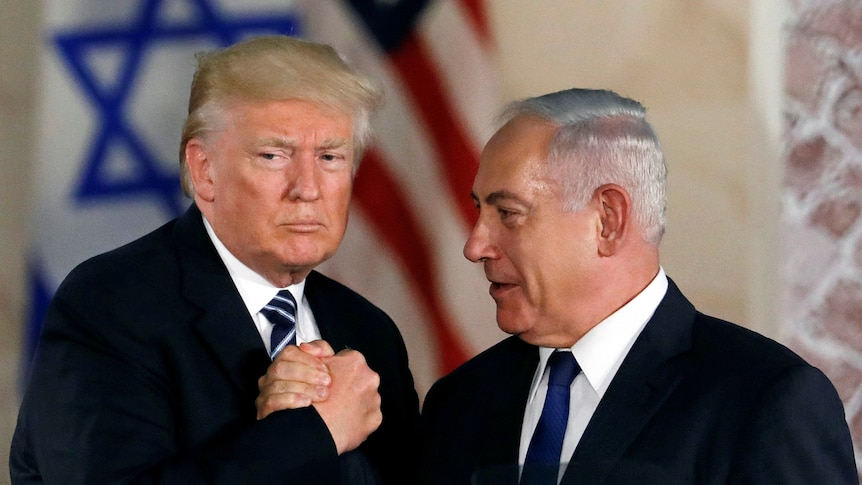

On February 11, a notable scene unfolded in the White House Situation Room, where the US president, whose disjointed speeches and erratic behavior have raised concerns about his mental acuity, yielded the floor to the Prime Minister of Israel, Benjamin Netanyahu. During this meeting, Netanyahu aimed to persuade President Donald Trump and his administration that the time was ripe for regime change in Iran, advocating for a collaborative US-Israeli initiative to dismantle the Islamic Republic.
This significant interaction has been detailed in a recent report by New York Times journalists Jonathan Swan and Maggie Haberman, which is part of an upcoming book. Their work is particularly important for two main reasons. Firstly, it appears to corroborate growing suspicions that Israel played a crucial role in pushing the US towards military action, a narrative that is increasingly provoking backlash among Americans, particularly as public sentiment towards Israel has shifted. A recent Pew Research Center study revealed that 60 percent of American adults now view Israel unfavorably, an increase from 53 percent the previous year, while 59 percent express little to no confidence in Netanyahu’s handling of international affairs, up from 52 percent.
Moreover, a notable shift is occurring among younger Republicans, with 57 percent now holding an unfavorable opinion of Israel, compared to 50 percent last year. This evolving perspective on Israel could have significant implications for future US financial and military support, particularly in the context of upcoming midterm elections, should they reflect current polling trends regarding Trump.
The second critical aspect of the report is its illumination of the lack of reliable information surrounding the ongoing conflict, contrasting with the detailed accounts provided by the authors. For instance, as the US and Israeli military operations against Iran continue, the global community has been largely left in the dark about the internal dynamics of Iran, including the effects of the conflict on its populace and infrastructure.
Information trickling in about the war’s consequences has been sparse; for example, reports have emerged indicating that the aftermath of an Iranian strike on the US embassy in Riyadh was far more severe than initially reported. The implications of the conflict on both Israel and the US remain vague, as do the effects on Gulf states targeted by Iranian assaults. The extent of damage to the USS Abraham Lincoln, which was sidelined for weeks due to either an Iranian attack or an onboard fire, remains unclear. Additionally, Gulf nations have minimized reports regarding damage to their infrastructure, with the recent revelation that Saudi Arabia’s oil production capacity has decreased by 600,000 barrels a day only surfacing late.
Concerns have been raised regarding the depletion of air defense systems in the Gulf and Israel, but concrete figures are lacking. Similarly, there is uncertainty about the number of vessels navigating the Strait of Hormuz, apart from a general acknowledgment that traffic has been limited. Despite claims of success from both Iran and the US following the announcement of a tentative ceasefire, external observers are left to interpret the situation based on observable conditions: the Strait of Hormuz remains contested, and Iran still possesses the capability to launch strategic missile and drone strikes against Israel and Gulf states, undermining assertions of victory from the US and Israel.
Amidst the ongoing tumult, Donald Trump’s unpredictable statements often overshadow the complexities of the US-Israeli operations in Iran, particularly the stark contrast between Israel’s advanced intelligence capabilities and its questionable strategic assessments. Israel has demonstrated an ability to conduct precise strikes against adversaries in Iran and Lebanon but seems to have consistently misjudged the broader implications of its military engagements.
According to Swan and Haberman, during the Situation Room meeting, Netanyahu presented a narrative of imminent success, claiming that Iran’s ballistic missile capabilities could be neutralized swiftly and that the regime would be rendered incapable of threatening the Strait of Hormuz. Netanyahu’s assertions included expectations of renewed protests within Iran, spurred by Mossad’s involvement, which he believed would create conditions favorable for an opposition-led regime change.
Trump’s response to these assertions was notably enthusiastic: “Sounds good to me.” However, his advisors appeared less convinced, prompting them to prepare a thorough evaluation of the Israeli briefing. The New York Times reported that CIA Director John Ratcliffe characterized Netanyahu’s claims with skepticism, highlighting the need for a more cautious approach to the situation.