
Iskhandar Razak from ABC News delves into the thriving Australian cosplay community, highlighting its evolving landscape and the unspoken guidelines that govern it.
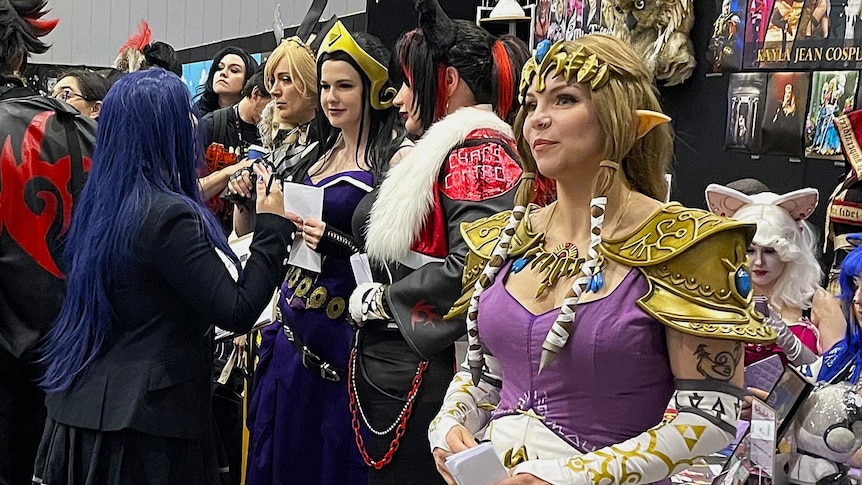
At the heart of a bustling cosplay tournament in Melbourne, a character known as Miss Twisted, an elf princess, leads an ensemble of warriors, sorceresses, and other enchanting figures.
This event is part of a larger trend, with various conventions taking place across the nation, including the Supernova Comic Con and Gaming convention set to occur this month in both Melbourne and the Gold Coast.
According to Miss Twisted, whose real name is Charlotte, the cosplay phenomenon has seen significant growth over the past decade.
A distinguished cosplayer and researcher, Emerald King, explains that cosplay encompasses dressing as characters from various mediums such as anime, manga, films, and even tabletop games.
However, there are certain standards that participants must adhere to within this rapidly mainstreaming subculture. For those attending conventions in costume, understanding the basic guidelines is essential.
When ABC News speaks with Miss Twisted, she is embodying Princess Zelda from the renowned Legend of Zelda video game franchise. As a professional cosplayer, she earns a living by crafting costumes, competing in events, and judging contests.
Miss Twisted emphasizes that the essence of cosplay lies in enjoyment—creating or wearing costumes to honor beloved characters. She notes that there are no strict financial limits; while some might assemble a costume for as little as $50, others may invest thousands.
In competitions, however, prizes and titles are at stake, which necessitates criteria to determine the best costumes. A key guideline is that a significant portion of the costume must be handmade.
As Miss Twisted explains, competitors typically need to create 70 to 80 percent of their attire by hand. Shaydon, also known as Shadinski_Cosplay, is recognized for his precise armor designs and mentions that the remaining 20 percent may include store-bought accessories or 3D-printed items.
He highlights that two critical factors in competitions are character accuracy and craftsmanship, noting that high-level events expect the majority of costumes to be handmade.
Some rules can be quite stringent, as Dr. King notes that one might be required to create every component of their outfit, even down to undergarments.
As a judge, Miss Twisted evaluates a range of skills, including sewing, embroidery, pattern making, and even advanced techniques such as electronics integration. She comments that there are virtually no limits to creativity.
While accuracy is paramount in cosplay, it is not solely about replicating a character’s appearance. Dr. King reflects on past restrictions regarding gender representation in cosplay, particularly in the early 2000s, where guidelines at conventions deemed it inappropriate for masculine-presenting individuals to dress as female characters.
She adds that these guidelines existed alongside outdated laws in some regions, like Tasmania, which criminalized cross-dressing after dark. Conversely, female competitors often felt the need to dress as male characters due to the more compelling storylines associated with them.
Fortunately, societal norms have transformed, allowing cosplayers in Australia to portray characters of any gender. Miss Twisted shares her experiences of adapting characters to fit her vision, including purchasing prosthetics for authenticity.
However, race representation remains a sensitive topic. Miss Twisted firmly states that attempts to alter one’s appearance to mimic another race, such as through makeup, are unacceptable. Dr. King reinforces this by explaining that such actions are often rooted in mockery.
When judging, cosplayers also perform for an audience, providing a glimpse into how their costumes function while embodying their characters. Miss Twisted notes that whether portraying a villain with strong stances or a delicate anime character with graceful movements, the focus remains on the character and costume rather than physical appearance alone.
Dr. King explains that using skin color to depict fantastical races is more acceptable, as these characters often exist outside the boundaries of reality. However, she warns that reducing a character to merely their skin tone is a simplistic approach.
In terms of sexualization, fans find flexibility; comic book characters have long been depicted in revealing outfits. In modern competitions, as long as the portrayal captures the essence of the character, variations in design—like opting for modest clothing—are not penalized. Miss Twisted reassures that she would never deduct points for such adjustments, recognizing the skill involved and emphasizing comfort over strict adherence to the original design.