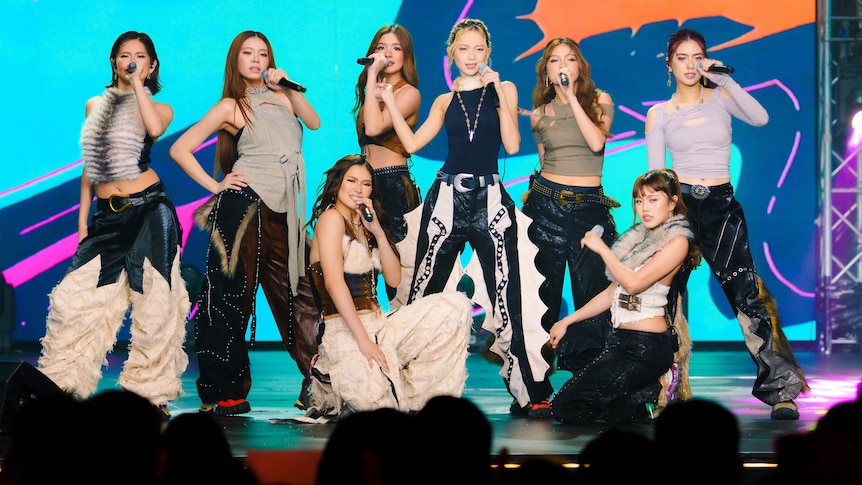

This weekend marks the commencement of one of the largest music festivals in the world, where a groundbreaking event will take place as a Filipino pop group makes its debut.
BINI is set to be the inaugural Filipino girl group to grace the stage at Coachella in California. While individual Filipino artists have performed at previous festivals, this event holds particular significance for the group.
Owen Nebril, a supporter of BINI from Melbourne, expressed his belief that this performance will demonstrate the group’s potential to resonate with audiences beyond their home country. “They’re exceptionally talented,” he stated. “This will highlight the exceptional singing and entertainment skills of Filipinos, not just in the Philippines, but on a global scale.”
The name BINI is derived from the Tagalog term ‘Binibini,’ which translates to ‘young woman.’ They represent the P-pop genre, a rising style of music from the Philippines that is increasingly gaining international recognition. P-pop is influenced by various Asian pop cultures, including K-pop from South Korea and J-pop from Japan, and it embraces idol culture, which involves training performers to engage deeply with their fans.
Kara Angan, a music journalist from the Philippines, emphasized the importance of BINI’s performance at Coachella, noting its potential to introduce Filipino pop music to a wider audience. “It brings Filipino culture and music to listeners who might not have initially sought out BINI,” Angan remarked.
BINI is not alone in making history for P-pop at music festivals. Filipino-British artist Beabadoobee is scheduled to perform at Lollapalooza in the United States this July, alongside SB19, another Filipino group that will also make its debut at the event.
Angan noted that the ascent of these groups, who perform in Tagalog, illustrates that language is no longer a barrier for listeners. “There’s more than just the music; the choreography, the live experience, and the interaction with idols create a complete package,” she explained.
Idol culture is a significant aspect of the music scene in both Japan and South Korea. In the Philippines, the major media outlet ABS-CBN produces one of the idol training programs, Star Hunt Academy, where the members of BINI were trained in 2019. Guided by local and South Korean mentors, they developed their skills on this televised talent show before securing a recording contract.
Following their debut, BINI cultivated a dedicated fan base, fostering a sense of community among listeners. Angan remarked that fans from around the world, regardless of their backgrounds, have found common ground in their admiration for the group.
The success of SB19’s sold-out concerts in Sydney and Melbourne last year highlighted the robust P-pop following in Australia, with approximately 4,800 attendees across the two shows, as reported by Mike Venezuela, the promoter for SB19 in Australia. However, this audience size is still modest compared to the larger crowds that attended K-pop group Blackpink’s concert earlier in 2023.
Melanie, a fan of K-pop who has also embraced P-pop, attended SB19’s Sydney performance and praised their production quality and stage presence. She recalls discovering the group in 2024 and feeling an immediate connection. “I remember thinking, ‘Who is this group? I need more,’” she shared.
Melanie pointed out that while P-pop shares similarities with K-pop, it also incorporates traditional Filipino instruments, giving it a unique flavor.
P-pop began gaining traction in 2020, with the emergence of idol groups in the Philippine music scene that built large followings through viral performances and engaging dance videos.
According to James Gabrillo, an assistant professor of music at the University of Austin, previous Filipino groups followed a more rigid training model showcased on reality television. As many of those programs have faded from the airwaves, the training has evolved to resemble South Korea’s idol system. “It has become more structured and intense,” Dr. Gabrillo noted, while still blending idol training with traditional OPM (Original Pilipino Music) values, such as strong vocal delivery and emotional resonance.
Dr. Gabrillo observed that P-pop groups have successfully carved out a niche for themselves, achieving a blend of global and local appeal. “Their branding is compelling, combining global attraction with distinctly Filipino elements,” he stated.
While there is ongoing discussion about whether P-pop constitutes a separate genre, Dr. Gabrillo maintains that it still falls under the umbrella of OPM. Originally associated with popular ballads of the 1970s in the Philippines, OPM has evolved to encompass a wide array of genres performed or produced by Filipino artists.
Despite the growing recognition of OPM through the success of P-pop, it faces criticism, particularly regarding the lack of representation for dialects such as Bisaya in the music industry. Angan highlighted that songs in languages other than Tagalog are often viewed as regional, leading to exclusion and discrimination against non-Tagalog speakers.
Melanie believes that both OPM and P-pop should be more inclusive of various dialects. She has learned basic Tagalog through her engagement with P-pop groups like SB19. “Ken, who sings in Bisaya, has received a warm response whenever he performs in his language, which shows that there is an appetite for diversity,” she remarked. “I feel that some P-pop groups are beginning to shift perceptions about which languages are deemed acceptable.”