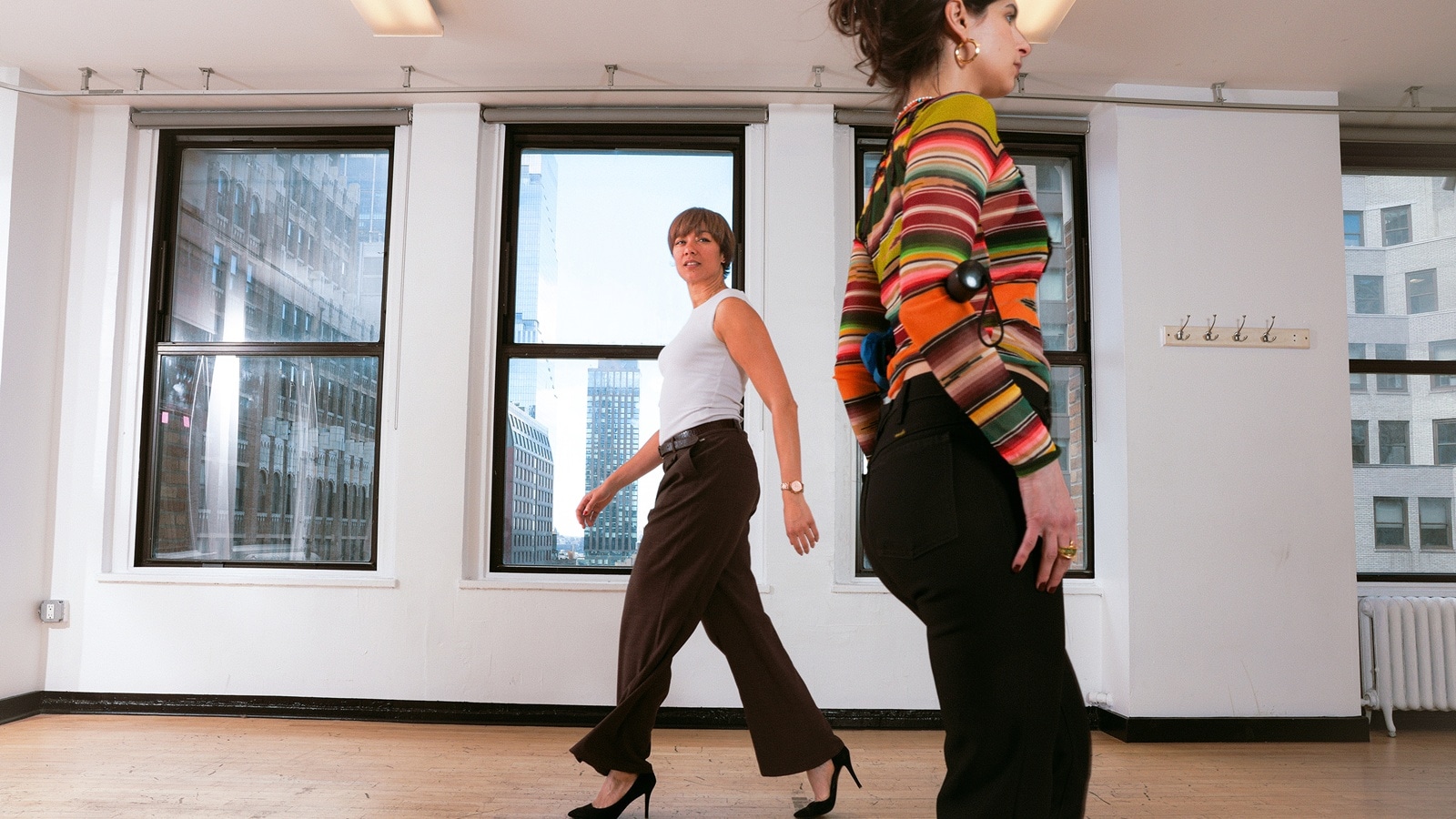

When I first met with Mandy Lieveld, I made sure to express my concern about my tendency to hunch, similar to a less graceful version of Bernie Sanders. “Walking in heels makes me feel as though I’m collapsing under the weight of gravity,” I explained. However, Lieveld, a former model and runway coach, appeared unfazed by my apprehension.
Lieveld specializes in guiding both models and non-models in mastering the art of walking the runway with poise and assurance. With her expertise, she transforms clumsy strides into confident movements for high-profile brands like Michael Kors, Versace, and Bottega Veneta.
I learned about Lieveld, who is 40 years old, from author Zoe Dubno, who was invited to participate in Rachel Scott’s debut Proenza Schouler show last February. Although honored by the opportunity, Dubno was engulfed by anxiety. “I have a rather clumsy walk reminiscent of Groucho Marx,” she admitted. To make matters worse, she was tasked with walking in heels, which she likened to instruments of torture reserved for special occasions like her brother’s wedding.
Proenza Schouler’s casting team enlisted Lieveld, and after just two days of intensive coaching, she successfully transformed Dubno’s walk from an awkward shuffle to that of a seasoned supermodel.
Intrigued by this transformation, I wondered if Lieveld could work her magic on me as well. Could she correct my suspected scoliosis and elevate my habitual slouch? I decided to book a 90-minute session for personalized coaching, priced at $750, at her studio in Midtown Manhattan.
Equipped with a pair of 3.3-inch silver Jimmy Choo heels, I entered a bright, mirrored studio on the 16th floor of Ripley-Grier Studios, a bustling space filled with aspiring Broadway performers.
Lieveld immediately guided me to open my chest as if greeting “the sunshine” with my posture. She frequently emphasized the importance of relaxing and adjusted my shoulders, easing the tension in my upper back. She introduced me to her “CNS” principles—standing for confident, natural, and strong—attributes that modeling agencies and casting directors often seek.
Originally from the Netherlands, Lieveld has been a walking coach for over a decade. Standing at 6-foot-1, she was always tall for her country, and it wasn’t long before others suggested she pursue modeling. “I started modeling and realized that there was so much to learn, yet no one was teaching it,” she reflected. This realization prompted her to attend a dance academy, where she honed her skills in ballet and modern jazz, gaining insight into the importance of grace.
At the age of 21, her dance aspirations were interrupted by a diagnosis of myasthenia gravis, a muscular disorder that nearly left her paralyzed. “This experience taught me to cherish the activities that bring me joy,” she shared.
Lieveld then attended the University of Amsterdam, where she studied psychology. “I found this knowledge invaluable for models, as confidence is essential in dealing with rejection,” she explained about the benefits of her education. After completing her bachelor’s and master’s degrees, she decided to pursue a career as a model coach.
On the runway, even a slight misstep can have significant consequences. Our manner of walking reflects much about our identity and emotional state. Nicole Maleh, a clinical psychologist in Westchester, New York, noted that adolescents often slouch intentionally to conceal themselves, while adults may do so unconsciously. “It’s a way of saying, ‘I don’t want to draw attention; I just want to go about my day,’” she explained.
Maleh also connects our walking behavior to evolutionary traits. “Consider a group of apes in the wild,” she illustrated. “The alpha male stands tall with a prominent chest, taking measured strides, while the rest of the group exhibits a more carefree and playful gait.”
However, no species of ape has had to navigate the unique challenge of walking a runway in ill-fitting shoes. Lieveld provides practical strategies and memorable cues to help her clients adapt to the demands of the catwalk. During our session, she often encouraged me to visualize “splashing” as my foot made contact with the ground, which she clarified was about energy rather than forceful stamping.
She shared various techniques, including the idea that “the core is the engine of your walk,” urging me to engage my core for stability while still being able to breathe and converse. At one point, she handed me an umbrella to hold behind my back, a technique borrowed from horse riding that opened my chest and provided a gentle stretch.
To help models achieve the iconic “Blue Steel” facial expression, Lieveld encourages them to imagine emitting laser beams from their eyes, suggesting that this gives an air of intrigue, as if they hold secrets.
At the conclusion of our session, Lieveld presented me with video comparisons of my walk before and after the lesson. My posture had visibly improved; I now walked upright with a confident stride, even in heels. My movements felt purposeful. However, I had one lingering concern: what happens if I stumble?
“Sometimes,” she advised, “the best strategy is simply to get up and keep moving forward.”
This article was originally published in The New York Times.