
A representative from Iran’s foreign ministry has addressed the recent negotiations held in Islamabad, indicating that the discussions unfolded in a climate of skepticism. The spokesperson noted that it would not be feasible to expect a resolution to emerge from a single meeting, as reported by Reuters.
The spokesperson also mentioned that Iran, Pakistan, and their regional partners would maintain ongoing communication and consultations in the future.
On Sunday, Pakistan’s Foreign Minister Ishaq Dar emphasized the necessity for both Washington and Tehran to adhere to a ceasefire agreement, following extensive discussions aimed at concluding the conflict in the Middle East, which ultimately did not result in a consensus.
“It is essential for all parties to honor their ceasefire commitments,” he stated.
Dar further asserted that Pakistan intends to continue facilitating dialogue and engagement between the Islamic Republic of Iran and the United States in the days ahead.
In a notable development, Pope Leo XIV made a statement in the international political sphere, as reported by Edward Helmore of the Guardian. During evening prayers at St. Peter’s Basilica in Vatican City, he called for an end to war and criticized the “delusion of omnipotence” that compels leaders into conflict.
Cardinal Robert McElroy, the Archbishop of Washington and a close associate of Pope Leo XIV, urged Catholics to take civic action against the “immoral” conflict involving Iran. In a video shared by journalist Christopher Hale, McElroy implored his followers to “move beyond prayer.”
“As citizens and believers in this cherished democracy, we must advocate for peace with our leaders,” he said. “Merely praying is insufficient; we must take action. There is a real possibility that negotiations could falter due to stubbornness on both sides, prompting the president to escalate military involvement in this unjust war.”
He urged that at this critical moment, followers of Jesus Christ, called to be peacemakers, must collectively declare: ‘No. Not in our name. Not at this moment. Not with our country.’
Interestingly, JD Vance, who recently led the US withdrawal from peace discussions with Iran, converted to Catholicism in 2019. He has announced a memoir discussing this experience.
According to Iran’s semi-official Tasnim news agency, an informed source stated that Iran is not rushing to negotiate, emphasizing that there will be no changes in the Strait of Hormuz unless the US agrees to a “reasonable deal,” as reported by Reuters. The US has expressed that reopening the Strait of Hormuz, a critical passage for a substantial portion of the world’s oil supply, is a key condition for concluding the conflict with Iran.
Welcome to our live coverage of ongoing events in the Middle East; the US-Iran talks in Islamabad appeared to stall on Sunday.
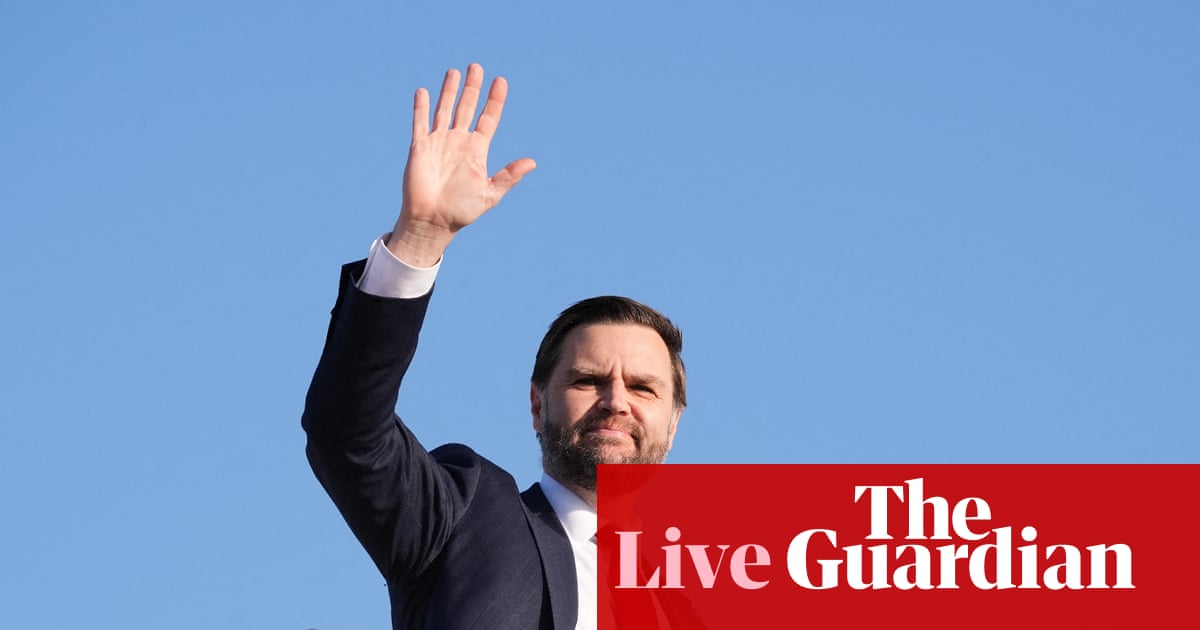
Following a lengthy first day of negotiations lasting 21 hours, US Vice President JD Vance announced that his team was departing Pakistan without reaching an agreement.
Vance indicated that Iran had rejected US conditions, which included a commitment to refrain from developing nuclear weapons.
In contrast, Iranian state media reported that the discussions collapsed due to the US’s “unreasonable demands.”
For those just tuning in, here’s a brief overview of the latest developments: High-stakes negotiations between the US and Iran seemed to falter on Sunday, despite marking the highest-level direct engagement between the two nations in decades. The talks in Pakistan aimed to secure a peace agreement to end the ongoing conflict. The core US delegation, led by Vance, has since departed Pakistan.
Prior to the talks, the Iranian foreign ministry cautioned that the success of the discussions hinged on Washington avoiding “excessive demands” and “unlawful requests.” Key topics included the strategic Strait of Hormuz, nuclear development, war reparations, and sanctions.
The Strait of Hormuz remains a significant point of contention, according to the reports from Iran’s semi-official Tasnim news agency.
Israeli Prime Minister Benjamin Netanyahu declared on Saturday that Israel is committed to continuing its efforts against Iran. “Under my leadership, Israel will persist in combating Iran’s terror regime and its affiliates,” he posted on social media. Israel was not part of the US-Iran negotiations.
Former President Donald Trump commented to reporters outside the White House that it was inconsequential to him whether a deal was finalized with Iran. “Regardless of the outcome, we win,” he stated. “The success of the negotiations is irrelevant to me.”
Recent Israeli assaults on Lebanon have resulted in over 2,000 fatalities and more than 6,300 injuries, according to the health ministry’s data. Previously, Iranian negotiators had called for a ceasefire in Lebanon, reparations, and a commitment to release frozen assets as part of an initial agreement with Pakistani mediators.
In an update released on Saturday, the US military announced that it had “begun setting the conditions for clearing mines in the Strait of Hormuz,” mentioning that two navy destroyers had transited the waterway. However, a spokesperson for Iran’s joint military command later refuted the US military’s assertion that the navy destroyers had passed through the strait.