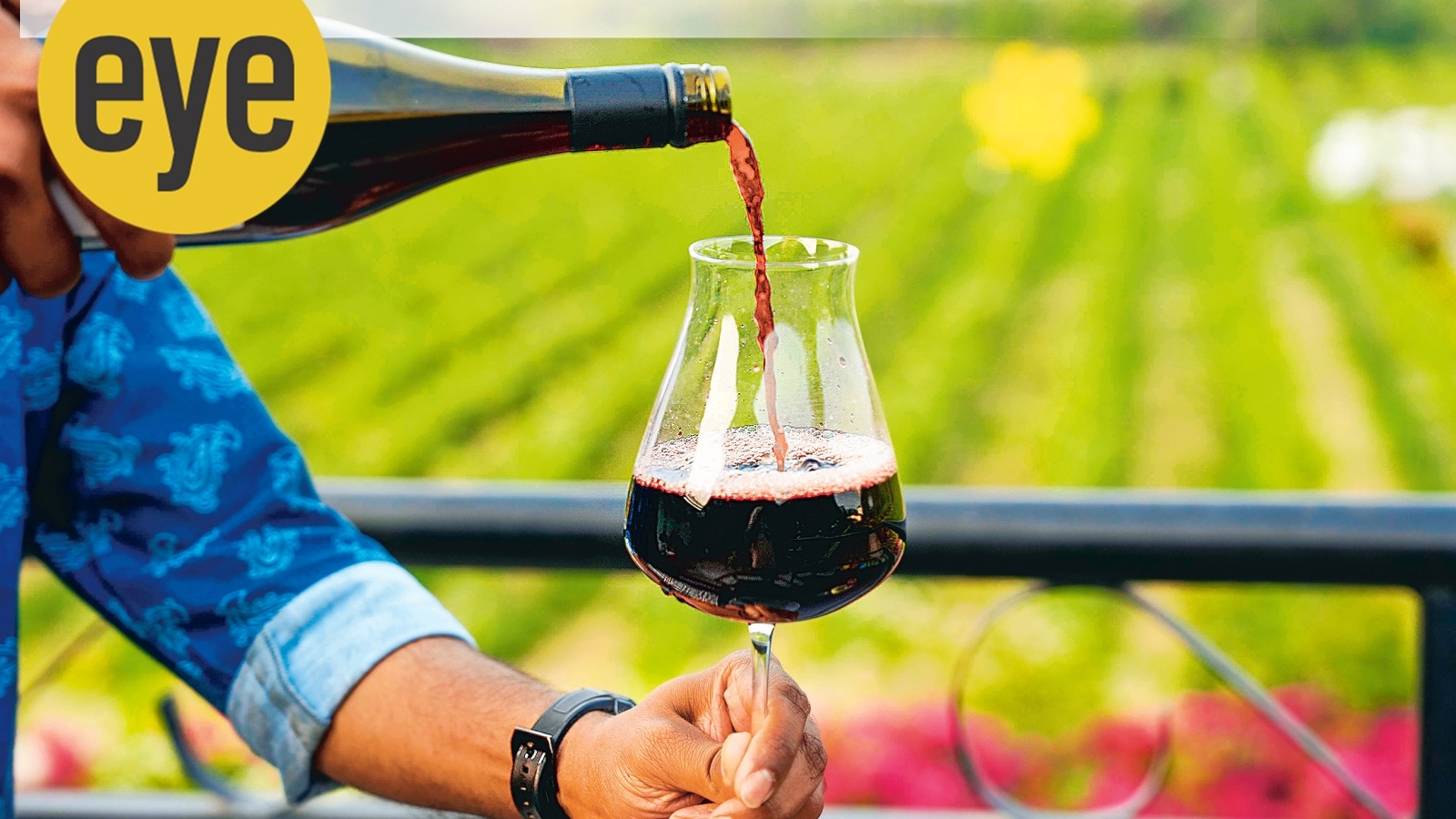

On a sunny Sunday afternoon in mid-March, the tasting room at the edge of lush vineyards is filled with approximately 20 inquisitive visitors, including families, couples, and young adults. They attentively listen as a young winemaker elaborates on the distinctions between Chenin Blanc and Chardonnay. Attendees swirl, sniff, and sample white wine from elegantly designed long-stemmed glasses. Nearby, the sound of grape-crushing resonates, signaling the peak of harvest season. The reception area buzzes with activity, and the restaurant is alive with joyful conversations, creating an inviting ambiance.
A seasoned winemaker humorously points out, “Did you know that wine is the least understood and least sold alcoholic beverage in India? Yet, every liquor store is labeled a ‘wine shop.’” The audience laughs, but the irony highlights the contradictions within India’s wine sector, particularly in Nashik, nestled in the picturesque Sahyadri mountains. While it flourishes as a tourist hotspot, wine consumption remains minimal, accounting for less than one percent of the country’s total alcohol intake.
As if these challenges were not enough, a new concern is brewing. The proposed trade agreement between the EU and India aims to significantly reduce tariffs on imported wines. Should this agreement be finalized, local wine producers—who are already contending with complex taxation, insufficient distribution networks, and a limited domestic market—might face increased competition. This situation raises questions about the potential fragility of the emerging industry.
Driving into the region presents a different perspective. Leaving the industrial clusters of Nashik behind, a narrow road flanked by open fields and the scent of a nearby river leads to Sula Vineyards, a pioneer in the local wine industry. Spanning 22 acres and featuring postcard-worthy grape vineyards, Sula is responsible for producing approximately 60 percent of India’s wine.
The winery’s origin story has become a part of industry legend. In 1994, Rajeev Samant—having graduated from Stanford and worked at Oracle—stood on his family’s land in Nashik. Observing flourishing orchards of table grapes, he recognized the region’s ideal natural conditions: warm daytime temperatures around 35°C that drop to 10°C at night, red laterite and sandy loam soils enriched with limestone for drainage, and the moderating influences of the Godavari River, Gangapur Lake, and Sahyadri hills during the monsoon season. This combination provided the perfect terroir for viticulture.
Samant returned to the United States for three weeks of training at a winery in California, operated by his friend Kerry Damskey, before coming back to India. In 1998, he planted Vitis vinifera vines and named his venture Sula in honor of his mother, Sulabha. The release of the first bottle of Chenin Blanc in 2000 marked the beginning of a transformative era.
Following Sula’s lead, the Maharashtra government’s Grape Processing Policy in 2001 introduced tax incentives and subsidies, encouraging other entrepreneurs to enter the industry. Wineries such as Grover, Zampa, York, Soma, and Chandon emerged in various locations throughout the region, forming a burgeoning wine cluster. Consultants from California were enlisted, farming practices were refined, and contracts were established with farmers to transition from table grapes to wine varieties.
By 2010, Nashik had firmly established itself as a key player in the Indian wine sector.
Currently, around 30 wineries operate within the Nashik region, contributing nearly 80 percent of the country’s wine production. Maharashtra, with a total of 40 to 50 wineries, accounts for 90 percent of national output. Approximately 8,000 acres are devoted to wine grapes, producing a variety of whites—including Chenin Blanc, Sauvignon Blanc, Chardonnay, and Riesling—and reds such as Shiraz, Cabernet Sauvignon, Merlot, Zinfandel, and Tempranillo. The annual grape crush reaches about 20,000 tonnes, yielding 14 million liters of wine, and the industry is valued at nearly Rs 2,000 crore. “Sula has expanded from a 30-acre family vineyard to over 2,800 acres nationwide,” notes Samant, who now oversees operations from Dubai after launching an IPO in 2022.
While these figures suggest a thriving industry, underlying issues persist.
The realization soon emerged that while producing wine was one challenge, encouraging consumption was another. India lacks a deeply rooted wine culture, with spirits like whisky, rum, and beer dominating the market. Wine, often perceived as sophisticated and challenging to navigate, intimidated many consumers.
In response, Sula shifted its focus. After spending its first 15 years developing essential infrastructure—such as crushers, casks, bottling facilities, and distribution networks—the winery aimed to demystify wine. Its estate transformed into a lifestyle destination, offering vineyard-facing accommodations, treehouses, restaurants, selfie opportunities, grape-stomping events, and guided tastings that made wine more approachable.
This strategy proved successful, attracting over 350,000 visitors each year. The recent 15th edition of SulaFest in February 2026 drew 12,500 attendees for a celebration of music, wine, and gastronomy beneath the stars.
Other wineries have adopted similar strategies, each adding its unique touch. Grover Zampa, currently upgrading its Sanjegaon facility, showcases tastings that highlight their innovative concrete fermentation tanks, in contrast to the more common steel varieties. Their One Tree Hill label features a charming narrative about a large mango tree that dominates the vineyard’s landscape, adding character to the brand.
Vallonné Vineyards, located behind a scenic yellow building by a lake, was founded by Shailendra Pai, who transitioned from a marketing career with Champagne India Limited to viticulture. His first harvest occurred in 2009, and he continually experiments with new grape varieties and styles, demonstrating that Indian wine can indeed innovate.
Lastly, Fratelli, situated in Akluj (Solapur), was chosen for its terroir suitability based on insights from expert viticulturist Piero Masi. This winery complements the diverse landscape of Indian wine, showcasing the region’s potential.