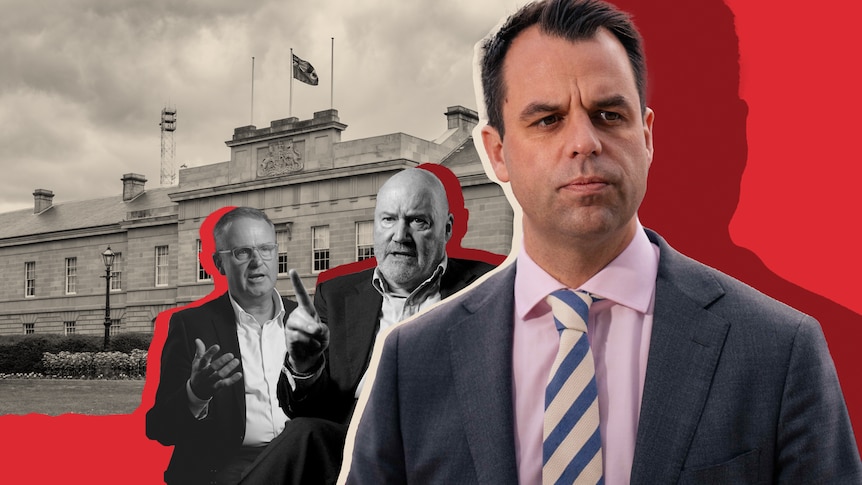

Labor leaders in Tasmania have expressed significant concern over the party’s current status, stating that the opposition’s policies closely mirror those of the Liberal Party. They emphasized that without collaboration with the Greens and other crossbenchers, there is no viable route to regaining government.
While Labor holds power at the federal level for the second consecutive term, the state branch in Tasmania has remained in opposition for over ten years. Recent polling from EMRS indicates a decline in Labor’s primary vote to 23 percent, a drop of three points since the last election, prompting former state treasurer Michael Aird to call for immediate changes. “What we are currently doing isn’t effective,” Aird remarked. “A reset is necessary.”
Aird challenged his fellow Labor members to identify distinct differences between Labor’s and the Liberal Party’s policies, noting their silence in response. He humorously referenced a comment about greyhound racing, suggesting that while Labor may take a stance on that issue, it does not reflect a broader ideological divergence.
Former Premier David Bartlett recently expressed “shame” regarding Labor’s opposition to the ban on greyhound racing, labeling it as an example of the party’s failure to adapt. Following his remarks, Bartlett noted that the majority of feedback he received from party members was supportive of his stance, indicating a desire for change within the party.
Four years ago, Labor’s national executive intervened in the Tasmanian branch to address internal conflicts and hyper-factionalism, which included a legal threat from former state president Ben McGregor against then-leader Rebecca White. Currently, Tasmanian Labor is gradually emerging from this intervention.
The upcoming state conference in Hobart, the first in seven years, marks a significant step in this process. Prime Minister Anthony Albanese is expected to address the gathering, which is anticipated to be a carefully orchestrated event.
Bartlett foresees potential criticism directed at the parliamentary Labor party from grassroots members during the conference. “There may be some surprises,” he said, encouraging rank-and-file members to voice their opinions to improve policy-making. He emphasized the need for the party to adopt a forward-thinking approach to develop innovative policies.
He criticized the party’s reluctance to move away from supporting an industry that offers minimal employment and economic benefits while being harmful to animals. “It seems illogical for us to stake our future on defending outdated practices when Tasmania has evolved significantly,” he stated.
In a recent interview, Labor leader Josh Willie acknowledged the importance of the national executive’s decision to lift its intervention in Tasmania, expressing enthusiasm for reintegrating membership into policy discussions. He affirmed that the party’s approach to the next state election would be methodical, emphasizing the need for consistent messaging without hastily introduced policies.
Labor has been out of power in Tasmania since 2014, following the defeat of former Premier Lara Giddings by the Liberals. By the time the next state election occurs in 2029, the party will have been in opposition for 15 years, marking a historic low for the Tasmanian Labor branch, which has traditionally held significant power throughout much of the 20th century.
Despite a strong federal presence and victories in other jurisdictions, including last month’s notable win in South Australia, Tasmania’s Labor party has suffered five consecutive electoral losses. Its primary vote in the 2025 election was the lowest since it began contesting state elections in 1903.
Former treasurer Aird questioned the strategic decision to hold an election in 2025, criticizing what he described as a series of poor political judgments that led to the party’s current predicament.
Professor Richard Eccleston, director of the Tasmanian Policy Exchange, noted that Labor’s performance in the 2025 state election was particularly disappointing, especially in light of the party’s success in the federal election just months earlier. He pointed out that if state Labor had mirrored that federal success, they could have secured government. Voters attributed blame to Labor for initiating an unwanted early election, reflecting a broader uncertainty about the party’s identity and position.