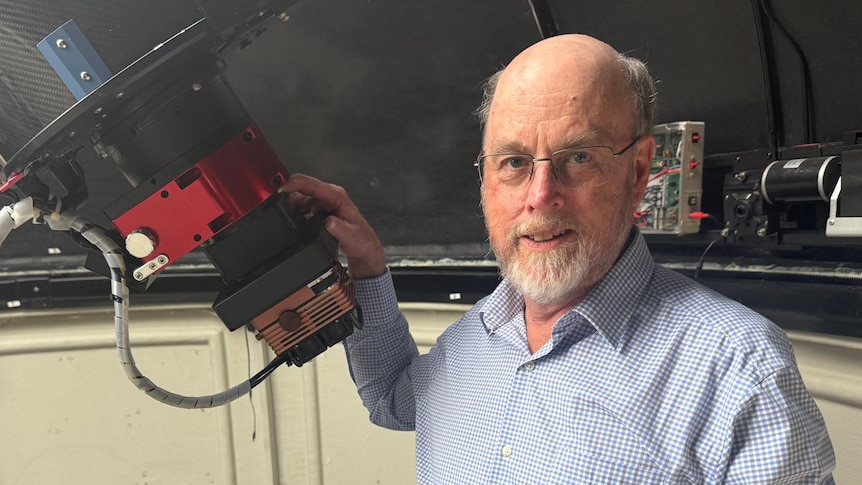

From his home observatory in regional Victoria, astronomer Chris Stockdale is playing a significant role in the quest to discover distant planets by monitoring minute fluctuations in starlight.
His research contributes to various global scientific initiatives, including missions associated with NASA, aimed at identifying new celestial bodies beyond our solar system.
Mr. Stockdale is committed to persistently scanning the heavens for indicators of new planetary systems.
Operating from a compact observatory in eastern Victoria, Chris Stockdale dedicates his nights to observing the subtle flickers of light emitted by stars located hundreds of light years away.
This endeavor may seem like something out of science fiction, but for this astronomer from Gippsland, it has become a regular pursuit—a meticulous search for planets that orbit distant suns.
Mr. Stockdale’s passion for astronomy began in the 1960s as a personal interest.
“My journey into astronomy started with the Apollo missions and the Moon landings,” he recounted. “There were also several bright comets visible at that time, and I vividly remember my father waking me up at 4 AM to see them, which was truly fascinating. I’ve kept my interest alive ever since.”
That early enthusiasm has evolved into a significant pursuit. Mr. Stockdale now manages a fully automated telescope system situated in his backyard observatory in Churchill, gathering valuable data from far-off star fields.
The setup includes a 320-millimeter telescope mounted on an advanced tracking system that allows it to focus on a specific area of the sky for extended periods.
From this data, Mr. Stockdale is on the lookout for a very particular phenomenon—a slight dimming in a star’s brightness that occurs when a planet transits in front of it.
These slight variations in light are critical for discovering planets orbiting distant stars. His efforts have led him to collaborate on a global scale, including projects associated with NASA, where he aids in the validation of potential exoplanets identified through space-based surveys.
Mr. Stockdale has played a part in over 100 scientific publications and has assisted in confirming about 100 exoplanets. However, he emphasizes the collaborative aspect of this research.
He verifies predicted targets from the ground, meticulously working through extensive lists of potential candidates that require precise observation timing.
Some nights yield clear signals, while other times the analysis can become a lengthy challenge. “I might spend an additional eight to ten hours trying to decipher the observations,” he added.
Recently, Mr. Stockdale’s contributions have been formally acknowledged by the Astronomical Society of Australia (ASA), which presented him with the 2026 Berenice and Arthur Page Medal.
Dr. Tanya Hill, an ASA representative and resident astronomer at Melbourne’s Scienceworks, highlighted the importance of Mr. Stockdale’s work to contemporary space science. “This award is an opportunity for professional astronomers to celebrate and recognize the remarkable contributions of amateur astronomers,” she stated.