
A network of volunteers across Europe has taken on the initiative of 3D printing components for the Ukrainian military. In various locations, including spare rooms and garden sheds, these volunteers operate 3D printers continuously to produce essential parts.
This grassroots effort aims to address supply shortages that arise when traditional supply channels become inadequate. In a concealed garage located in the outskirts of Warsaw, Alex manages a constant production line in the Polish capital, utilizing three 3D printers that run day and night, every day of the week.
The printers, roughly the size of a compact refrigerator, work by layering liquid plastic onto a base through a nozzle. Currently, one of the machines is fabricating a mechanical safety switch designed to prevent a drone’s payload from unintentionally dropping. Once finished, this component will be sent to Ukraine for use by soldiers.
“It’s straightforward and low-cost. These switches are just a few cents each, and they play a crucial role in safeguarding our troops,” Alex shared with ABC News.
When the conflict escalated in Ukraine, Alex, who was living outside the country, felt compelled to assist but was uncertain how. The spark for action came when a friend in Ukraine requested that he send a 3D printer from Poland to manufacture vital supplies for the front lines.
“I realized that this person is in the military, so why should he incur expenses for something essential for his duties?” Alex remarked. He then set out to raise funds to purchase a printer, acquired one for himself, and became part of a volunteer network that spans Europe, contributing to military efforts when conventional supplies are inadequate.
In 2024 alone, Alex utilized over 500 kilograms of plastic to create various items, from mechanical safety switches and LED flashlights to antennas for drone navigation. These printers, capable of producing small parts quickly and adapting to new designs, have become indispensable in the ongoing conflict in Ukraine.
Lyosha, a Kyiv resident, is among those who helped establish this volunteer network two years ago. He explained that volunteers acquire their own printers and materials, then manufacture parts that are dispatched to frontline soldiers.
“We operate through a secure website accessible only to volunteers and military personnel,” he said. “The military needs to confirm their identity to receive assistance. Once verified, they gain access to a closed catalog of products.”
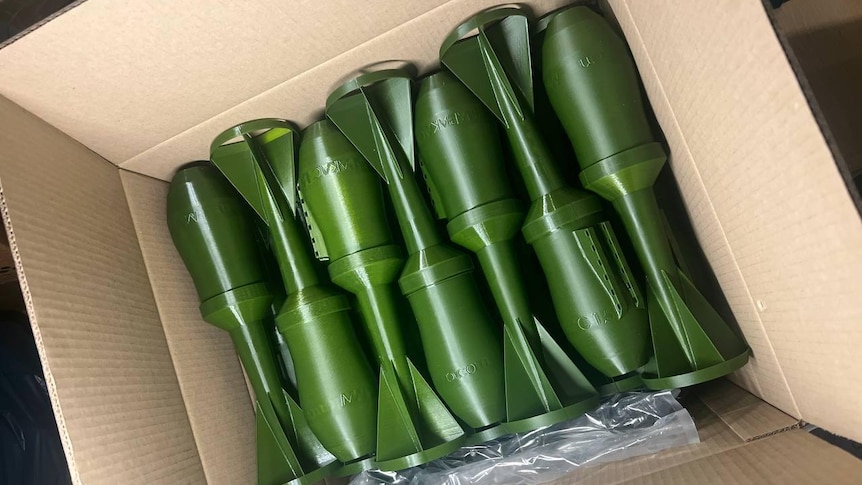
Once an order is placed, it is forwarded to the volunteers who create the requested items and send them directly to the troops. Last year, Lyosha’s network of approximately 400 volunteers produced 100 tonnes of plastic items for the Ukrainian military, including essential components for ammunition and drone-launched explosives.
The lightweight plastic casings are a crucial asset for soldiers, enabling drones to operate further behind enemy lines before engaging targets. “Without the efforts of volunteers, the situation regarding ammunition in Ukraine would be significantly dire, as the government lacks the capacity to advance drone ammunition development,” Lyosha stated.
He noted that all volunteers are civilians and are not authorized to handle explosives or detonators. “We create the shells, which are then sent to the military, where they add the necessary explosives and shrapnel to transform them into functional bombs,” he explained.
Due to safety concerns, ABC News has decided to use only the first names of Alex and Lyosha in this report.
The scale of these underground 3D printing networks remains uncertain, as participants do not disclose their locations due to the risk of Russian attacks. However, Lyosha mentioned he is aware of at least 30 volunteer groups, with some individuals operating printer farms consisting of over 30 machines.
This network extends across Europe, reaching as far as the United Kingdom. Etienne Paresys is part of a different group known as Print Army, which he joined two and a half years ago from his home in London. Since then, he has printed and sent over 100 kilograms of items to the Ukrainian military.
“I had no prior experience with 3D printing, so I initially explored the website to learn what I needed to do,” he recounted. “I purchased my first printer, which was not very efficient, and after a few months of learning, I bought a better one. I just wanted to assist the army.”
Paresys maintains a rigorous printing schedule that runs around the clock. “I let it run overnight, and then I head to work — it’s non-stop,” he said. “We produce thousands of items and send them to the military for various operational needs, primarily for drones and bombs.”
When the war began, he felt a strong desire to contribute, which led him to join the 3D printing networks. “It’s disheartening. This conflict seems to drag on endlessly. Many have forgotten about it, but the army continues to require support, and I believe this is the only way to prevent the situation from worsening,” he added.
While the emergence of such a substantial volunteer network may seem unexpected, Nick Reynolds, a research fellow at the Royal United Services Institute (RUSI), finds it unsurprising. “This dynamic has been evident since 2014; it’s indicative of the way Ukrainian civil society operates,” he stated.
“Ukrainian society has always been characterized by strong grassroots mobilization and civic engagement. This is a reflection of modern Ukraine.” Reynolds acknowledged that while it is innovative for Ukrainians to utilize 3D printing for military supplies, it highlights their resilience and commitment to supporting their armed forces amid ongoing challenges.