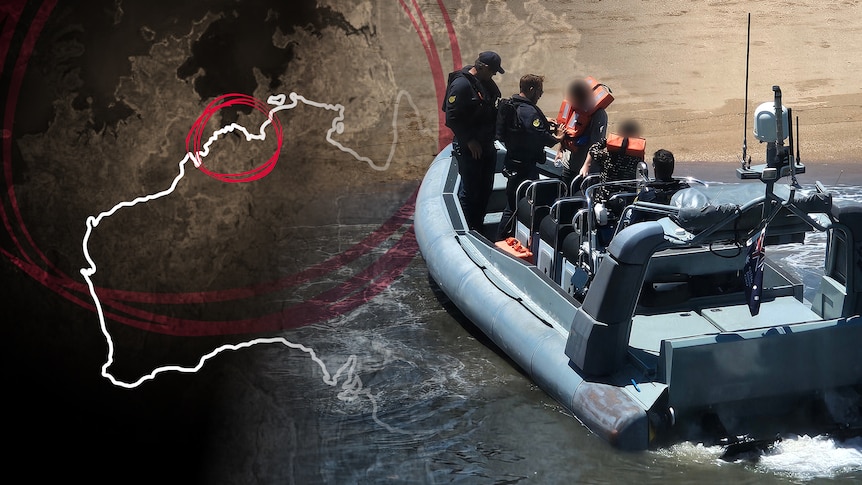

Four months ago, authorities apprehended six Chinese nationals in the remote community of Kalumburu, raising concerns regarding a potential seventh individual believed to be aiding the group.
This incident has sparked a political discourse surrounding the country’s border security, leaving some local residents anxious about their safety.
Reports indicate that Australia may be emerging as an alternate route for human smuggling operations involving Chinese individuals.
With a population of approximately 300, the arrival of outsiders in this secluded community is particularly noticeable.
During a routine evening walk in December, Matilda Djanghara spotted two unfamiliar faces in Kalumburu, located roughly 3,000 kilometers north of Perth.
“One was tall, the other was shorter, and one was dressed quite nicely. He greeted me with, ‘Hello, good evening,’” she recounted.
The brief interaction raised her curiosity, but it wasn’t until the following day that she connected it to a bigger event.
“The next morning, I heard from the coast guard that they were searching for five or six Indonesians,” she explained.
Later, the Australian Border Force (ABF) verified that they had detained six Chinese nationals who arrived in Kalumburu by boat in early December.
This revelation quickly garnered widespread media attention, igniting intense political discussions about national border security.
For the residents of Kalumburu, the news fueled various rumors, fears, and even humor.
Djanghara shared a humorous anecdote, noting that she heard the men had asked for directions to a McDonald’s—though the nearest one is a 12-hour drive away in Broome. “They certainly came to the wrong place; this is a community,” she remarked.
However, lingering concerns remain about the seventh individual reportedly attempting to enter the area around the same time.
Local resident Uriah Waina recounted his experience of helping a stranded stranger on a closed road due to wet-season flooding. “He was stuck at the Carson River Crossing, about 10 kilometers from here,” Waina said.
Describing the man as “big” and “solid,” Waina recalled asking him about his presence. “He told us he was there to pick up the guys who came off the boat,” he stated.
According to Waina, the man spent one night in Kalumburu while waiting for his vehicle to be recovered. “We took him in, and he stayed at the Coconut Lodge for a night. The next day, we helped him get his car out of the mud, and then he drove back to Broome,” he said.
Waina expressed surprise that the man was allowed to leave. “All I know is that I helped him out of the bog and sent him on his way,” he added.
The ABC has learned that the man had rented a car from Broome Airport and returned it a few days later.
Kim Holm, CEO of the Kalumburu Aboriginal Corporation (KAC), noted that the individual did not possess the necessary permit to travel on the closed road or to enter Kalumburu, which requires all visitors to obtain permission. “He was found on Kalumburu Road, and locals spent considerable time assisting him,” she stated. “It’s simply not safe, and the road was impassable.”
Holm further mentioned the community’s suspicions regarding the man’s possible connection to the detained Chinese nationals, although she has received no confirmation. “It took a significant amount of time and effort to get him out of the bog,” she added.
The status of the seventh man remains unclear, with both the ABF and the Australian Federal Police refraining from comments on whether he was arrested or charged.
This is not the first occurrence of Chinese nationals arriving by boat in the Kimberley region, as another group was noted to have entered through the Truscott-Mungalalu Airbase in 2024.
Recent reports suggest that Australia is becoming an alternative destination in global human smuggling routes for Chinese nationals, especially following stricter border policies enacted during the Trump administration in the United States.
In January, Indonesian media reported the dismantling of an international smuggling ring that facilitated the transport of Chinese nationals to Australia via Indonesia.
Antje Missbach, a sociology professor at Germany’s Bielefeld University with over a decade of experience in studying human smuggling in Indonesia, commented on the evolving demographics of individuals attempting to enter Australia. “Those currently arriving are often not categorized as asylum seekers but rather individuals seeking better economic opportunities,” she clarified.
Missbach noted a shift in tactics, with more individuals trying to enter the Australian mainland undetected rather than targeting remote outposts. “People are attempting clandestine entry into Australia, not necessarily for protection but to start a new life under the radar,” she explained.
She emphasized that successful clandestine operations typically involve a local contact who can assist newcomers, particularly in remote areas like Kalumburu. “To facilitate secret entry, one must arrange for a pick-up; public transportation options are unavailable in such isolated locations,” she stated.
“If he had been at the right place at the right time and his vehicle hadn’t broken down, he could have easily collected the six individuals and vanished without a trace,” she added. “Often, we only learn about these operations when something goes awry.”
Meanwhile, local resident Waina expressed that the recent arrival has left him feeling somewhat apprehensive. Kalumburu, with its single clinic, one store, and limited accommodation, is not prepared for unexpected visitors. “Our clinic faces increased pressure, and we only have two police officers to manage the entire community,” Holm concluded.