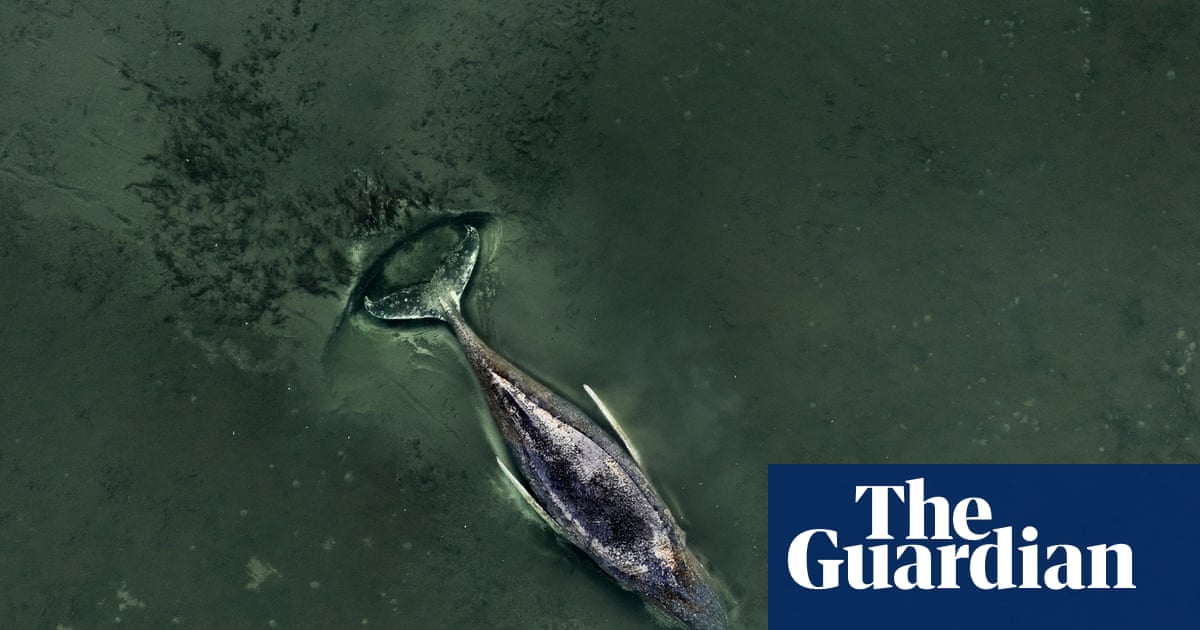

Last month, a 10-meter long humpback whale became trapped on a sandbar in the Baltic Sea, leading to unforeseen consequences for those involved in its rescue efforts. The male whale was first observed near Wismar and Timmendorfer Strand on Germany’s northern coast. Since then, it has repeatedly stranded itself and freed itself, but it is currently stuck once again, with rescuers indicating it is nearing death.
The situation has gripped the nation, provoking emotional responses from politicians and attracting shamans from afar. Experts initially brought in to assist in the rescue have now faced hostility, including death threats, as some individuals blame politicians and environmental activists for exacerbating the whale’s condition, even suggesting that this incident could be exploited by far-right political factions.
The mayor of the local area has expressed the community’s sense of helplessness, stating, “We have all been totally out of our depth.” One prominent expert on humpback whales has chosen to withhold her name from the media, describing the current climate around discussing the whale as “dangerous.”
The whale is currently located in the Kirchsee, a small bay on the island of Poel, where local firefighters are continuously spraying it with seawater to provide some comfort in its final moments.
A cover story from the news magazine Spiegel portrayed the unfolding events as akin to a “failed theatre production,” featuring “offended animal rights activists, frustrated police, helpless authorities, and a whale that refuses to follow the script.”
Nearly two weeks ago, an emotional press conference was held by Till Backhaus, the environment minister of Mecklenburg-Vorpommern, alongside rescue workers and scientists from a nearby maritime museum. They announced that efforts to save the whale had officially ended, with experts declaring it beyond rescue. They appealed to the public to allow the whale to pass peacefully.
The whale’s rapid decline is thought to be linked to a fishing net caught in its jaw, which has weakened it and affected its navigation. Experts noted that the whale should not have been in the Baltic Sea, as it lacks the necessary salinity and depth for its survival. It is believed it may have followed herring schools into these waters.
Additional injuries and infections have been detected on the whale, with Backhaus acknowledging, “The patient is very sick.” While some locals have affectionately named it Timmy, experts discourage anthropomorphizing the whale, emphasizing that nature should be allowed to take its course.
Despite the conclusion of the rescue efforts, suggestions from the public continue to pour in. Backhaus, who described the operation as one of the most challenging in his 27 years of service, shared that various proposals had been considered, including using a helicopter to lift the whale or renting a large catamaran to retrieve it, but none were deemed feasible.
Individuals identifying as well-wishers and environmental advocates have flocked to the water in hopes of coaxing the whale back to deeper waters, with the situation becoming a trending topic on social media. Recently, a woman in her late 50s from Bavaria was rescued by upset water police after attempting to come within three meters of the whale.
Numerous unconventional suggestions have emerged, including using cranes, planes, inflatable pontoons, and even whale songs. An Austrian inventor proposed constructing a swimming pool around the whale, while a self-proclaimed whale ambassador created a healing song titled HeJaWa, claiming it would energize the whale and facilitate its return to the sea.
A wealthy German individual has expressed willingness to fund efforts, arguing that if humanity can reach the moon, saving a whale should be achievable. Recent proposals have included administering a lethal injection, though experts have noted that this would be extremely difficult to execute. Some have even suggested attaching explosive devices to the whale, a method reportedly tested in Australia, though German authorities have dismissed this option due to potential risks.
Backhaus has stated that authorities will remain with the whale “until the end.” He had once hoped for a miraculous recovery by Easter, as the whale sporadically sprays water and emits what are perceived as mournful cries, but he now acknowledges that a revival seems unlikely.