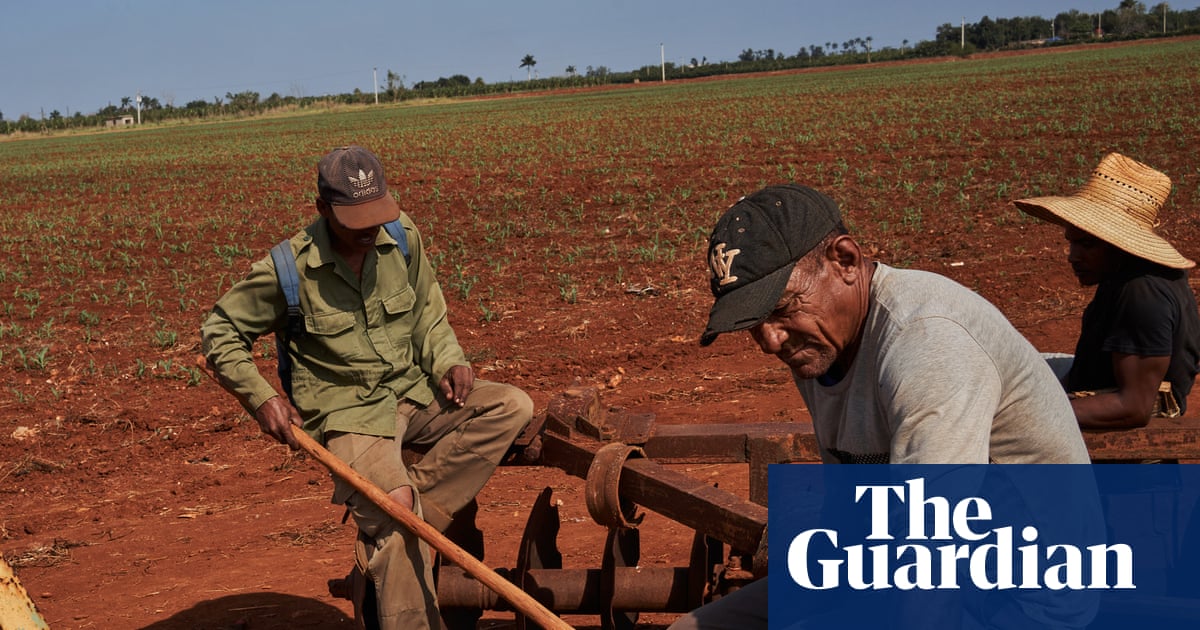

Abraham Rodríguez surveys the rows of corn that await his plowing before the day’s end. Although it is still morning in Artemisa, Cuba, the relentless sun has already drained his energy; farming is undoubtedly a demanding profession. At just 26 years old, he has been working the fields for nearly half his life, starting at the age of 13 when his mother divorced.
Rodríguez comments on the increasing difficulty of farming, stating, “I earn 1,200 pesos (approximately £1.80) daily, which means I need to work two days just to afford a bottle of oil.”
It has been several weeks since he last consumed meat; his most recent meal consisted solely of white rice and fried bananas. “Breakfast? What’s that?” he quips.
Previously, he could allocate a portion of his earnings for dining out weekly, but the situation has drastically changed post-Covid. Now, he expresses a willingness for U.S. intervention, “as long as it leads to improvement.”
In Artemisa, known as the agricultural heart of Cuba just south of Havana, many farmers are struggling to obtain basic meals and facing challenges due to cuts in the government procurement system, which traditionally allows the state to purchase their produce. This has resulted in crops rotting in the fields. The crisis has been exacerbated by inflation following the pandemic and U.S. sanctions, prompting some to engage in illegal charcoal trading or seek migration as families disperse in search of survival.
Rodríguez’s plight is not unique. Yomar Matos, who originally hails from Guantánamo, transitioned from construction work in Havana to agriculture three months ago after being laid off. He moved to Artemisa to join his brother and stepfather, who have been involved in farming since relocating from Guantánamo seven years prior. Together, they share a meager breakfast consisting of a small plastic bottle of black coffee and a few cigarettes.
Matos, who has two daughters, speaks with a hint of emotion in his voice. One of his daughters lives in Curitiba, Brazil, with her mother, a supermarket cashier, and is doing better than they are in Cuba. “The girl was skinny when she left, but now she’s grown up healthy, just like me,” he shares, smiling. His younger daughter, just five months old, remains in Cuba with her mother.
Once celebrated as “Havana’s granary,” Artemisa provides around 40% of the capital’s fresh produce. Its fertile land and favorable climate have made it essential for cultivating grains, vegetables, and fruits, with diversified farming including sugarcane and livestock reinforcing its reputation in Cuban agriculture.
A sign near the road proudly proclaims, “Proud to be farmers,” yet many farmers lament the escalating challenges they face. Fuel shortages have inflated their costs, leading many to declare that agricultural work is no longer financially sustainable.
Siblings Edián and Maykel Romero Álvarez, who inherited a small parcel of land from their father and grandfather, have always relied on farming but now find themselves anxious about the future. They believe the U.S. military intervention in Venezuela earlier this year, which resulted in the capture of socialist president Nicolás Maduro, has intensified Cuba’s energy crisis.
It pains him to see food wasted in a time of such need. “It’s heartbreaking to harvest a good crop and not be able to sell it.”
Although land ownership in Cuba has primarily been state-controlled since the 1959 revolution, management practices have evolved. For many years, the focus was on large-scale industrial monoculture, especially sugar, which led to soil degradation and heavy reliance on exports to the former USSR.
Following the collapse of the socialist bloc, the government encouraged crop diversification, the establishment of cooperatives, and the redistribution of state land in usufruct to farmers, who were required to sell a portion of their harvest to the state while being permitted to market the remainder.
This strategy helped avoid a total collapse of the food system, but it has not proven efficient or viable for farmers, resulting in some agricultural land being left fallow. In 2008, then-President Raúl Castro relaxed regulations to attract new farmers to cultivate previously idle state-owned land.
Despite these opportunities, small-scale producers often receive minimal investment, as the government prioritizes cooperatives and state farms, urging them to continue producing despite the ongoing energy crisis under the revolutionary slogan of “feeding the nation.”
Maykel expresses frustration, stating, “We work so that people can eat—we urgently need solutions.”
In response to ongoing blackouts, charcoal production has become another evolving industry in Cuba’s rural areas. Luis Torres García, 63, has been making charcoal in his backyard near Güira de Melena for as long as he can remember. “We’re accustomed to cooking with it,” he explains, noting that it’s the urban centers that face the greatest hardships.
Each morning, he ventures into the forest to gather marabú wood, transports it home via tractor, and burns it in a homemade open-air oven for ten days until it transforms into charcoal. His primary client is the state, which compensates him 900 pesos for a sack weighing about 20 lbs (9 kg). Similar to farmers, he can sell any surplus privately to cover his expenses.
He charges the market price—approximately $2.40 (about £1.80) per sack—though prices have spiked as high as $4. “I recall what it was like to be poor and hungry,” he reflects. “Why should I take advantage of others?”
On the porch, his wife, Milagros Moreno, meticulously sorts rice, removing impurities as they navigate these challenging times together.