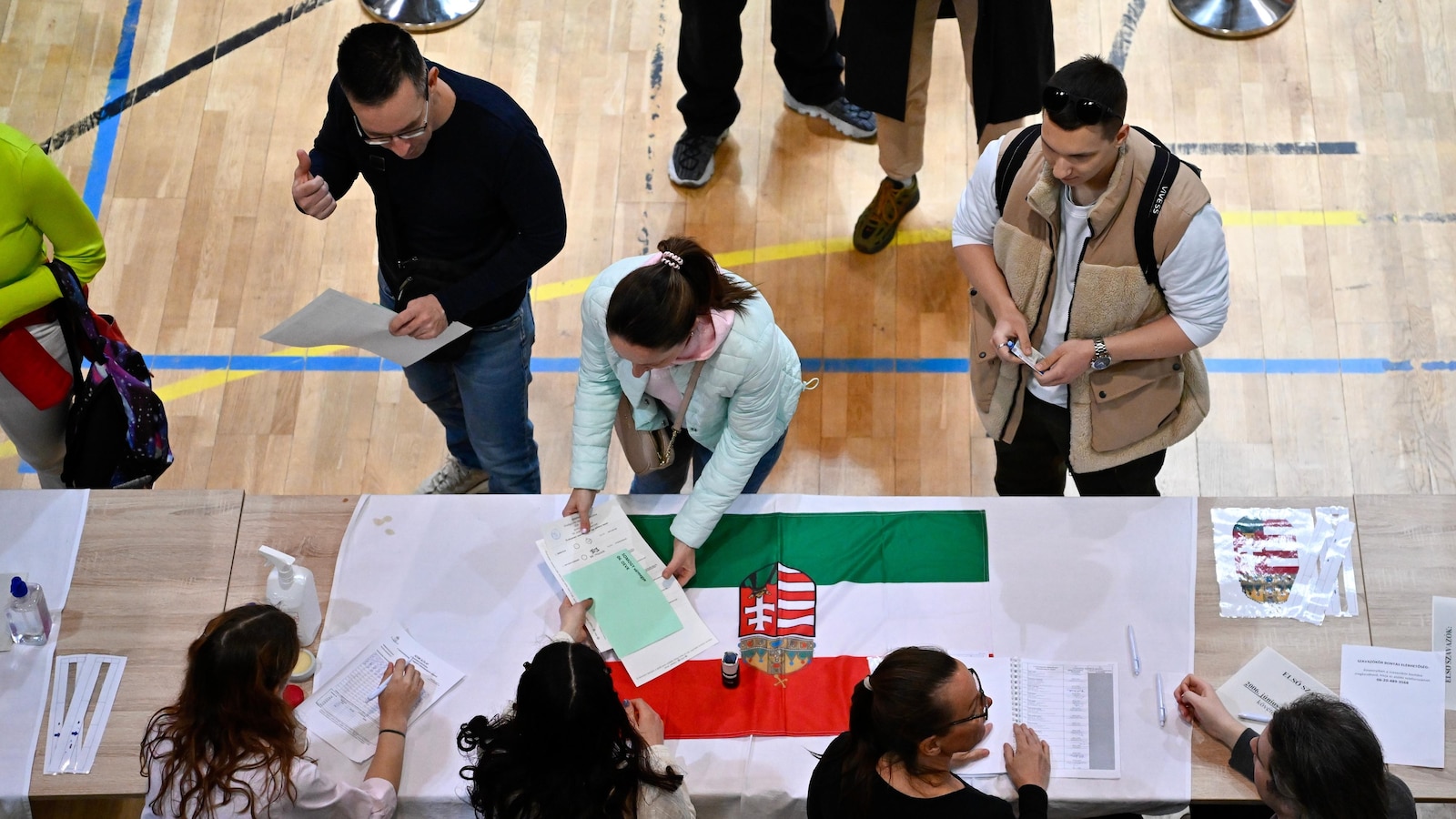

BUDAPEST, Hungary — On Sunday, Hungarian Prime Minister Viktor Orbán acknowledged his defeat in what he described as an “arduous” election outcome, marking the end of his 16-year tenure as a dominant figure within the far-right political movement, which has close ties to both former U.S. President Donald Trump and Russian President Vladimir Putin.
Initial official results indicate that opposition leader Peter Magyar’s political party has taken a commanding lead in the vote, signaling a significant electoral shift with potential implications across Europe and beyond. “Thank you, Hungary!” Magyar expressed on social media platform X, as thousands of his supporters gathered along the banks of the Danube River in Budapest.
Orbán, addressing his supporters in a separate location, extended his congratulations to the winning party. “We will continue to serve the Hungarian nation and our homeland from the opposition as well,” he affirmed.
With 60% of the votes counted, Magyar’s Tisza party garnered over 52% of the support, compared to 38% for Orbán’s ruling Fidesz party. This percentage may fluctuate as the counting progresses.
This election result represents a significant setback for Orbán, who is the longest-serving leader in the European Union and has often been a divisive figure within the bloc. His political journey has evolved from being a liberal, anti-Soviet activist to a nationalist leader supported by the global far-right, known for his alignment with Russia.
Both parties reported alleged electoral irregularities, indicating that the outcomes might be contested by either side.
Voter turnout was over 77% by 6:30 p.m., a record high for any election since Hungary transitioned from communism, according to the National Election Office.
Gergely Gulyás, Orbán’s chief of staff, highlighted the high turnout as evidence of the strength of Hungarian democracy.
Throughout his time in office, Orbán has consistently obstructed EU initiatives aimed at supporting Ukraine amidst its conflict with Russia, while fostering a close relationship with Putin and maintaining Hungary’s reliance on Russian energy imports.
Recent disclosures revealed that a senior member of Orbán’s administration was regularly sharing details of EU discussions with Moscow, leading to allegations that Hungary was acting in Russia’s interests within the EU framework.
This election attracted significant attention from various countries across Europe, underscoring the influential role Orbán plays in the global far-right political landscape. His government and the Fidesz party are viewed by members of Trump’s “Make America Great Again” movement as exemplars of conservative, anti-globalist governance, while they are often criticized by advocates of liberal democracy and the rule of law.
After casting his ballot, Magyar stated that the election represented a choice between aligning with Eastern influences or embracing Western values, as well as a decision between propaganda and honest communication, and between corruption and integrity in governance.
Marcell Mehringer, a 21-year-old voter in Budapest, expressed that his motivation for voting was to help Hungary integrate more closely with Europe and to encourage unity among citizens, especially the youth, to overcome divisions rooted in animosity.
During his extensive time in office, Orbán has faced criticism for implementing strict measures against minority rights and freedom of the press, undermining various institutions within Hungary, and being accused of directing substantial public funds into the hands of his business allies, which he has denied.
His leadership has also strained Hungary’s relations with the EU. Despite Hungary being a smaller EU nation with a population of 9.5 million, Orbán has frequently utilized his veto power to obstruct decisions requiring unanimous agreement.
Most notably, he blocked a €90 billion ($104 billion) EU loan intended for Ukraine, leading his partners to accuse him of undermining vital support.
Magyar has quickly emerged as Orbán’s most formidable opponent. The 45-year-old leader of the center-right Tisza party campaigned on issues resonating with everyday citizens, such as the declining public healthcare system and transportation issues, alongside what he characterizes as widespread government corruption.
A former ally of Orbán within the Fidesz party, Magyar severed ties in 2024 and swiftly established Tisza. Since then, he has been actively campaigning across Hungary, often visiting multiple towns in a single day.
In a recent interview with The Associated Press, Magyar described the election as a “referendum” on Hungary’s future direction—whether it will continue to lean towards Russia under Orbán’s leadership or reclaim its standing among democratic nations in Europe.
In the 2024 European Parliament elections, Tisza received 30% of the vote, with Magyar securing a seat as an EU lawmaker. Tisza is part of the European People’s Party, which governs in 12 out of 27 EU countries.
Despite their momentum, Magyar and Tisza face significant challenges. Orbán’s dominance over Hungary’s public media, which has become a platform for his party, along with control over a large portion of the private media sector, provides him with a considerable advantage in disseminating his message.
The alterations made to Hungary’s electoral system and the gerrymandering of its voting districts by Fidesz mean that Tisza will likely need to secure about 5% more votes than Orbán’s party to achieve a simple majority.
Furthermore, hundreds of thousands of ethnic Hungarians residing in neighboring countries have the right to vote in Hungarian elections and traditionally favor Orbán’s party.
Both Fidesz and Tisza have established platforms for reporting electoral irregularities and have accused each other of planning to engage in election misconduct.
Media reports, including those from The Washington Post, suggest that Russian intelligence services attempted to meddle in the election to favor Orbán. However, the Prime Minister has accused Ukraine and Hungary’s EU allies of engaging in interference.