
The London stock market began the trading day on a downturn, reflecting traders’ concerns over the stagnation in US-Iran diplomatic resolutions.
The FTSE 100, which tracks the performance of major companies, opened down by 0.6%, a drop of 67 points, bringing it to 10,533 points.
Among the biggest decliners was AB Foods, a conglomerate involved in grocery, agriculture, and retail sectors, which saw its shares fall by 2.7%. Other sectors such as airlines, mining, banking, and construction also experienced declines.
In contrast, energy firms showed resilience, with both BP and Shell recording increases of over 1% in their stock prices.
Recent research from the Resolution Foundation indicates that the ongoing conflict in Iran is expected to add nearly £500 to the energy expenses of the average UK household. The organization forecasts that escalating energy costs may lead to a decline in living standards growth this year.
The analysis suggests that the burden of higher energy and fuel prices will likely fall on consumers. Households are projected to experience a 0.6% decrease in income, which equates to approximately £480, compared to earlier forecasts that indicated a 0.9% growth before the onset of the conflict.
For the lowest income bracket, average growth is now anticipated at 1.2%, a significant drop from the previously expected 2.8% growth.
James Smith, the chief economist at the Resolution Foundation, stated, “While there is hope for a lasting peace, the conflict’s trajectory remains unpredictable and energy prices continue to be significantly elevated, meaning many families will see a drop in their purchasing power this year. This financial strain will affect all income levels. Although lower-income groups will benefit from an increase in real benefit levels, inflation is likely to diminish their gains by over a percentage point. Meanwhile, those in middle and higher income brackets are now facing a downturn instead of the modest growth they had anticipated.”
Smith further urged the government to create a social tariff to assist households that may struggle this winter due to these financial pressures.
Heathrow Airport has expressed uncertainty about the coming months due to the ongoing tensions in the Middle East. In its latest update, the airport mentioned its commitment to supporting airlines and passengers as they navigate airspace restrictions, while ensuring that operations remain unaffected by the broader supply chain disruptions.
The US dollar has strengthened as investors adopt a cautious approach amid global market shifts. The dollar index, which measures the currency against a selection of others, has risen by 0.35% this morning.
The British pound has weakened slightly, dropping half a cent to slightly above $1.34.
Wholesale gas prices also saw an increase this morning, with the month-ahead US gas contract climbing 9% to 119.50 per therm, marking its highest point since the previous Tuesday, prior to the announcement of a two-week ceasefire with Iran.
Before the conflict escalated at the end of February, gas prices were below 80p per therm, spiking to 180p in mid-March.
Analyst Priyanka Sachdeva from brokerage Phillip Nova cautioned that any increase in oil market risks carries significant inflationary implications for the global economy. She noted, “Oil markets have decisively re-entered a phase influenced by geopolitical tensions, with prices surging back above the crucial $100 per barrel mark following the US’s announcement of a naval blockade aimed at Iranian shipping through the Strait of Hormuz. Both WTI and Brent crude prices opened significantly higher, reflecting the reality that risks in the Hormuz region are tangible and impactful.”
The recent collapse of US-Iran peace negotiations has had a limited adverse effect on Asia-Pacific markets, with Japan’s Nikkei index falling by 0.75%, and both Hong Kong’s Hang Seng index and South Korea’s KOSPI dropping by 1.15%.
Michael Brown, a senior research strategist at Pepperstone, commented, “While crude prices have risen and stocks have dipped slightly, the overall market response to the news of the US Navy’s blockade in the Strait of Hormuz has been relatively muted, as many traders perceive this as a strategic maneuver by President Trump. The current market sentiment can be summarized as ‘it could be worse.’”
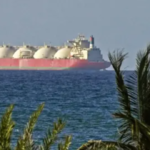
The US blockade poses challenges for approximately 20,000 seafarers currently stranded in the Gulf. One individual shared, “I submitted my resignation exactly one month ago. I’ve informed my captain that I will not navigate through the strait due to safety concerns.”
As we begin a new week, the escalating tensions in the Middle East remain a significant concern following the breakdown of US-Iran peace discussions last weekend. President Trump’s threat to enforce a blockade in the Strait of Hormuz has pushed oil prices back above the $100 per barrel mark, dampening hopes for a swift resolution to the conflict.
Brent crude has surged by 7% to $101.88 per barrel, while US crude has climbed over 8% to $104.69 per barrel, signaling continued volatility in the energy market.