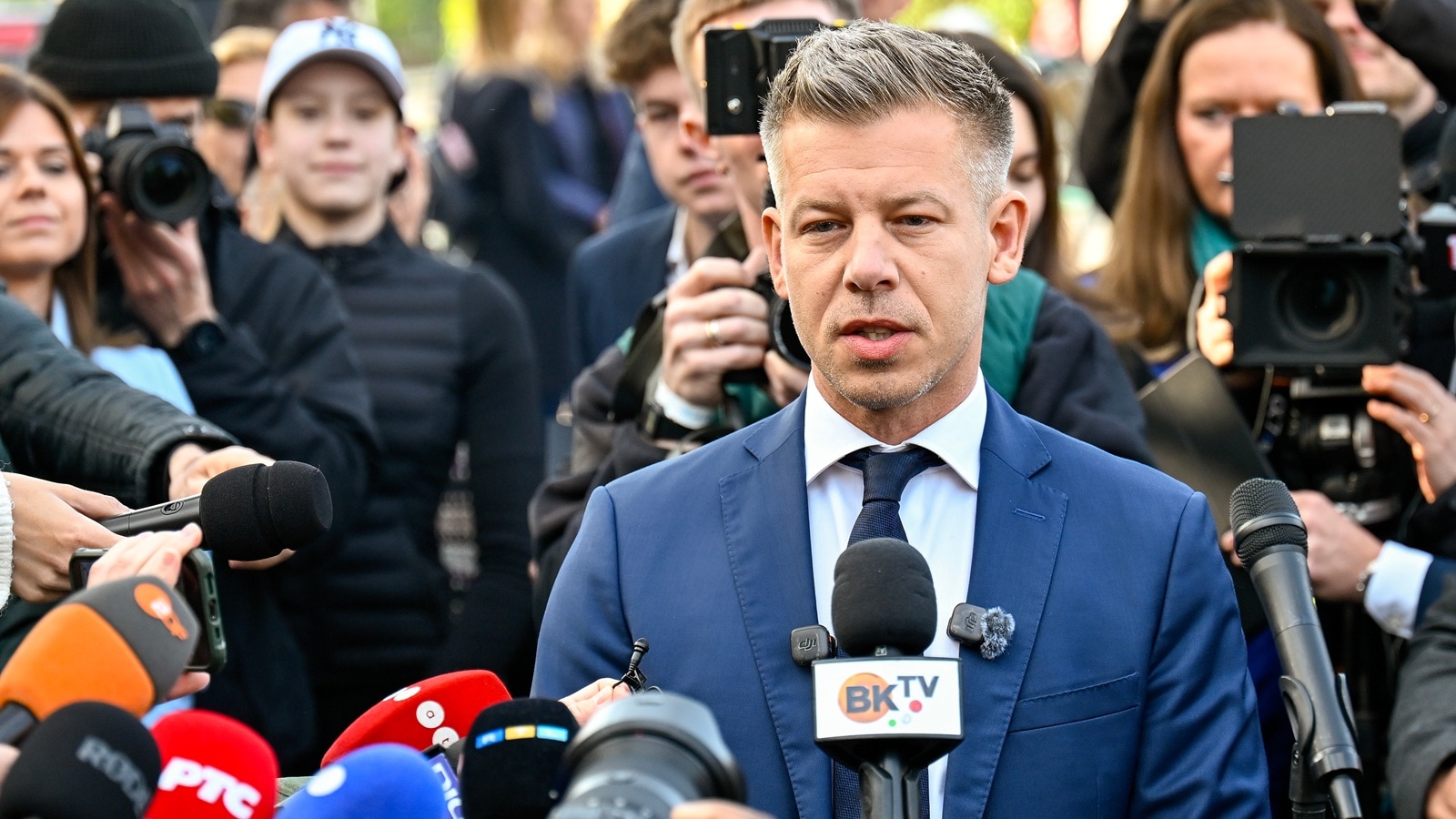

Initial official reports from Hungary’s elections on Sunday indicate that Peter Magyar’s opposition party is currently in the lead, while the party of long-serving Prime Minister Viktor Orbán trails behind in the vote tally.
The final outcome remains uncertain as votes continue to be counted.
With 29% of the ballots processed, Magyar’s Tisza party garnered 50% of the votes compared to 41% for Orbán’s ruling Fidesz party. These numbers are likely to shift as additional votes are tallied.
The counting process revealed that Tisza is leading in 95 out of Hungary’s 106 electoral districts. It is anticipated that the counting will progress more slowly in Budapest, which is expected to favor Magyar’s party.
By 6:30 p.m., voter turnout exceeded 77%, according to the National Election Office, marking a historic high for any election since Hungary transitioned from communism.
Magyar expressed cautious optimism about the results, urging his supporters to remain peaceful. He stated, “I’m asking our supporters and all Hungarians: Let’s stay peaceful, cheerful, and if the results confirm our expectations, let’s throw a big, Hungarian carnival.”
As the sun set, thousands of Tisza supporters gathered along the Danube River, waving Hungarian flags and celebrating. In contrast, Orbán’s party held a private event, restricted to party members, elites, and a select group of journalists.
Gergely Gulyás, Orbán’s chief of staff, remarked that the unprecedented voter turnout demonstrates the strength of democracy in Hungary. He noted that the ruling party had reported several electoral irregularities but remained confident that Fidesz would secure the necessary 100 parliamentary seats for a majority.
Orbán has consistently hindered EU initiatives aimed at supporting Ukraine amid its conflict with Russia while fostering close ties with President Vladimir Putin and maintaining Hungary’s reliance on Russian energy imports.
Recent disclosures have revealed that a senior member of Orbán’s government frequently communicated details of EU discussions to Moscow, leading to allegations that Hungary was acting on behalf of Russia within the EU framework.
The election has drawn significant attention from nations across Europe and beyond, reflecting Orbán’s prominent role in the global far-right populist movement.
Supporters of former President Trump’s “Make America Great Again” initiative view Orbán’s administration and the Fidesz party as exemplary models of conservative, anti-globalist governance, while liberal democracy advocates criticize them vehemently.
After voting, Magyar told journalists that the election represents “a choice between East or West, propaganda or honest public discourse, corruption or clean public life.” He encouraged all Hungarians to exercise their voting rights.
Marcell Mehringer, a 21-year-old voter in Budapest, stated his motivation for voting was to help Hungary become a genuine European nation and to encourage unity and civic engagement among young people.
During his 16 years in office, Orbán has implemented strict measures against minority rights and media freedoms, undermined various Hungarian institutions, and faced allegations of diverting significant funds to benefit allied businesses, claims he denies.
His administration has also strained Hungary’s relations with the EU. Although Hungary is a smaller member state with a population of 9.5 million, Orbán has repeatedly utilized his veto power to obstruct decisions requiring unanimous consent.
Most recently, he vetoed a €90 billion ($104 billion) EU loan intended for Ukraine, leading to accusations from his partners that he was obstructing vital assistance.
Magyar has quickly established himself as Orbán’s most formidable opponent. The 45-year-old Tisza party leader, who has gained traction in independent polls, campaigned on issues pertinent to everyday citizens, such as Hungary’s struggling healthcare and transportation systems, as well as rampant government corruption.
A former member of Orbán’s Fidesz party, Magyar separated from the group in 2024 and swiftly founded Tisza. Since then, he has actively campaigned across Hungary, holding numerous rallies, sometimes visiting up to six towns in a single day.
In an interview with The Associated Press earlier this month, Magyar described the election as a “referendum” on whether Hungary will continue to align with Russia under Orbán or reclaim its place among the democratic nations of Europe.
Tisza received 30% of the votes in the 2024 European Parliament elections, with Magyar securing a position as an EU lawmaker. Tisza is affiliated with the European People’s Party, a mainstream center-right political group governing in 12 of the EU’s 27 member states.
However, Tisza faces significant challenges. Orbán’s dominance over Hungary’s public media, which has been transformed into a platform for his party, along with control over large portions of the private media landscape, grants him an advantage in disseminating his message.
The Fidesz party’s unilateral adjustments to Hungary’s electoral system and the gerrymandering of its 106 electoral districts necessitate that Tisza achieve approximately 5% more votes than Fidesz to secure a simple majority.
Moreover, hundreds of thousands of ethnic Hungarians residing in neighboring countries have the right to vote in Hungarian elections and typically cast their ballots in favor of Orbán’s party.
Both Fidesz and Tisza have established platforms for reporting electoral irregularities, accusing each other of planning to commit electoral fraud.
Media reports, including those from The Washington Post, have suggested that Russian intelligence services may attempt to influence the election in Orbán’s favor. Orbán, however, has alleged that Ukraine and Hungary’s EU allies are attempting to interfere to install a “pro-Ukraine” government.
Such accusations contribute to the perception among many in the EU that Orbán poses a threat to democratic values.