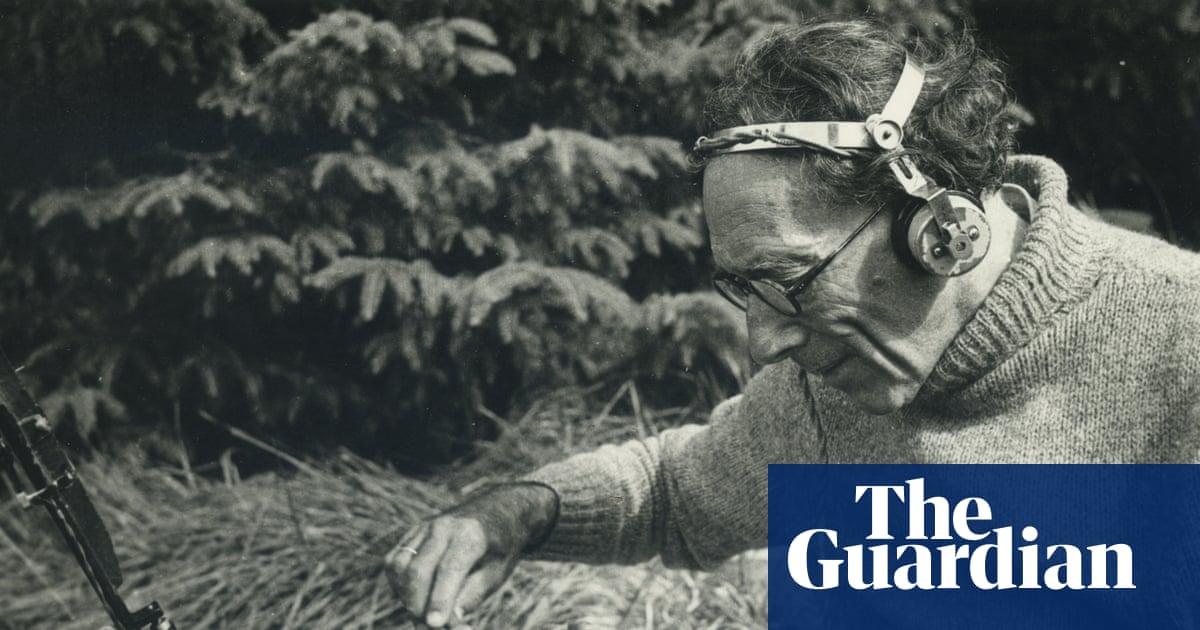

Ludwig Koch, a groundbreaking German sound recordist, was a prominent figure in British media during his lifetime, much like David Attenborough is today. His unwavering dedication to recording birdsong allowed him to share the beauty of nature with audiences in Germany and later, after fleeing Nazi Germany, in Britain through sound books and BBC radio. From the late 1930s onward, Koch became a well-known personality.
His legacy continued after his death, as he was parodied by Peter Sellers and depicted in Penelope Fitzgerald’s 1980 novel, “Human Voices,” which captures the essence of Koch’s meticulous nature in recording sounds and showcases how the BBC benefited from fresh talent like his.
However, according to his granddaughter, filmmaker Anthea Kennedy, Koch was a somewhat distant figure. She recalls, “I don’t remember ever having a conversation with him.” Instead of engaging in dialogue, he preferred to sing to her, reminiscing about his short-lived career as a tenor opera singer, which he had to abandon due to World War I. “He’d tightly squeeze my hand, which I disliked, and sing classical opera, then ask me what he had been singing. It didn’t seem to matter that I had no idea,” she reflects.
Despite this complicated relationship, Kennedy, along with her partner Ian Wiblin, has crafted a heartfelt homage to Koch through their film, “Alarm Notes.” This work weaves together modern imagery and sounds from Berlin and other locations he explored, alongside Koch’s own recordings, including the melodic call of the golden oriole and the sounds of seals on Skomer Island, as well as his renditions of Schubert lieder from his later years. The film serves as a poignant dialogue between granddaughter and grandfather, filling the gaps left by their lack of communication in life.
“I wanted to delve into what truly happened to him in Berlin,” Kennedy explains. “Neither he nor my grandmother ever spoke about their past.” Before the rise of the Nazi regime, Koch had a successful career leading the cultural department at a prominent German record company, producing popular sound books focused on birds and nature, as well as urban environments. He pioneered the technique of location recording, often going to great lengths to capture authentic sounds, including a notable recording of his pet shama bird at the age of eight, which is thought to be the first of its kind.
Kennedy also highlights the incident that entangled Koch and his wife, Nelly, in a Gestapo investigation linked to the 1933 Reichstag fire, an event exploited by the Nazis to consolidate power. They had unknowingly rented a room to Dr. Steiner, who was actually Georgi Dimitrov, a communist revolutionary later to become the leader of Bulgaria. Following Dimitrov’s arrest, the Kochs were interrogated by the secret police. Fearing further detention, they attempted suicide by taking barbiturates and turning on the gas in their kitchen, but were saved by their maid. This incident was brought up during Dimitrov’s trial, leading him to express regret to the couple.
Kennedy pieced together this story through archival documents and Dimitrov’s diaries. To her knowledge, her grandparents never discussed their suicide attempt and rarely talked about their experiences under Nazi rule. Although his Jewish heritage initially barred Koch from the Reich Association for the Protection of Birds, the Nazis overlooked this fact due to his valuable skills as a sound recordist. In August 1933, he even proposed creating a sound book for military propaganda, which included a chilling array of recordings from military life.
However, during a work trip to Switzerland in January 1936, after the assassination of his Nazi monitor, Koch was alerted by a Swiss official that his life was in jeopardy. “The air in Switzerland is better than in Germany,” he was advised, prompting his escape to Britain, where he found solace among fellow naturalists and bio-acoustic enthusiasts, quickly becoming a beloved figure on the BBC’s Children’s Hour.
Koch passed away in 1974 at the age of 92. Kennedy recalls that he never took her along on his recording expeditions. Her only notable memory of him in his element was an unsettling visit to the London Zoo at the age of seven, where she was placed in a birdcage and had a toucan playfully drop a grape into her mouth. “It was quite creepy,” she remembers.
Creating “Alarm Notes” has shifted Kennedy’s perception of her grandfather. Through letters and archives, she uncovered his struggles for recognition among his British peers and the difficulties he faced in sustaining a livelihood. “I can’t help but think they turned him into a caricature, and he decided to go along with it if that’s what it took,” she reflects. “It’s mad…”