
It was perhaps predictable that a flamboyant Christian nationalist, recently appointed as defense secretary after his tenure as a Fox News weekend host, would reference a fabricated Bible verse from a violent Hollywood film during a Pentagon prayer gathering aimed at motivating military personnel for the ongoing conflict in Iran.
This week, a series of stories have surfaced regarding Pete Hegseth, including impeachment articles initiated by a group of ambitious Democratic lawmakers. However, the peculiar claim that Hegseth was using a fiery script from Quentin Tarantino’s film as scripture drew significant attention.
On Wednesday, during one of his recent worship services at the Pentagon intended to support the military efforts in Iran, Hegseth delivered a prayer for search and rescue teams, claiming it was inspired by a verse from the Old Testament, specifically Ezekiel.
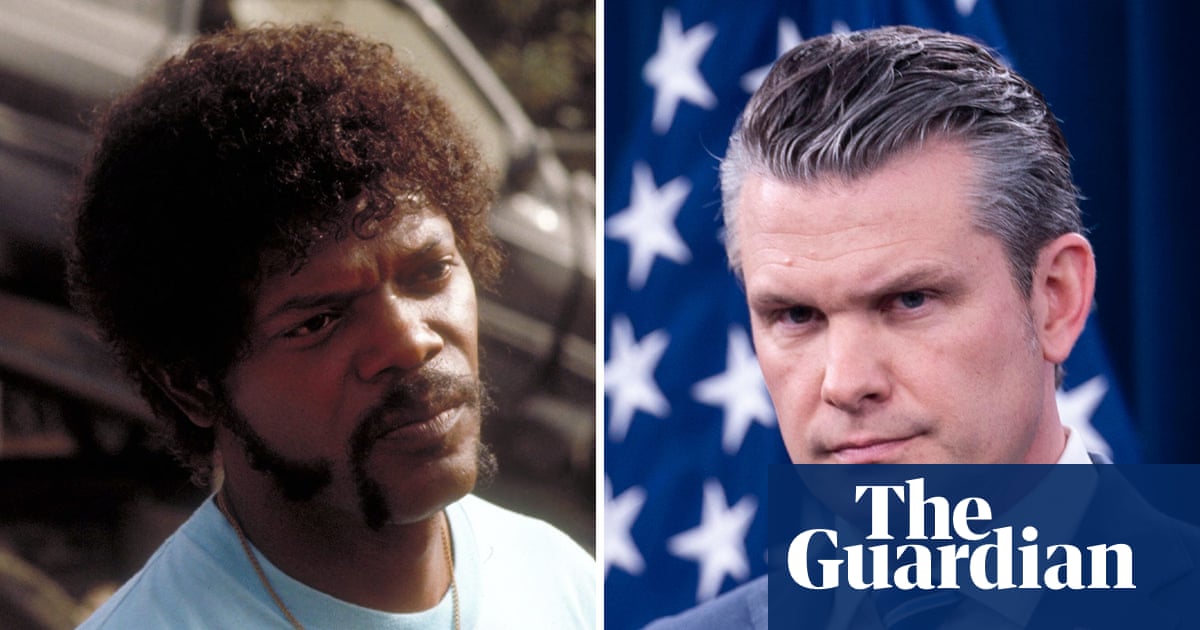
Yet, in a twist characteristic of Donald Trump’s second term, the prayer Hegseth referenced appeared to be a distorted version of a monologue delivered by actor Samuel L. Jackson in the film Pulp Fiction. Reports from the event indicated that Hegseth only cited Ezekiel 25:17, neglecting to acknowledge the dialogue from the movie that closely resembled his words.
The situation was further complicated by the transformation of a movie excerpt that emphasizes “great vengeance” and “furious rebukes” into a prayer for the well-being of military personnel, which Hegseth attributed to his remarks.
Newsweek provided a detailed comparison of the three texts involved: the original Bible verse from Ezekiel 25:17; Jackson’s iconic dialogue from Tarantino’s 1994 film; and Hegseth’s own rendition, referred to as prayer CSAR 2517 (combat search and rescue), which is commonly shared among military ranks and was recited to crews involved in a recent rescue operation of an Air Force colonel in Iran.
The Bible verse is succinct: “And I will execute great vengeance upon them with furious rebukes; and they shall know that I am the Lord, when I shall lay my vengeance upon them.”
The other two passages are lengthier and closely aligned, significantly expanding on the original biblical text. In Pulp Fiction, just prior to his character executing a corrupt associate, Jackson’s character, Jules Winnfield, states: “The path of the righteous man is beset on all sides by the iniquities of the selfish and the tyranny of evil men. Blessed is he who, in the name of charity and good will, shepherds the weak through the valley of darkness, for he is truly his brother’s keeper and the finder of lost children. And I will strike down upon thee with great vengeance and furious anger those who attempt to poison and destroy my brothers. And you will know my name is the Lord when I lay my vengeance upon you.”
Hegseth claimed that the military prayer he recited was intended to reflect Ezekiel 25:17 and made no mention of Tarantino’s script or Jackson’s nearly identical delivery. He stated, “The path of the downed aviator is beset on all sides by the iniquities of the selfish and the tyranny of evil men. Blessed is he who, in the name of comradery and duty, shepherds the lost through the valley of darkness, for he is truly his brother’s keeper and the finder of lost children. And I will strike down upon thee with great vengeance and furious anger those who attempt to capture and destroy my brother. And you will know my call sign is Sandy One, when I lay my vengeance upon thee.”
The Department of Defense did not respond immediately to inquiries regarding the origins and content of Hegseth’s remarks. However, Pentagon spokesperson Kingsley Wilson did address questions about the Democratic impeachment initiative against Hegseth, labeling it “just another charade to distract the American public from the significant achievements we’ve made at the Department of War.”
Newsweek highlighted that the Bible passage is a denunciation of the Philistines and the Cherethites, historical adversaries of the Israelites from the 5th century BC. The book of Ezekiel focuses on a provocative prophet who engages in dramatic performances to capture public attention for his messages.
During a press briefing on Thursday regarding the progress of the conflict in Iran, Hegseth, who is adept at engaging audiences from his previous television career, again referenced the Bible, likening the media to the Pharisees, a group from the New Testament often at odds with Jesus Christ and his teachings. “As the passage concludes, the Pharisees went out and immediately held counsel against him, how to destroy him,” Hegseth remarked, recalling a sermon he attended the previous weekend.
“As I sat in church, I thought: ‘Our press is just like these Pharisees. The hardened hearts of our press are calibrated only to impugn.’” The defense secretary has vocally criticized media coverage of the Iran war, as well as skepticism surrounding the Trump administration’s assertions that the conflict is nearing resolution and that Iran’s leaders are “begging for a deal” to conclude it, despite denials from Tehran.
Touching on the media’s perceived negativity, Hegseth stated, “Sometimes it’s hard to determine what side some of you are actually on.”