
The National Indigenous Cricket Championships are currently taking place at the Great Barrier Reef Arena in Mackay, concluding this Sunday. The event has attracted eight men’s teams and five women’s teams from across Australia, highlighting its significance within Cricket Australia’s high-performance program as a vital avenue for emerging talent.
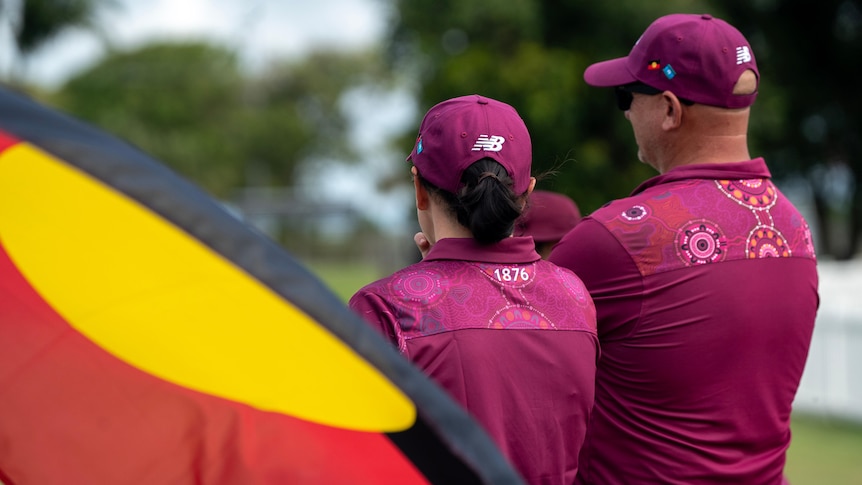
Caitlyn Henry, a dedicated player from Mount Garnet in Far North Queensland, has been commuting for two and a half hours each week to participate in cricket matches in Cairns. Since her involvement in the State Indigenous Challenge last November, she has been diligently preparing for the National Indigenous Cricket Championships (NICC) this week in Mackay. “It’s been tough,” she remarked with a chuckle, acknowledging the long journey but emphasizing the pride she feels wearing the maroon jersey.
Henry’s family shares her excitement, expressing immense pride in her achievements. “Seeing me in the Queensland shirt has made them really proud,” she noted. “It makes me feel like a proud Indigenous woman to represent like this.”
This year marks the 10th anniversary of the NICC in its current format, and it is the second time the event has been hosted on Yuwibara Country. The championships feature teams from nearly every Australian state, and for the first time, the tournament includes Papua New Guinea’s national team, the Barramundis.
According to Tamika Hansen, the manager and mentor of the Queensland women’s team, the tournament transcends the sport itself. “Wearing the mighty maroon jersey is a significant honor in our state, regardless of the sport,” she explained. “However, our primary focus is to represent our families and to play with both the spirit of cricket and as Indigenous people.”
Hansen, who has witnessed the evolution of the championship over the last decade, recognizes the dedication of the players. “Some girls from remote communities face long travels, which involves not just the journey but also finding a vehicle and covering fuel costs,” she commented. Reflecting on the last ten years, she expressed satisfaction with the increased opportunities available to young Indigenous athletes. “It’s been remarkable to see how much support the younger generation has now,” Hansen said. “I can only imagine what the sport will look like in another decade.”
While she appreciates the progress made in reaching Indigenous players in regional areas, Hansen believes there is still work to be done at a societal level to eliminate racism and improve culturally appropriate pathways for Indigenous individuals in sports.
The origins of the National Indigenous Cricket Championships can be traced back to a match between Alice Springs and Tennant Creek in the 1990s. Cricket Australia assumed control of the event in 2001, transforming it into a national competition.
The championships provide a platform for up-and-coming players to connect and compete against prominent figures in Australian cricket. Patrick Rosser, a player and coach from New South Wales, emphasized that the tournament is integral to Cricket Australia’s high-performance pathways program, offering prospects for talented young cricketers, including the National Indigenous under-23 side. “Being recruited by other premier clubs presents another opportunity,” he noted, adding that many female players from previous years have advanced to the WBBL and even the Australian team.
This year holds special significance for Rosser, as his son James is also playing for the New South Wales team. James, who visited Mackay last year, expressed surprise at having the chance to play at just 16. “I thought I might get a chance later on, not this soon,” he said.
Bradley Ilott, a member of the Northern Territory squad, reflected on the tournament as a “full-circle moment,” having spent much of his childhood in Mackay. He noted that cricket in the Northern Territory is played during the dry season, offering a unique experience compared to most southern states. Ilott mentioned that the week in Mackay includes several cultural engagement sessions, where teams discuss the championships and share their visions for future progress. “It’s one big brotherhood or sisterhood here,” he remarked. “We take pride in representing not just our state but our communities back home.”
For Caitlyn Henry, the championships are also an opportunity to inspire younger cricketers in her hometown. “Some younger people from home are starting to get interested in cricket, and they want to pursue it,” she said. “It would be amazing to see them achieve as much as I have.”