
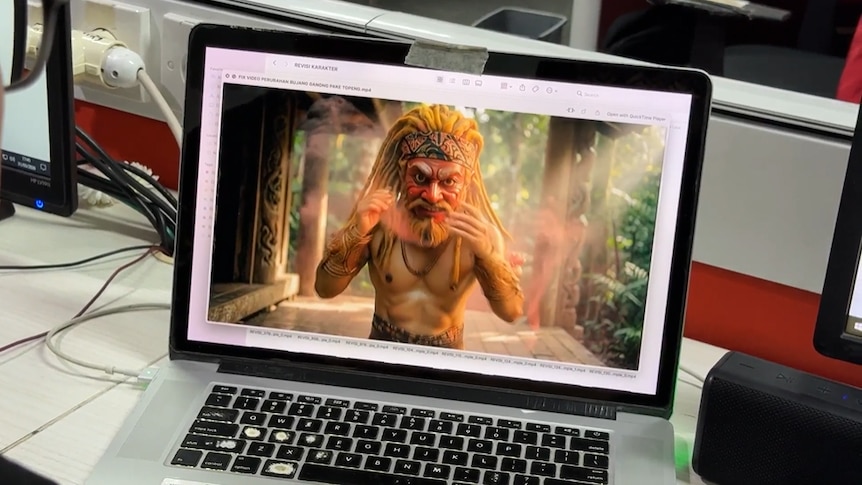

An enormous, menacing giant flails his arms as he is engulfed by swirling brown mud, vanishing beneath its surface. Initially, this character, inspired by the Javanese folktale of Timun Mas, appears to be a creation from an animation studio. However, upon closer inspection, it is evident that this giant has been brought to life using generative artificial intelligence (AI).
At one moment, the giant’s gaze is misaligned, and during a confrontation with a young girl, the sequence of battle frames appears jumbled and disconnected. These scenes are part of Legenda Bertuah, Indonesia’s pioneering television series that fully utilizes AI for its animation.
Since its debut in January, Legenda Bertuah has aired 14 episodes, each lasting half an hour, on free-to-air television. While countries like China have already produced entirely AI-generated shows, this series represents a significant achievement for Indonesia, eliciting mixed responses from audiences.
Each episode features a different Indonesian folktale and is also available for streaming on the website of TRANS7, the company responsible for the series. One viewer praised the show on social media, noting its refreshing approach and educational value for Gen Z and Gen Alpha audiences regarding Indonesian legends. Another viewer labeled it a “quality AI TV show.”
Conversely, some viewers expressed dissatisfaction with the AI-generated human characters, criticizing their stiff expressions and unnatural tones. One social media user remarked, “Is there really a shortage of animators in this country? Are you so financially constrained that you cannot hire professionals to illustrate these folktales?”
Mira Khairunnisa, a spokesperson for TRANS7, refuted the notion that cost-cutting was the primary motivation for employing AI. “Producing a TV program with AI is not particularly economical. Our intent was not to reduce costs,” she stated. “We view it as an innovative tool to enhance our content production.”
Khairunnisa explained that each episode takes a month to complete, with a team of about ten people involved in the process. “AI is merely a tool; it cannot operate independently. Human input is essential,” she emphasized, adding that this technology does not eliminate jobs but can create new roles.
The creation of each episode begins with storyboarding, image selection, scripting, and video editing, all handled by human staff. The company employs prompt engineers from diverse backgrounds, such as camera operators and IT specialists, who guide the AI to generate animations. These engineers first use ChatGPT to create still images for each scene, which serve as reference points for maintaining consistency in the animation.
These still images are then animated into video using Google Veo, followed by final editing to adjust sound, colors, and lighting. Khairunnisa noted that the producers consulted folklore experts to ensure accuracy in scripting and visual representation. “We want to ensure that everything displayed on screen is factually correct and authentic, from the story to the costumes,” she said.
Dermawan Syamsuddin, a representative from the Indonesian Animation Industry Association, questioned whether the AI-generated footage could genuinely be classified as animation. He remarked that the character movements and acting appeared exaggerated, stating, “From a visual standpoint, this does not adhere to traditional animation styles, which typically feature a cartoony aesthetic.”
Satriaddin Maharinga, a director and writer known as Arie Kriting, highlighted the ethical concerns this series raises within the creative sector. He suggested that the use of AI for Legenda Bertuah may have been driven by financial considerations. Maharinga pointed out the specialized nature of animation and the years of training professional animators undergo to hone their craft. Currently, there is no comprehensive data in Indonesia regarding the potential job impacts due to AI integration in this field.
As an artist, Maharinga believes the implications of AI should be thoroughly examined before its widespread adoption. “Given the growing concerns among artists and creative professionals, it is crucial to approach its use cautiously until its ethical implications are fully understood,” he stated.
Maharinga mentioned that he personally utilizes AI for inspiration and streamlining his writing process. However, he acknowledged that some view AI as a threat to creativity, as it can detract from personal creative input. “Others see it as a supportive tool,” he added, while questioning how AI-generated content should be regarded and credited. “AI lacks emotion, independent thought, and true creativity,” he noted. “Thus, we must ask ourselves: are the shows we enjoy genuine works of art, or merely products of a commercial industry?”
Franklin Darmadi, a film director and CEO of Wokcop Pictures, commented on the role of AI in filmmaking, stating that while AI is beneficial, it cannot entirely replace the human element. “Filmmaking still requires a personal touch,” he asserted.