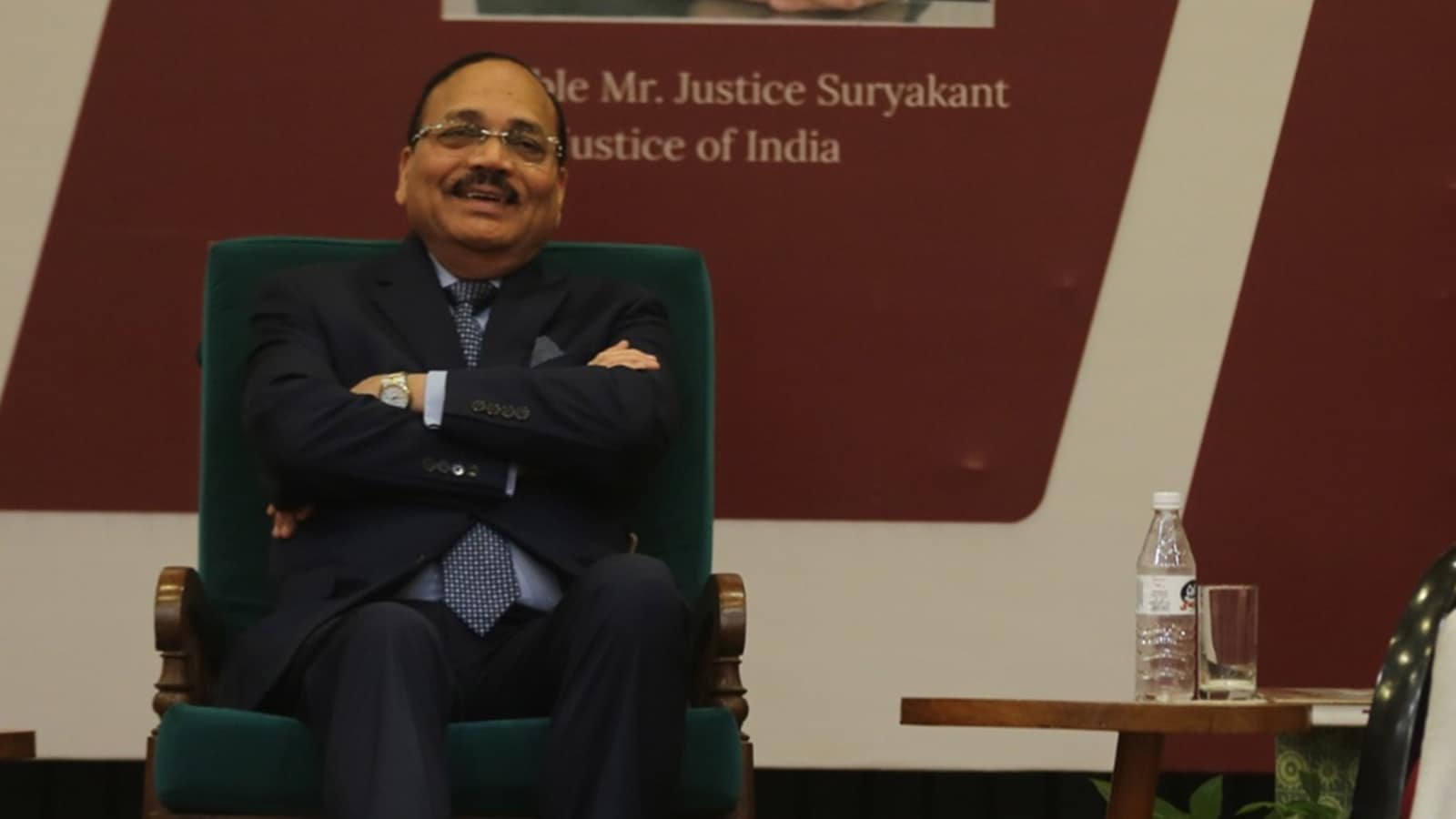

During the 4th Ashok Desai Memorial Lecture held at the India International Centre in New Delhi on Monday, Chief Justice Surya Kant emphasized the importance of making justice more accessible to citizens. He asserted that the Indian judicial system of 2076 should not require individuals to seek justice actively but should ensure that it is delivered directly to them.
Addressing the topic “Reimagining Justice: The Indian Judiciary 50 Years Hence,” Justice Kant argued that future courts should not be limited to physical locations. He stated, “Justice should not be something that requires a journey; rather, it should reach individuals swiftly, fairly, and with an awareness of the evolving societal landscape.”
The Chief Justice noted that the law evolves over time, observing, “The ink of a judgment does not dry upon delivery. What may be seen as a fixed principle today often reveals its true significance only years later when faced with new, unforeseen circumstances. Thus, the law is perpetually in conversation with the passage of time.”
He suggested that the realm of criminal law might expand its definitions, potentially encompassing behaviors that do not fit conventional offense categories. Additionally, he proposed that the civil process could be redefined to enhance speed and accessibility.
Reflecting on the transformations within the judiciary over the past fifty years, Justice Kant noted that advancements in technology have not only improved access to information but also changed how individuals interact with that information. He cited public interest litigation as an example of the judiciary’s proactive expansion in addressing social issues. Regarding artificial intelligence, he acknowledged that while current tools will evolve significantly, there will be boundaries to their application.
“AI will certainly not supplant judicial reasoning, yet its role will be substantial,” he explained, highlighting its capacity to manage extensive data and pinpoint precedents, allowing judges to concentrate on interpretation and the implications of their decisions.
Justice Kant also warned that the pursuit of efficiency should not overshadow the essential human aspect of justice. He remarked that “the equilibrium between efficiency and due process requires meticulous attention,” stressing that “empathy, discretion, and an understanding of context must remain central to the adjudication process.” The lecture also featured insights from author and historian Manu S. Pillai, who discussed “Resisting Injustice: The Raj, the Law, and the Making of Modern India.”