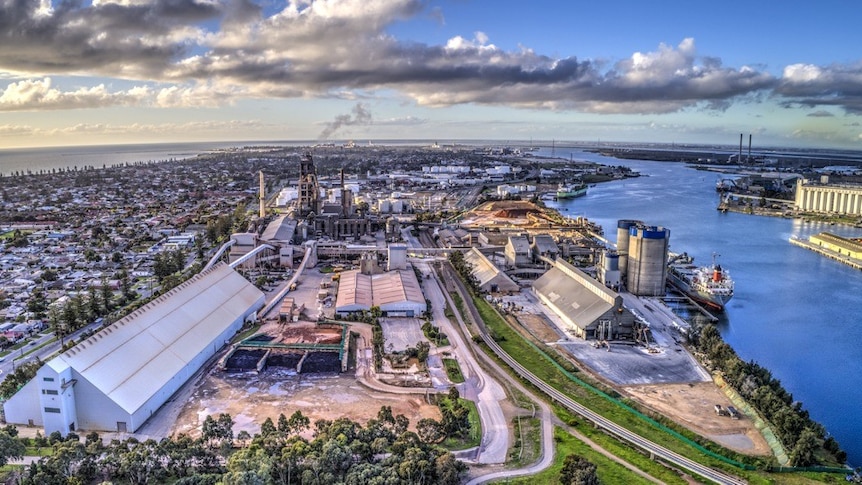

Adbri has been utilizing refuse derived fuel (RDF), sourced from construction and demolition waste, at its cement manufacturing facility in Adelaide for over two decades.
Local residents have expressed worries regarding pollution in light of Adbri’s proposal to increase its use of RDF at the plant.
The Environment Protection Authority (EPA) is currently reviewing this proposal.
Residents near the large cement plant in Adelaide are apprehensive about the company’s intention to burn a greater quantity of plastic as fuel, aiming to reduce reliance on natural gas.
Previously known as Adelaide Brighton Cement, Adbri has incorporated construction waste, termed “refuse derived fuel” (RDF), into its cement production at the facility located in Birkenhead, close to Port Adelaide.
A local council member plans to introduce a motion at tonight’s council meeting, advocating for the council to communicate its opposition to the EPA and South Australian Environment Minister Emily Bourke regarding Adbri’s plans to increase both the amount of RDF and the percentage of plastic used in the fuel mix.
Peter McGregor, a councillor from the City of Port Adelaide Enfield, has voiced his opposition to the proposed trial that would lead to a reduction in natural gas consumption for cement production.
“Adbri has been using refuse-derived fuel, which is essentially waste, and it currently contains 20 percent plastic. The new proposal suggests increasing both the RDF and the plastic content in a dedicated area of their plant,” he remarked during an interview with 891 ABC Adelaide.
McGregor highlighted the historical context, noting that the plant has been operational since 1914 and is situated very close to residential areas. “You could practically throw a rock across the road and hit a house,” he added.
An Adbri representative stated that the company has organized informational sessions and welcomed community feedback regarding potential trials aimed at minimizing fossil fuel dependency at the Birkenhead site.
“If approved by the EPA, this trial would provide crucial data for Adbri to investigate further possibilities for utilizing Refuse Derived Fuel (RDF) as a substitute for natural gas in the future,” the spokesperson explained.
Adbri’s website indicates that the RDF they employ is derived from construction and demolition waste that would otherwise be disposed of in landfills. The company is exploring options to replace natural gas with RDF at its Birkenhead facility.
Currently, Adbri holds a license from the EPA that permits the incineration of 32 tonnes of RDF per hour, with a stipulation that the RDF may contain no more than 20 percent plastic by weight.
However, Councillor McGregor claims that the proposal includes increasing the plastic content in the RDF to 50 percent, although this detail has not been confirmed by the EPA.
McGregor mentioned that Adbri assured him that RDF can be burned cleanly under “optimum operating conditions,” but he expressed concerns about the potential risks if those conditions are not met.
An EPA representative confirmed to ABC that Adbri has been authorized to use RDF as a natural gas alternative since 2003. They are aware of the company’s engagement with the local community regarding the RDF proposals and the exploration of alternative RDF suppliers for the kiln.
“Adbri has submitted a proposal for a trial involving RDF in its kiln, which is under assessment by the EPA following established standards for RDF production and use,” the spokesperson stated. “The EPA’s primary concern is ensuring that any proposed trial can be conducted safely and evaluated for stability, emissions, uniformity, and suitability of the RDF. Community feedback will be considered during the evaluation process.”
Concerns regarding potential health impacts have also been raised. Melanie Carter, a resident of Largs Bay, attended a community meeting organized by Adbri about the proposed trial. She noted that the local community is significantly affected, often detecting odors and seeing emissions from the plant.
“This unexpected news has come with little time for us to respond, and it poses a significant setback to the concept of clean energy,” Ms. Carter stated. “This is not a clean fuel.”
She emphasized the need for monitoring any health implications for local residents, asserting that any approval for the trial should include an independent medical assessment.
In 2024, Adbri was acquired by the Irish building materials firm CRH.