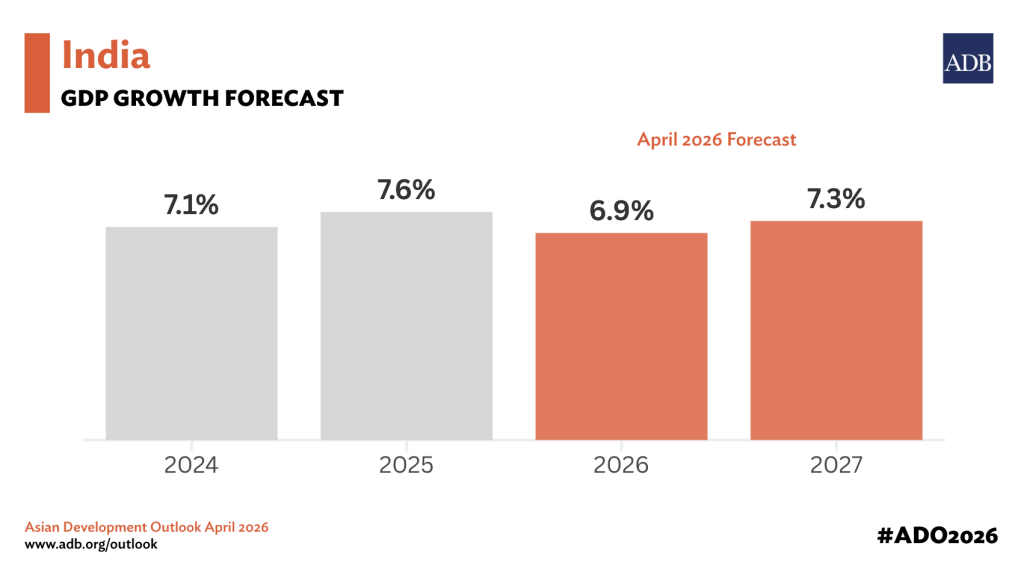

NEW DELHI, INDIA — The Asian Development Bank (ADB) has revised its growth projections for India’s economy, predicting a decrease in gross domestic product (GDP) growth to 6.9% for the fiscal year 2026 (FY2026, which concludes on March 31, 2027), down from 7.6% in FY2025. This outlook is detailed in the Asian Development Outlook (ADO) report published in April 2026.
The forecasts, based on assessments made on March 10, occur amid considerable uncertainty, particularly regarding the situation in the Middle East. Recent developments indicate a greater chance of ongoing disruptions in the region.
The expected slowdown in FY2026 is primarily attributed to increased global uncertainties stemming from the Middle East conflict, rising energy prices, and fluctuating trade and financial conditions. Such external factors are anticipated to negatively impact exports, inflation, and capital flows in the short term. However, growth is projected to rebound in FY2027, driven by robust domestic demand, ongoing public investment, and a more favorable external environment.
“Despite facing external challenges, India’s growth trajectory remains strong, bolstered by supportive fiscal and monetary policies, as well as regulatory reforms aimed at improving labor market flexibility and integration into global value chains,” stated Mio Oka, ADB Country Director for India. “In the medium term, investments in clean energy, reforms in the power sector, and initiatives to enhance manufacturing competitiveness and attract investments will ensure sustained growth.”
Domestic consumption is expected to be the primary engine of growth during FY2026 and FY2027. Private spending is likely to remain robust in FY2026, driven by increasing real incomes, stable rural demand, and easing monetary conditions, although the diminishing effects of previous tax cuts and rising inflation may temper this growth. A further boost is anticipated in FY2027 with a significant revision to government wages and pensions expected once a decade.
Investment levels are forecasted to stay strong, with central government capital expenditures projected to increase by 11.5% in FY2026, reinforcing India’s strategy for investment-led growth. A favorable monetary policy environment, regulatory reforms, enhancements in logistics, and stronger balance sheets in both corporate and banking sectors are likely to encourage private investment.
Inflation is expected to rise to 4.5% in FY2026 due to increased food and energy costs before easing to 4.0% in FY2027 as supply conditions improve. The current account deficit is anticipated to widen in FY2026 due to higher import levels, especially of crude oil, but is expected to narrow in FY2027 as global energy markets stabilize and exports grow, thanks to recent trade agreements with significant partners such as the European Union, the United States, and New Zealand.
On the production side, both manufacturing and services sectors are predicted to continue their strong performance. Manufacturing is set to benefit from recent trade agreements and key support initiatives included in the budget aimed at semiconductors, electronic components, and rare earth elements. The services sector will also thrive, supported by the growth of global capability centers and strong demand for high-value business services.
The ADO April 2026 highlights the necessity of rationalizing subsidies and transfers to safeguard vulnerable populations while maintaining fiscal space for infrastructure and other productivity-enhancing investments essential for long-term growth.
The ADB is a prominent multilateral development bank committed to fostering sustainable, inclusive, and resilient growth throughout Asia and the Pacific. By collaborating with its members and partners to address complex challenges, ADB leverages innovative financial mechanisms and strategic partnerships to improve lives, develop quality infrastructure, and protect the environment. Established in 1966, ADB is owned by 69 members, 50 of which are from the Asia-Pacific region.