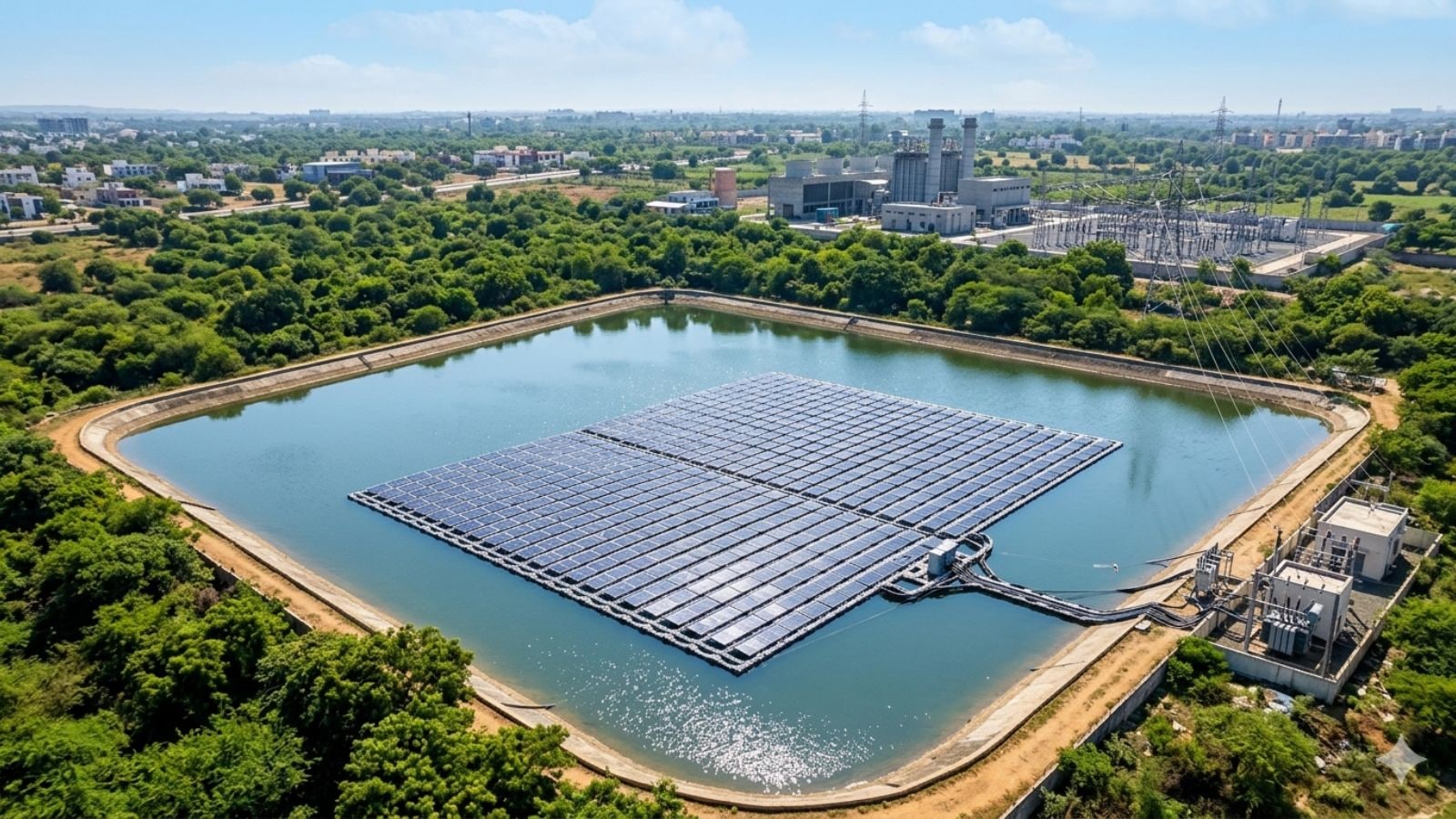

The Delhi government, led by the BJP, has introduced a novel plan to harness electricity from floating solar farms on various water bodies throughout the Capital. This initiative follows the successful implementation of rooftop solar projects and marks the first time such a concept has been proposed in Delhi, according to officials. The power department is set to launch a pilot project featuring floating solar panels at Bawana Lake in Northwest Delhi.
Floating solar technology has already been utilized in several Indian states, including Telangana and Visakhapatnam. Officials emphasized that this venture is unique for the Capital, as no previous administration, including the former AAP government, has advanced a similar proposal since a 2022 attempt that did not materialize.
Officials confirmed that the government has approved the project, with plans to issue tenders shortly to initiate groundwork. If the pilot project is successful, additional floating solar installations will be developed in suitable locations, including the Yamuna River at Wazirabad.
Floating solar farms can be established on both natural and artificial lakes, although officials noted that a steady water flow is essential for effective electricity generation. Bawana Lake was selected for the pilot due to its proximity to an existing power plant under the Delhi government’s jurisdiction, facilitating the necessary permissions and clearances from agencies like the Delhi Jal Board (DJB).
The floating solar panels at Bawana Lake are expected to produce approximately 1 megawatt (MW) of electricity. Given the substantial capacity of the nearby power plant, which ranges from 1,500 to 1,600 MW, the energy generated from this pilot will help fulfill its auxiliary power needs.
The overarching goal of the project is to achieve an electricity output of 2 to 3 MW. The floating solar panels will be supplied with treated water from the Rohini Sewage Treatment Plant (STP), which will be routed through pipelines to the power plant’s condensers.
In terms of implementation, officials outlined that floaters will first be positioned on the water surface, followed by the installation of solar panels. These panels will then be connected to a transformer located across the water body. “A wire rope will link the floaters to the solar panels and the transformer, allowing electricity generated to be stored and distributed through the grid,” officials explained.
Moreover, floating solar installations are considered to be more cost-effective and efficient compared to traditional rooftop systems. The estimated initial investment for the first floating solar project is around Rs 5 to 6 crore, with the final cost determined after the tendering process.
Currently, Delhi produces a total of 431 MW of electricity from solar panels installed by over 21,900 consumers. Under its new solar policy, the Delhi government aims to expand this capacity to 4,500 MW by March 2027, offering subsidies of Rs 10,000 per kilowatt, capped at Rs 30,000.
Stay informed with the latest updates – Follow us on Instagram.