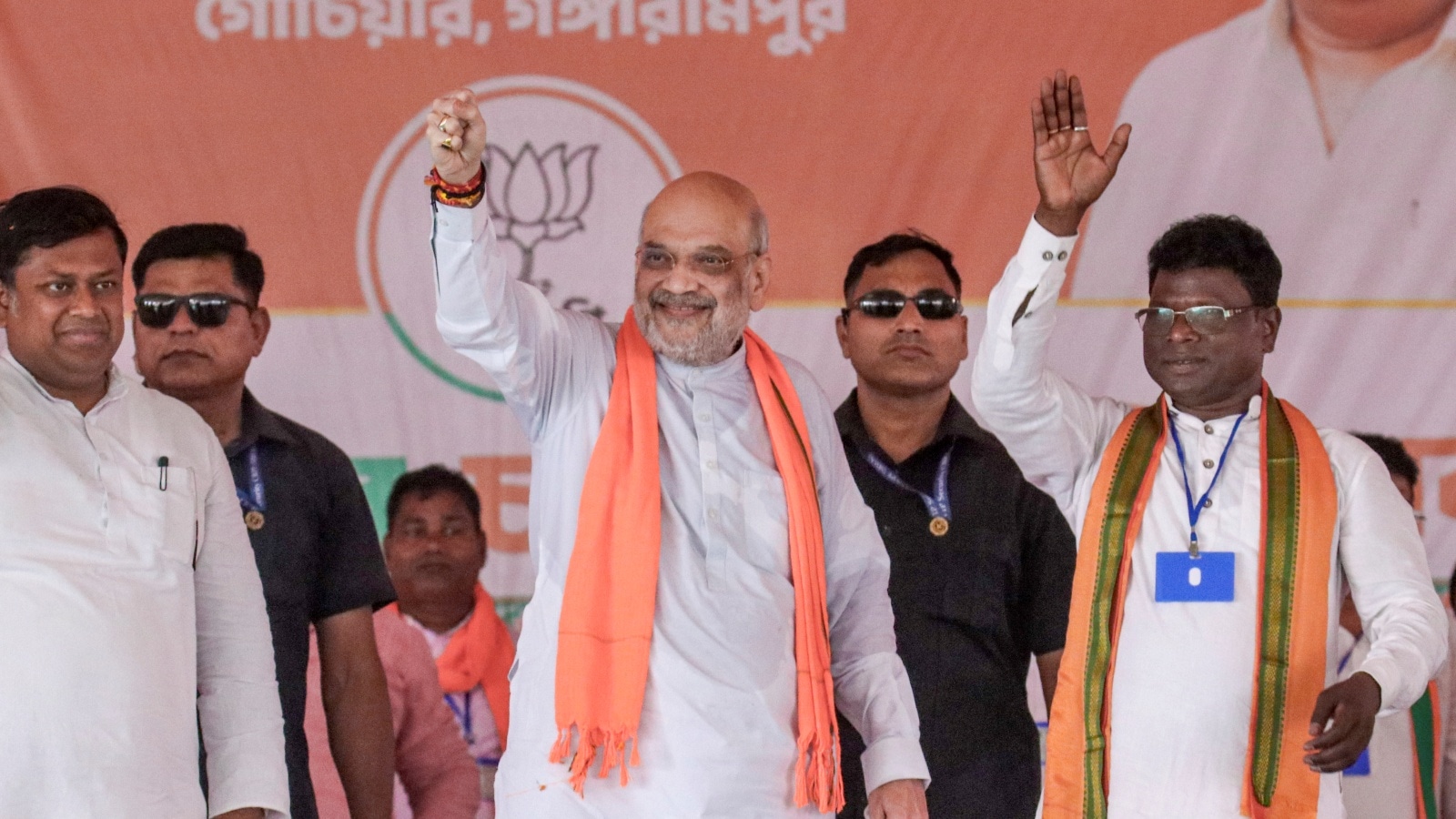

While campaigning in north Bengal, Union Home Minister Amit Shah emphasized that the “Gorkha issues” in the Darjeeling hills would be addressed through constitutional means, without causing any division of West Bengal. He also committed to advocating for the inclusion of the Rajbanshi language in the Constitution’s Eighth Schedule.
Speaking at a BJP election rally in Gangarampur, located in Dakshin Dinajpur district, Shah reassured the Gorkha community of Darjeeling that if elected, the BJP would not only create an eco-adventure hub in the hills but also find a constitutional solution to their longstanding issues. However, he did not provide further details on the matter.
Last October, the central BJP government appointed Pankaj Kumar Singh, a former Deputy National Security Advisor, as its representative to engage with the Gorkha community regarding their enduring demands. This move was criticized by leaders from the Trinamool Congress (TMC), who labeled it a political maneuver aimed at attracting Gorkha voters ahead of the Assembly elections. TMC Chief Minister Mamata Banerjee even sent a formal letter to Prime Minister Narendra Modi expressing her disapproval.
The Nepali-speaking residents of the Darjeeling hills have been advocating for a separate state called Gorkhaland for nearly a century. The region has experienced various political movements, some of which turned violent, since the 1980s in pursuit of statehood. Since 2011, governance has been provided by the semi-autonomous Gorkhaland Territorial Administration (GTA).
In the forthcoming elections, the TMC has formed a strategic alliance with the Bharatiya Gorkha Prajatantrik Morcha (BJPM), led by Anit Thapa, a splinter group from Bimal Gurung’s Gorkha Janmukti Morcha (GJM), leaving the Darjeeling, Kalimpong, and Kurseong constituencies to its ally. Conversely, the BJP has regained the support of Gurung, its previous coalition partner in the region.
Additionally, Shah reiterated his pledge to incorporate the Rajbanshi language into the Eighth Schedule of the Constitution. The Rajbanshi community, which forms the largest Scheduled Caste group in both West Bengal and the adjacent state of Assam, numbers approximately 5 million and has been calling for a separate state since India’s independence.
Shah also announced plans to establish a tribal university in north Bengal. Among the BJP’s proposed development initiatives for the region, he highlighted the party’s manifesto that includes the construction of an AIIMS facility, featuring a modern 600-bed cancer hospital, along with separate campuses for IIT and IIM, as well as a dedicated sports university.
Criticizing the TMC government for allegedly failing to allocate 600 acres of land for border fencing with Bangladesh, Shah asserted that such fencing would be completed within 45 days following the BJP’s establishment of a government in West Bengal. He described infiltrators as a national security threat, claiming they undermine job opportunities and access to resources for the underprivileged. “After we take office, we will expel infiltrators from West Bengal and across the nation,” he declared.
At the rally, Shah urged voters to exert their influence by casting their ballots for the BJP, saying, “Press the EVM buttons next to the lotus symbol with such force that the infiltrators throughout India can feel the shock.”
Furthermore, he assured that West Bengal farmers would be allowed to export potatoes to ensure they receive fair prices for their produce.
In a separate statement, Shah accused Humayun Kabir, the founder of the Aam Janata Unnayan Party and a former TMC member, of acting as an “agent” for TMC leader Mamata Banerjee. He alleged that Kabir was attempting to construct a mosque modeled after the Babri Masjid with her approval. “Kabir should heed my warning that the BJP will not permit this mosque to be built. Mamata Banerjee and her nephew should also be aware that their aspirations for the mosque will be dashed on May 5, the day following the vote count,” he stated at a rally in Manikchak, Malda district.
Kabir, who was suspended from the TMC last year after advocating for the mosque’s construction in Murshidabad, is currently seeking re-election as an MLA for Bharatpur.
Tanusree Bose is an experienced journalist for The Indian Express based in Kolkata, specializing in the intricate political, administrative, and judicial matters of West Bengal, thereby establishing her as a credible voice in regional news reporting.
Her current role involves delivering trustworthy content for The Indian Express, focusing on West Bengal’s political landscape, judicial developments, and educational issues, while also addressing social and electoral concerns within the state.
Bose’s consistent reporting on high-stakes topics for a reputable media outlet highlights her status as a reliable source for news from West Bengal.
Stay informed with the latest updates—click here to follow us on Instagram.