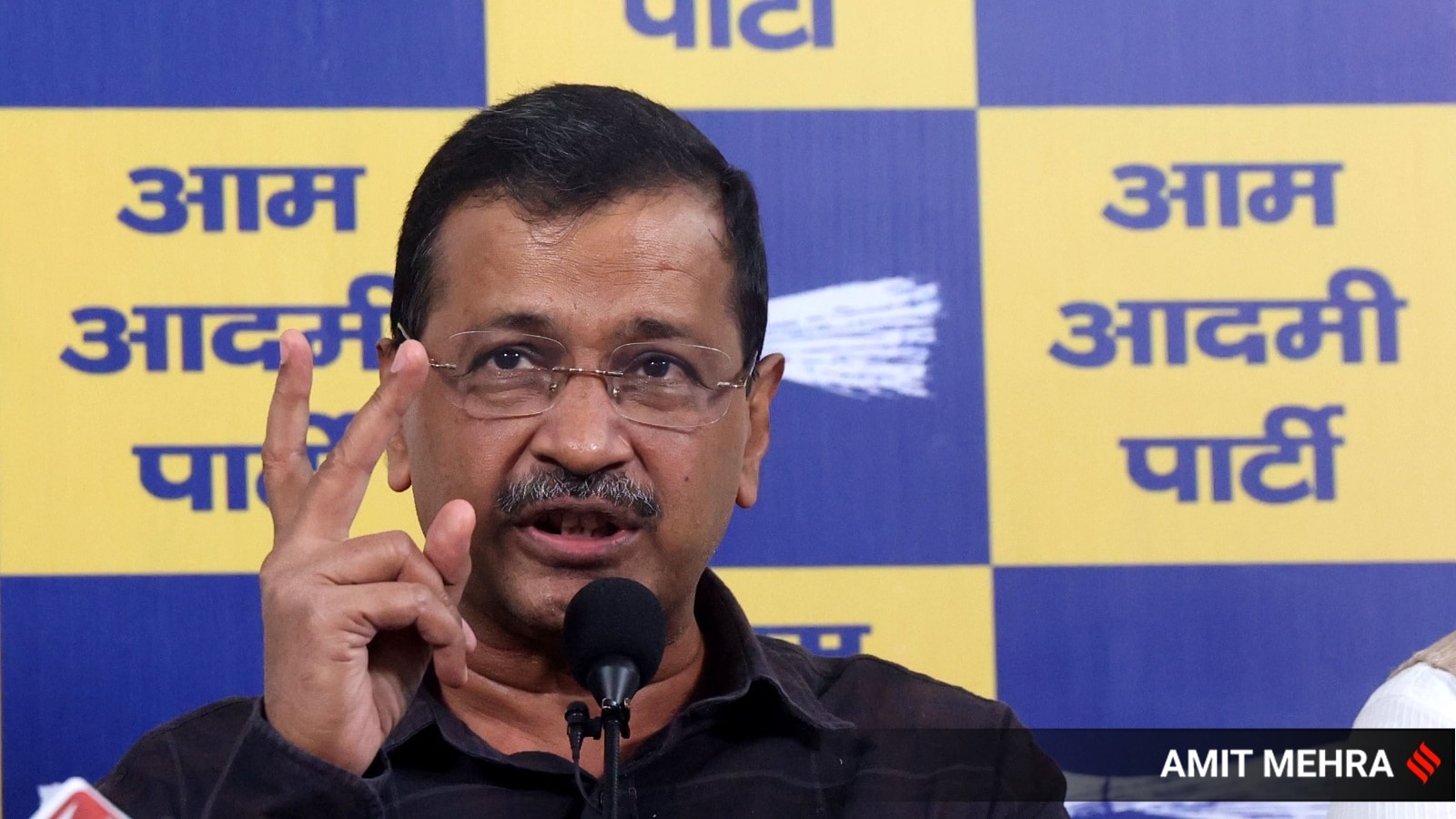

Arvind Kejriwal, the former Chief Minister of Delhi, has submitted a new affidavit to the Delhi High Court, presenting two additional reasons for requesting the recusal of Justice Swarana Kanta Sharma from the case concerning the Central Bureau of Investigation (CBI)’s appeal against his discharge in the excise policy matter.
In this updated motion, Kejriwal claims a potential conflict of interest, highlighting that the judge’s children have been appointed as counsel for the Central government. He also contends that he was not afforded a fair hearing because the proceedings were conducted outside of the usual court hours.
In the affidavit filed on April 14, Kejriwal expresses concerns about a significant and direct conflict of interest, noting that Justice Sharma’s offspring are listed as panel counsel for the Union of India. Panel counsel are private attorneys designated by the government to advocate in legal cases on its behalf.
Kejriwal asserts that official documentation reveals that Justice Sharma’s son, Ishaan Sharma, serves as a Group ‘A’ Panel Counsel for the Supreme Court, while her daughter, Shambhavi Sharma, acts as a government pleader for the Delhi High Court and is also a Group ‘C’ Panel Counsel for the Supreme Court. He pointed out that the Solicitor General of India oversees the assignment of cases to these panel counsels, and is currently representing the CBI, opposing Kejriwal’s request for recusal.
The affidavit cites findings obtained through the Right to Information Act, which indicate that Justice Sharma’s son has been allocated a considerable amount of legal work from the Central Government, exceeding 5,500 cases from 2023 to 2025.
Kejriwal’s affidavit states, “The same legal officer representing the prosecution before this Hon’ble Court is also part of the institutional framework through which cases and government work are assigned to the immediate family of the Hon’ble Judge.”
He emphasizes that given the politically charged nature of the prosecution—where he is a key political rival of the ruling party—the concerns he raises are serious and cannot be overlooked.
The second reason for his request for recusal relates to the court proceedings that occurred on Monday, during which Kejriwal represented himself. After completing his argument, he requested to leave the court around 3:45 PM, not anticipating that the proceedings would extend significantly beyond standard court hours.
However, the CBI’s submissions persisted past 6:15 PM, with the proceedings concluding after 7 PM, at which point Justice Sharma reserved her decision. Kejriwal contended that he expected to have adequate time, potentially until the following day, to prepare a response to the CBI’s counterarguments. He claimed that the continuation of hearings beyond regular hours deprived him of a “fair and reasonable opportunity” to present his case.
Additionally, Kejriwal expressed concern regarding the court’s issuance of “effective orders in the main matter,” such as stipulating that the right to submit a reply would be forfeited if not done within a week, while his recusal request remained unresolved.
He argued, “Judicial propriety dictates that while the recusal issue is still pending, no effective or coercive procedural orders that affect the substantive rights of the parties should be issued,” suggesting that this action implied a predetermined outcome regarding the continuation of the case before the same bench.
Kejriwal clarified in his affidavit that he does not attribute any “improper motive” or claim “actual bias” from the court. Instead, he suggests that the law only necessitates circumstances where a reasonable litigant might fear that justice could be compromised.
This request for recusal is part of the ongoing legal proceedings, where the CBI is contesting a trial court’s February 27 decision that discharged Kejriwal and 22 others in connection with the alleged liquor policy scam.
In his initial recusal request, Kejriwal had expressed concerns about potential bias based on political affiliations and social media activity. He also indicated that an examination of the judge’s previous rulings revealed a pattern of favoring the positions of investigative agencies, and that her court was hastily addressing only two cases involving MPs and MLAs—one pertaining to him and the other to a political adversary of the Bharatiya Janata Party (BJP).
During earlier sessions, Solicitor General Tushar Mehta vehemently opposed the recusal motion, labeling the allegations as “frivolous, vexatious, and contemptuous,” and characterized Kejriwal’s decision to present his case personally as mere “theatrics.”