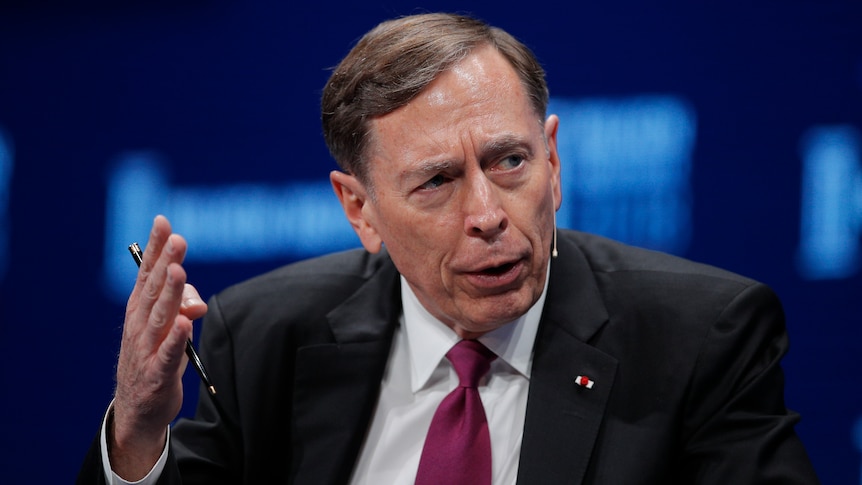

David Petraeus, the retired general and former director of the CIA, has expressed his support for President Donald Trump’s suggested naval blockade of the Strait of Hormuz. However, he cautioned that such a move is likely to provoke conflict in this strategically vital waterway.
In an interview with 7.30, Petraeus remarked, “I anticipate there will be confrontations. The pressing question is whether these confrontations can be contained.” He noted that while a ceasefire might still hold, the U.S. feels increasingly pressured to act against Iran’s dominance over the Strait.
Petraeus posited that the blockade could have been initiated even sooner, asserting that Iran’s attempt to control passage through the Strait and impose tolls necessitated a stronger U.S. response. “If Iran is restricting access to the Strait for other ships, then we should respond by denying access to all vessels,” he stated.
The U.S. military’s actions will include efforts to eliminate Iranian sea mines from the Strait, according to Petraeus. He suggested that a “Coalition of the Willing” could assist U.S. forces in escorting ships, although he described this as a daunting endeavor. “This mission is challenging and hazardous,” he emphasized. “De-mining is a labor-intensive and dangerous operation, and we also need to protect vessels from potential attacks.”
Experts in maritime operations have indicated that maintaining at least two aircraft carrier task forces would be essential for U.S. ships to operate safely, along with a need for eight to ten frigates and destroyers to provide adequate protection.
Despite the ongoing ceasefire, tensions in the Strait remain palpable. The Islamic Revolutionary Guard Corps of Iran has issued stern warnings, indicating that any military vessels approaching the area would face severe consequences. Petraeus highlighted the difficulty of safeguarding ships in this environment, stating, “Even a single attack every couple of days—whether from a drone, a small boat, or a missile—could pose significant risks.”
While many Western allies have refrained from direct involvement in the conflict thus far, Petraeus expressed hope that Australia would consider participating in the proposed coalition. Prior to discussions in Pakistan, a coalition involving 40 countries, led by the UK and France, had been exploring a joint operation to escort vessels through the Strait.
The UK government, however, announced its decision not to take part in Trump’s blockade plan, emphasizing its commitment to maintaining freedom of navigation in the Strait, which it considers vital for the global economy. A UK spokesperson remarked on the importance of keeping the strait open to alleviate economic pressures at home.
Petraeus expressed optimism about mending relationships with allies, noting the shared interest in this issue. “I hope we can rebuild some trust because this is a matter of global concern,” he stated. He acknowledged the UK’s advanced counter-mine capabilities and expressed a desire for participation from Gulf states like Saudi Arabia, the UAE, and Kuwait.
Having led Australian forces in Iraq and Afghanistan, Petraeus advocated for an Australian contingent, praising their competence and professionalism. He noted the strong ties between U.S. and Australian military and intelligence agencies.
However, Prime Minister Anthony Albanese clarified that no formal request for Australian participation had been received. “We have not been asked to join this initiative, and we want to see ongoing negotiations aimed at minimizing loss of life and restoring trade,” he explained, emphasizing the global economic implications of the ongoing conflict.
Beyond immediate military concerns, Petraeus highlighted a more profound strategic issue: Iran might emerge from the conflict in a stronger position, despite the destruction it faces. “Iran could potentially become militarily weaker but strategically more formidable if it retains control over the Strait,” he warned, adding that Washington recognizes the necessity of preventing such a scenario.
He called for a multifaceted response that combines military, diplomatic, and economic strategies, emphasizing the importance of not allowing Iran to dominate the Strait. “That is the fundamental objective,” he concluded.