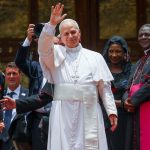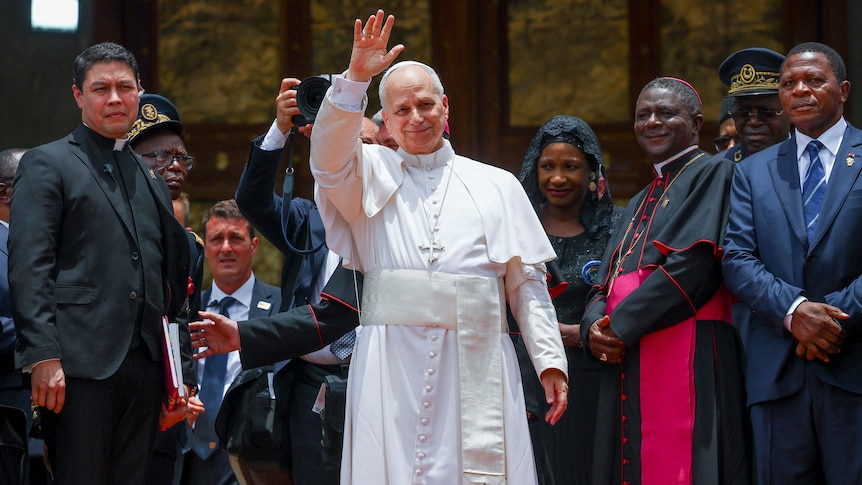

Pope Leo XIV has strongly criticized the “small group of tyrants” who are investing vast sums in warfare during his visit to Cameroon. Although he refrained from naming specific individuals, his remarks followed recent criticisms from US President Donald Trump regarding the pope’s views on the conflict in Iran.
Analysts suggest that Trump’s ongoing criticisms of the pontiff are diminishing his support among Catholics both in Italy and globally. During his visit to Cameroon, the US-born pope condemned what he described as “an endless cycle of destabilization and death,” a response to Trump’s comments about the war in Iran.
Addressing a gathering of well-wishers, the pope emphasized the importance of peace initiatives and cautioned against the exploitation of religion in conflicts. “Blessed are the peacemakers,” he declared. He further warned, “Woe to those who twist religion and the divine name for their military, economic, and political objectives, dragging the sacred into darkness and impurity.” He underscored that while the world suffers under a few tyrants, it is also supported by countless individuals dedicated to peace.
Pope Leo XIV called for a “decisive change of course” away from warfare, although he did not single out any individual for blame. Trump’s criticisms of the pope have been particularly pointed this week, including a statement on social media where he labeled the pope as “WEAK on Crime” and criticized his foreign policy stance.
Dr. Claudio Betti, director of the Rome campus at Australian Catholic University, indicated to ABC’s The World that Trump’s comments have alienated him from many Italian Catholics. “There is widespread disapproval of Trump’s remarks about the pope,” he stated. “The pope remains a significant figure in Italy.” A recent survey by the polling group Youtrend revealed that 79 percent of Italians disapproved of Trump’s approach to the conflict in Iran.
Prior to a temporary ceasefire with Iran that was established last week, Trump had warned on social media that “a whole civilization would die tonight” if Iran did not agree to a settlement with the United States regarding the Strait of Hormuz. Dr. Betti noted that this statement was a catalyst for the pope’s response, describing it as poorly chosen.
He added that the pope’s remarks reflect established Catholic doctrine. “He is reiterating what many others have previously expressed, which is entirely expected,” Dr. Betti said, suggesting that the pope aims to mitigate tensions while continuing to advocate for peace. “This is likely to be part of his enduring legacy. The responsibility now lies with President Trump,” he concluded.
The Archbishop of Canterbury has also voiced support for the pope, advocating for peace in the Middle East. Archbishop Sarah Mullally, who has led the Church of England since January, expressed her solidarity with the pope’s “courageous call for peace.” She highlighted the severe human cost of war, stating, “As innocent lives are lost and families are shattered, the ramifications are immeasurable.” She urged all people of faith to strive and pray for peace.
While she did not directly reference Trump, the Archbishop stressed that Christians should encourage political leaders to seek peaceful and just resolutions to conflicts. Earlier in the week, Italian Prime Minister Giorgia Meloni, who has previously allied with Trump, also publicly supported the pope, declaring, “I find President Trump’s remarks towards the Holy Father unacceptable. The pope, as the leader of the Catholic Church, has every right to advocate for peace and oppose all forms of war.”