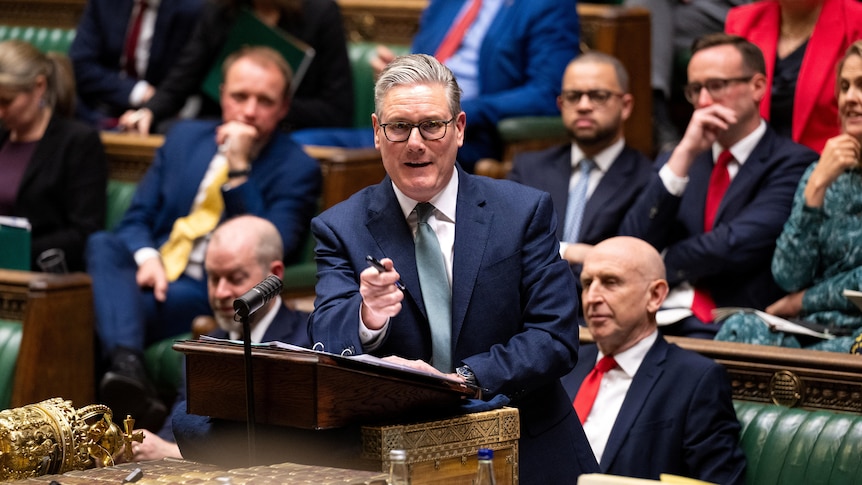

The recent session of Prime Minister’s Questions in the UK Parliament unfolded with the usual exchange of criticisms between Prime Minister Keir Starmer and his counterpart, Kemi Badenoch. However, the atmosphere shifted significantly around the 16-minute mark when Liberal Democrat leader Ed Davey stood to address the assembly.
“Mr. Speaker,” began Davey, “In a conversation with Sky News last night, President Trump threatened to terminate his trade agreement with the UK as retaliation for our refusal to participate in his misguided conflict in Iran. This should be the final straw. Surely, the Prime Minister cannot send our monarch to meet someone who treats our nation like a mob boss.” His remarks were met with cheers from his nearby allies as Starmer took the floor.
Starmer responded firmly, stating, “My stance on the Iran conflict has been clear from the beginning: we will not be drawn into this war. It is not our conflict, and I have faced significant pressure to change course, including recent developments. I will not alter my position. It is against our national interest to engage in this war, and we will not do so. I am resolute in my beliefs.”
Davey has been a vocal critic of U.S. President Donald Trump and has consistently opposed the planned state visit of King Charles to the U.S. later this month. For Starmer, as the leader of the government, such criticism is fraught with complications.
Recent comments by Starmer highlight the growing rift in the US-UK relationship, particularly as the conflict in Iran continues. Naomi Smith of Best for Britain commented, “This situation is not merely a pause in the special relationship; it indicates a profound reassessment. British voters are increasingly aware that our interests align more closely with our European neighbors than with Washington.”
Initially, Starmer and Trump appeared to share a positive rapport, but that phase has faded. Trump has publicly ridiculed Starmer, contrasting the earlier days when he praised him. While Starmer rarely mentions Trump directly, he emphasizes the long-standing connection between the two countries without endorsing the notion of choosing between the UK and Europe.
Starmer has historically opposed Brexit, advocating for a second referendum in 2019. By 2022, as the Labour leader, he had shifted focus away from Brexit discussions, ruling out any intentions to rejoin the EU. Although his policies as Prime Minister have remained consistent, his rhetoric has evolved. “As global tensions escalate, it is evident that our long-term national interests require a stronger partnership with our European allies and the EU,” Starmer stated amidst the ongoing conflict in Iran.
In the subsequent weeks, Starmer has maintained a similar stance, identifying defense, security, energy, emissions, and economic collaboration as key areas for enhanced ties with Europe. He has also intensified his critique of Brexit, declaring in Parliament that “Brexit has caused significant damage to our economy. The chances we now have to bolster our security and alleviate the cost of living are too significant to overlook.”
Looking ahead, a second summit between the UK and EU is scheduled for later this year to strengthen their partnership. In preparation, Starmer’s administration is drafting legislation for “dynamic alignment,” which would align UK standards with those of the EU regarding food, drink, and carbon emissions. This controversial proposal would empower ministers to adopt new regulations through secondary legislation, a power that dates back nearly 500 years to the reign of King Henry VIII.
Starmer contends that aligning more closely with Europe will simplify trade and reduce costs for British consumers. However, Reform leader Nigel Farage has labeled this initiative a betrayal of Brexit. Polling suggests that many voters may favor closer ties with Europe, with numerous surveys indicating a perception of Brexit as a mistake, even among some of its staunchest advocates.
According to Smith, polling data shows that a significant majority of Britons view Brexit as a failure, exacerbated by the ongoing crisis in Iran. “The British public appears to feel a stronger connection to Europe as a result of Trump, and the Prime Minister is merely echoing the sentiments of voters across the nation,” Smith remarked.
She cautioned, however, that the government must reconsider its strict positions on free movement and financial contributions to the EU if it wishes to expand beyond initial agreements. Meanwhile, Europe is carefully observing the rise of Reform in the UK, aware that a government led by Farage could dismantle any agreements Starmer negotiates with the EU and would likely seek to impose consequences for Brexit. This year marks a decade since the Brexit referendum.