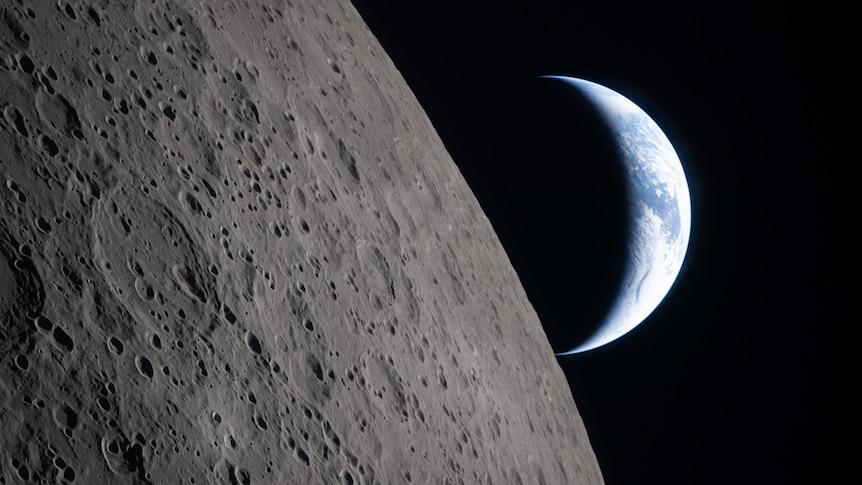

The Parkes Observatory, renowned for its role in the film “The Dish,” has once again played a pivotal role in space exploration by tracking Artemis II, marking humanity’s most ambitious journey around the Moon to date. This mission continues the observatory’s long-standing legacy, having previously contributed to the Apollo program in the 1960s and 1970s.
The significance of the Parkes Observatory is set to grow as space missions become more frequent in the coming years. Over half a century since its involvement with the Apollo missions, the CSIRO Parkes Observatory is actively supporting Artemis II, which represents the first human expedition to the Moon since 1972, reaching further from Earth than ever before and capturing unprecedented footage of the Moon’s far side.
Located in New South Wales’ Central West, the iconic radio telescope has been instrumental in monitoring the spacecraft during its lunar voyage. “During the close approach to the Moon, Parkes was tracking it,” stated John Sarkissian, a scientist with CSIRO. “We observed the spacecraft disappear behind the Moon, which was intriguing as the signal dropped out, only to reappear approximately 40 minutes later.”
The Artemis mission is part of NASA’s broader initiative to send astronauts back to the Moon by 2028, with aspirations of establishing a permanent lunar base. “There is going to be a lot of traffic,” Sarkissian noted, emphasizing that NASA may not always have the resources to manage the increasing number of lunar missions. “It reassures them that if they require our support in the future, we will provide world-class service.”
Throughout the Artemis II mission, the Parkes Observatory has collaborated with NASA’s Canberra Deep Space Communication Complex and the Australian National University’s Quantum Optical Ground Station. The spacecraft is anticipated to return to Earth on Saturday morning, according to Australian time.
The Parkes Observatory, affectionately known as “The Dish” by locals prior to the film’s release, first began tracking space missions in 1962 and played a vital role during the Apollo missions. Notably, in 1969, it was crucial in transmitting live footage of humanity’s inaugural Moon landing to an audience of over 600 million viewers. “We were essential during Apollo 11, as we received the television broadcasts of the historic moonwalk,” Sarkissian recalled. “For Apollo 13, we managed to pick up their very weak signals from the damaged spacecraft, enabling Mission Control to diagnose the issues and safely return the astronauts.”
Sarkissian reflected on the advancements in technology since then, noting, “Today, we have capabilities far beyond what we had during the Apollo era. In the past, extensive equipment and numerous personnel were required on-site, but now I can effectively manage the tracking on my own.”
In a significant cultural acknowledgment, Wiradjuri elders bestowed a traditional Indigenous name, Murriyang, on the observatory’s 64-meter telescope in 2020.
Looking back, the first crewed Apollo mission took place in 1968, concluding with the program’s end in 1972. The Artemis II mission marks a historic return of astronauts to the Moon. Sarkissian expressed his excitement, stating, “I have spent my adult life and a significant portion of my childhood dreaming about our return to the Moon. That moment has finally come, and it won’t just be one or two missions a year; we are entering an era of continuous exploration.”
He is optimistic that the upcoming missions will inspire a new generation in the same way the Apollo program did. “I vividly remember watching the Apollo 11 moonwalk alongside my classmates in first grade—it inspired an entire generation. I believe these new missions will ignite the same passion in today’s schoolchildren, encouraging them to engage with science.”