
In the last eight years, I have evaluated numerous portable speakers from leading brands, and I can assert with confidence that Sonos produces three of the finest portable speakers available.
According to The Guardian, their journalism remains independent, and they may receive a commission if you purchase through an affiliate link. For further details, please refer to their website.
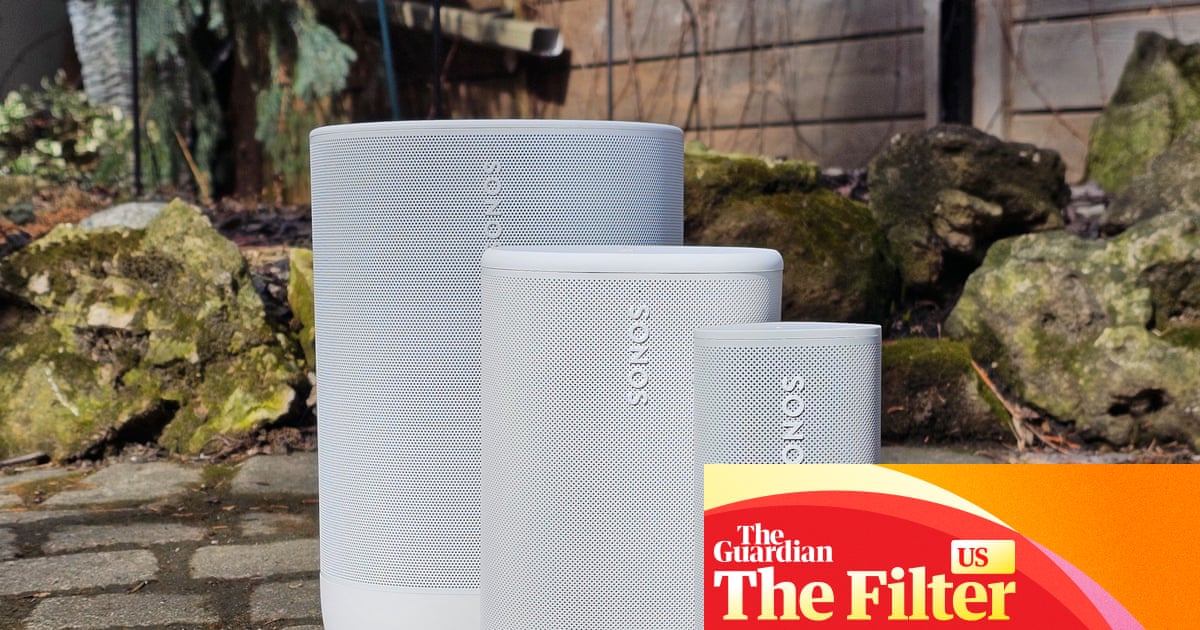
Among Sonos’ offerings is the Play, their latest portable speaker, which strikes an ideal balance in terms of size, sound quality, and features. Then there’s the Roam 2, a compact speaker shaped like a Toblerone, designed for easy transport. Lastly, the Move 2 stands out as a robust option that excels in bass performance without compromise.
All three speakers exhibit a noteworthy trait that defines Sonos: exceptional sound quality that surpasses expectations for their size. Characterized by clarity and balance, they provide an enjoyable listening experience typical of the Sonos brand.
While these speakers are more expensive than many competitors, they offer features that are often lacking in other models. For instance, they enable seamless switching between Wi-Fi and Bluetooth, ensuring uninterrupted music playback even when moving out of Bluetooth range. They also come equipped with built-in Amazon Alexa for various tasks and are fully resistant to water and dust. A distinctive feature, Auto TruePlay, automatically adjusts the speaker’s settings for optimal sound each time it is relocated.
The capabilities of these speakers expand significantly when paired with the Sonos app. Users can create stereo pairs, synchronize playback across multiple rooms, and compile playlists that incorporate various streaming services.
Having tested nearly every Sonos product while taking their portable models to diverse locations, from my backyard to tropical islands, I have compiled a guide to help you determine which model suits your needs best.
The compact option: Sonos Roam 2
The balanced choice: Sonos Play
The larger option: Sonos Move 2
What is it best suited for? Travel, outdoor activities, vacations, and daily commutes.
It provides classic Sonos sound in an ultra-portable format.
More intelligent than any other speaker of comparable size.
It does not resemble a rugged outdoor speaker.
Weighing just under a pound and comparable in length to an iPhone 17 Pro Max, the Roam 2 is incredibly portable. I can easily toss it into a backpack without noticing it’s there.
With an IP67 rating, this speaker is entirely dust and waterproof, capable of withstanding sand from the beach or accidental splashes in a pool. However, it doesn’t float, so retrieval will require a dive if it falls in. Despite its durability, it maintains a sleek and elegant design, available in black, white, olive, or two exclusive colors: sunset (a rich red) and wave (a light blue).
Thanks to its Wi-Fi capabilities, the Roam 2 serves as a hands-free smart speaker using either Amazon Alexa or Sonos Voice Control, a rare feature for such a compact portable speaker.
Additionally, it stands out as one of the few Bluetooth speakers that supports wireless charging. I usually place it on a 10-watt Qi-compatible charging mat, providing the same convenience as the Move 2 at home. For a personalized appearance, Sonos offers a $49 magnetic wireless charger that matches the Roam’s triangular design.
However, it is worth noting that the Roam 2 falls short against similar Bluetooth speakers like the JBL Flip 7 and Beats Pill, both of which are more affordable at $150. Its power and bass response are less impressive, and battery life is limited: when using Bluetooth at 50% volume, it lasts up to 10 hours, compared to the Flip 7’s 14 hours and the Pill’s 24 hours. With Wi-Fi use or higher volume, I have experienced battery life as low as five hours.
Should you buy it or pass? If you don’t need features like Wi-Fi and wireless charging, it may be better to look at alternatives such as the JBL Flip 7 and Beats Pill.
Battery duration: Up to 10 hours
Water and dust resistance? Yes/yes (IP67)
Powerbank capability (for charging other devices): No
User-replaceable battery: No
What is it best suited for? Gatherings and parties of any size.
It strikes the best balance between sound quality and portability.
It shares the Roam’s complete dust and waterproof features.
It also includes the Move’s replaceable battery and lasts for 24 hours.
Upon testing the newly launched Play, I found myself scanning the room for a larger speaker, whether it was playing intricate jazz and classical pieces or lively rock, rap, and hip-hop. In terms of sound quality, the Play meets the expectations set by its price point.
In Bluetooth mode, you can link up to four of these speakers for simultaneous playback, allowing your sound system to expand as your gathering increases from a few friends to a full-blown block party. I have enjoyed using a pair of stereo Play speakers for entertaining in my living room.
While working from home, I can easily grab the speakers and position them around me, creating a personal sound dome without the inconvenience of wired speakers. The included USB-C charging dock keeps the Play charged, and an additional $19 line-in adapter allows it to connect with turntables or other analog devices.
Although Sonos claims it is not intended for TV use, I connected it to a small 19-inch kitchen television, and it performed adequately.
Why do I refer to it as the Goldilocks of the trio? It weighs less than half of the hefty Move 2, yet shares its impressive replaceable battery design and 24-hour battery life. Furthermore, it delivers superior sound quality compared to the compact Roam 2 while offering the same level of drop protection and the full IP67-rated dust and waterproofing found in Sonos’ smallest speaker.
However, it does have a drawback: the Play is particular about its charging requirements. It necessitates at least an 18-watt USB-C power source (and up to 45 watts for faster charging), which means the standard 10-watt charger I use for my iPhone is insufficient, and my laptop’s USB-C port is also inadequate. Since Sonos does not provide an adapter in the box, you may need to purchase one separately; they offer 45-watt units for $29.
Should you buy it or pass? It’s still worth considering.