
When Sting reflects on his upbringing near a shipyard, it is a literal statement. In Wallsend, northern England, the Swan Hunter factory loomed large at the end of his street, its presence dominating the skyline. Daily, thousands of workers passed by his home, laboring on massive vessels that blocked out sunlight. A significant moment in his childhood occurred when he witnessed the Queen Mother driving by in a black Rolls-Royce, prompting Sting to realize that he desired more than a life among metal giants; he craved something grander, a pursuit he would eventually achieve as the charismatic lead of The Police and later as a solo artist.
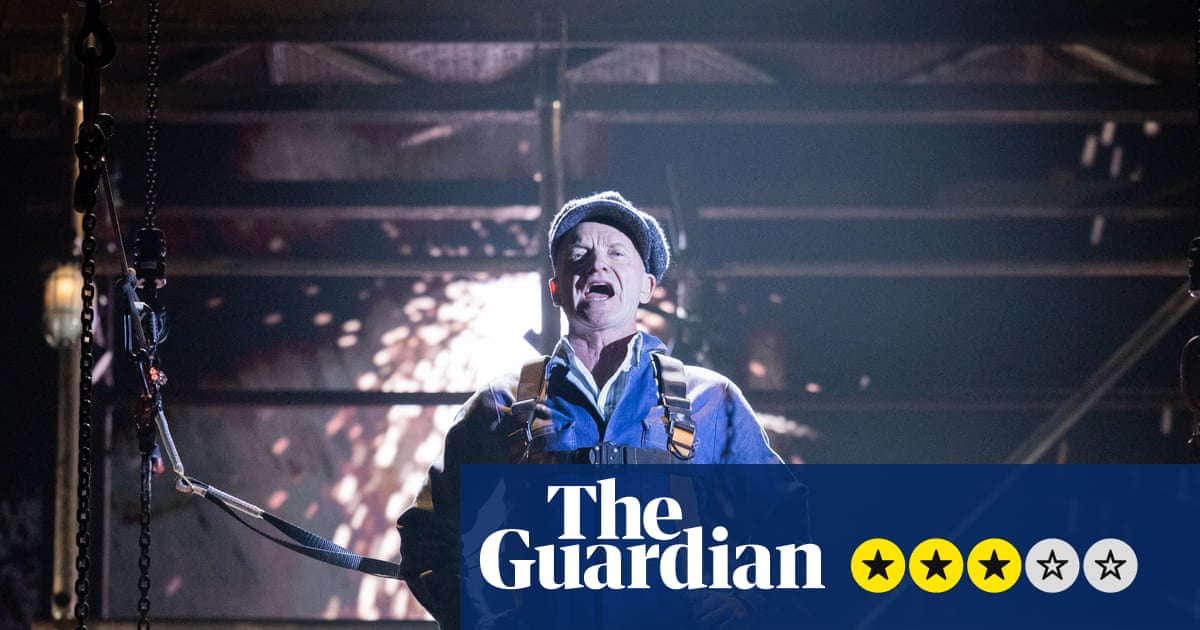
Now at 74 and boasting 17 Grammy Awards, the acclaimed musician has returned to the shipyard, this time in Australia, with a revitalized version of his musical, The Last Ship. Sting portrays the character Jackie White, a foreman grappling with the impending closure of the shipyard while also facing his declining health. He shares the stage with Reggae legend Shaggy, who portrays the Wallsend Ferryman, adding warmth and depth to the production.
The inclusion of Brisbane in the international tour of The Last Ship—alongside renowned cultural hubs like Paris, Amsterdam, and New York—marks a significant milestone for the Queensland Performing Arts Centre (QPAC), as it aims to elevate the city’s status as a global arts destination. The Glasshouse Theatre has been transformed into an industrial setting, featuring towering scaffolding and the striking bow of a ship. The set design, executed by the acclaimed projection design company 59 Studio, is visually impressive and immersive, with digital projections seamlessly integrated with the physical elements, sometimes blurring the lines between the two.
Sting composed the music and lyrics for The Last Ship, drawing inspiration from his 1991 album The Soul Cages and his familial ties to the shipbuilding industry. The musical score traverses various genres, including folk, ballads, and choral pieces, with fans likely to recognize songs such as “Island of Souls,” “All This Time,” and “When We Dance.”
The audience of 1,500 is undoubtedly attracted by Sting’s presence. He delivers a performance that is grounded and authentic, although it is more subdued compared to some of his fellow cast members. While his vocal power may not match the intensity of his earlier work from nearly 50 years ago, Shaggy brings his own charm to the stage, showcasing a different vocal style that extends beyond his reggae roots.
While the star power of Sting and Shaggy draws in the audience, the broader cast also contributes significantly to the production. Lauren Samuels shines as Meg Dawson, a publican who was once heartbroken by her childhood love, Gideon Fletcher, played by Declan Bennett, a character Sting loosely based on himself. Joe Caffrey delivers a compelling performance as union leader Billy Thompson, exuding authority and gravitas. The musical reaches its peak effectiveness when the entire ensemble performs together; the choral sequences are both powerful and poignant, emphasizing the theme of collective strength.
Originally developed in 2011 and premiering in 2014 to mixed reviews, this iteration of The Last Ship features new scenes, music, and updated character arcs. The story begins slowly but gains momentum in the second act, mirroring Sting’s own performance trajectory. However, the conclusion feels hurried, tying up numerous plot threads too quickly. A more concise narrative could enhance the overall experience and shorten the nearly three-hour runtime.
The central romantic storyline between Meg and Gideon is arguably the weakest aspect of the musical; it is challenging to empathize with a character who vanishes for 17 years without any communication, only to return expecting to pick up where he left off. In contrast, the female characters in The Last Ship exhibit strength, resilience, and independence, making Meg’s character arc feel at odds with these qualities.
The Last Ship delves into themes of mortality, labor, and identity, exploring the tension between tradition and progress. The shipyard serves as a metaphor for a community built on shared pride and purpose. Although the musical occasionally veers into overly sentimental territory, it resonates with contemporary issues regarding job security and the vital importance of collective action.
Sting, who once aspired to be like the ships from Wallsend—launching into the sea never to return—has come to appreciate his roots more profoundly over time. He recently expressed to AP, “My community made me who I am. They instilled in me a sense of dignity and work ethic that I still carry. I wanted to honor my community and my parents, and telling this story is a way of doing that. When you leave a community for a different kind of life, part of you yearns to return and make amends. This is my way of making those amends.”
In The Last Ship, Sting’s desire to reconnect with his past is genuine and heartfelt, even if the storytelling occasionally falls short of its emotional aspirations.
The Last Ship will be performed at the Queensland Performing Arts Centre’s Glasshouse Theatre until May 3.