
In a small square near Budapest’s Nyugati train station, 40-year-old Gabor admitted to feeling extremely hungover after a night of celebrations. “I celebrated all night,” he chuckled. “It was wild; I genuinely believed Fidesz would secure victory. Now, I feel a wave of optimism.”
This sentiment reflects the mixed emotions of excitement and disbelief currently sweeping across Hungary. In a significant shift after 16 years under Viktor Orbán’s leadership, characterized by attempts to mold the nation into an “illiberal state,” Hungarian voters decisively chose to remove Orbán and his Fidesz party from power in the recent elections.
The high voter turnout resulted in a commanding win for the opposition Tisza party, prompting thousands of jubilant supporters to flood the streets of Budapest on Sunday night.
Under the leadership of Péter Magyar, the center-right Tisza party captured 138 out of the 199 parliamentary seats, granting it the authority to amend the constitution and potentially dismantle key elements of Orbán’s “illiberal democracy.”
“I can hardly believe this is happening,” remarked 37-year-old Eva. “This morning, I was preparing for an announcement that they had discovered a trove of ballots that would alter the outcome. Now, I’m starting to accept that this is real.”
The election results were partly attributed to the mobilization of younger voters who rallied against Orbán’s administration. Many of these voters came of age during a time when Hungary’s press freedom declined and the nation faced criticism for not fully functioning as a democracy, becoming the most corrupt country in the European Union.
As results began to be announced on Sunday, spontaneous celebrations erupted along the banks of the Danube, spreading throughout the city as strangers embraced and exchanged high-fives in metro stations, chanting “We did it!” and “It’s over!” amidst the sound of honking horns.
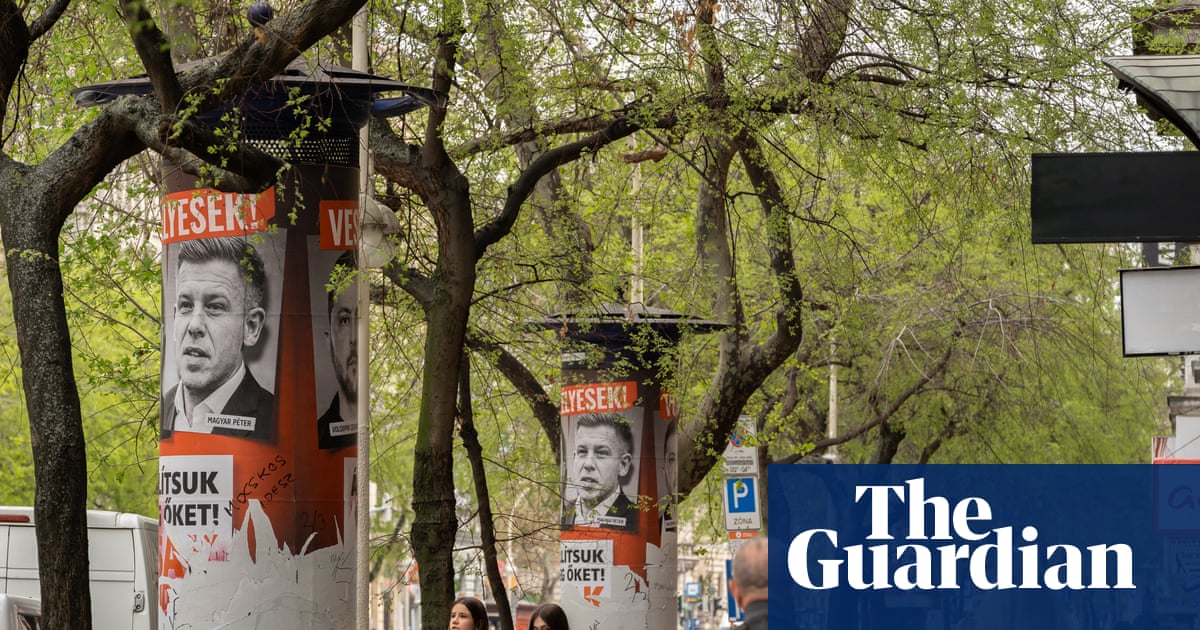
Some jubilant supporters climbed lampposts to remove government posters, this time targeting Magyar and Ukrainian President Volodymyr Zelenskyy—figures that had become synonymous with Orbán’s regime.
Despite the revelry, uncertainty loomed regarding the future direction of the country, including among Tisza supporters. “I feel we still don’t know Péter Magyar well enough,” said 27-year-old Franciska Dombi while walking her dog, Charlie. “His speech patterns remind me too much of Orbán. Being a conservative, I’m unsure what to expect from him.”
This comment alluded to Magyar’s history as a former Fidesz member. He began speaking out against the party in early 2024, citing corruption and cronyism, before establishing his own political movement.
As his party capitalized on public discontent regarding corruption and deteriorating public services, Magyar traveled extensively across the country, conducting multiple rallies each day during the campaign. He promised to mend Hungary’s strained relationship with the European Union, combat corruption, and restore essential public services.
However, his plans were often vague, a strategy interpreted as a means to mitigate scrutiny from the 80% of Hungary’s media landscape dominated by Fidesz loyalists.
On Monday, Magyar declared that his party had achieved an unprecedented supermajority, empowering them to implement their policies. “The Hungarian electorate did not merely seek a change of government; they demanded a complete regime change,” he stated.
The campaign occurred within a complex context, as the White House hastily endorsed Orbán days before the election. Additionally, allegations of Russian interference further complicated an already uneven playing field, which global observers noted was “tainted by the lack of a fair environment” in 2022.
Magyar expressed aspirations to assume power by May 5.
On the streets of Budapest, many speculated about the future of Orbán, who has been a prominent figure in Hungarian politics for decades, transitioning from a liberal, anti-Soviet advocate to a nationalist aligned with the far right.
“This feels like a significant blow to him,” remarked 28-year-old Márton Bács, reflecting on the overwhelming electoral outcome against Orbán. “I doubt he can recover from this politically in the long term.”
Others suggested that Orbán, the longest-serving leader in the EU, would not retreat quietly. “He’ll likely try to maintain a façade of strength as opposition,” noted 37-year-old Mariann.
Eva, sitting nearby, acknowledged Orbán’s prompt concession of the election results less than three hours after polls closed. “I can’t envision him stepping aside,” she said. “Yet I would be pleased to see him retreat; I can picture him fishing or gardening at home,” she added with a laugh.
Conversely, not all were pleased with the election outcome. “I voted for Fidesz and I’m quite disheartened by what transpired,” expressed 72-year-old Katalin, voicing her concern over the lack of clarity regarding Magyar’s plans. “I might trust Tisza politicians more if I knew more about them.”
Similarly, 38-year-old Márton Üveges, another Fidesz supporter, expressed surprise at the results. “I genuinely didn’t anticipate this outcome,” he stated, holding out hope that Orbán might find a path to return after a four-year hiatus in opposition. “We’ll have to see how he plans to rebuild from this point,” he added.
Given the extensive changes Orbán implemented since 2010, few expect Magyar to effectuate rapid transformations. “It will likely take several years,” predicted Dombi. During Fidesz’s tenure, the party had filled key state, media, and judicial positions with loyalists, raising questions about how they would respond to a Tisza-led government.