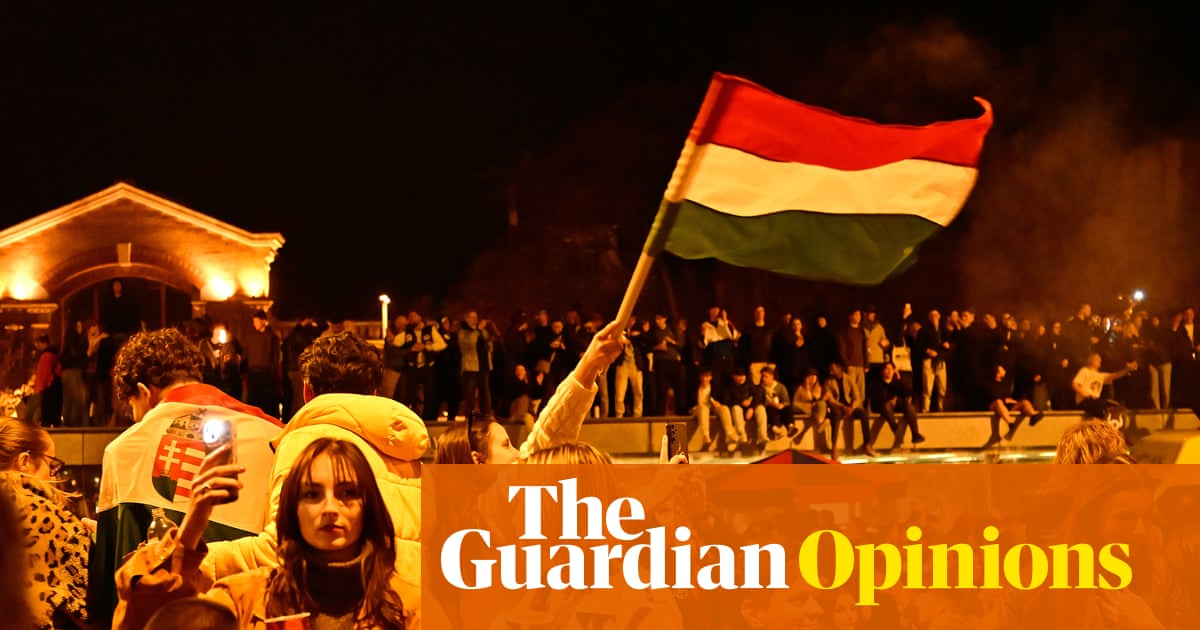

Last Sunday evening in Budapest marked a significant moment in history along the Danube River. Enthusiastic crowds gathered along the riverbank, opposite the parliament building glowing with lights, chanting “Ria-ria Hungaria!” and “Hungary-Europe!”. This collective celebration followed the remarkable electoral success of Péter Magyar’s Tisza party, a victory that holds substantial ramifications beyond Hungary’s borders. The outcome is particularly favorable for Ukraine and the European Union, while it spells trouble for Russian President Vladimir Putin and US President Donald Trump, both of whom have supported Viktor Orbán’s government. The pressing question now is whether Hungary can set a precedent as the first nation to navigate away from the populist decline of democracy—termed “Orbánisation”—that Trump seeks to replicate in his own country, and whether Europe possesses the political resolve and creativity to support this transition.
On the preceding Friday, I found myself amidst a vibrant gathering of young individuals at a concert aimed at instigating systemic change in Heroes’ Square. This is the same square where, in 1989, I watched a passionate young Viktor Orbán demand the dissolution of the old communist regime and the withdrawal of Russian forces. Now, a fresh generation of Hungarians was calling for the end of Orbán’s long-standing leadership and the Fidesz party. “Filthy Fidesz!” they shouted, alongside “Russians go home!” It is widely recognized that the current Orbán serves as Putin’s ally in Brussels.
On Saturday evening, I attended Orbán’s final campaign address in front of St. Stephen’s statue on the Buda side, where the atmosphere starkly contrasted with the youthful energy of the previous night. Despite an elaborate mobilization effort—complete with branded flags and groups equipped with megaphones—the rally felt lackluster, reminiscent of a gathering for retirees. Orbán appeared weary and irritable, even criticizing the younger generation at one point. I couldn’t help but think he had become the embodiment of an outdated regime. On the bus ride from Buda, I overheard a woman questioning a Fidesz supporter about his payment since March 15, to which he cryptically responded, “I’ll tell you later.”
Despite optimistic polling leading up to the election, uncertainty lingered as we approached election day. However, as Sunday progressed and voter turnout reached unprecedented levels, optimism grew. Following the closure of polls at 7 PM, early constituency results revealed a sweeping victory for Tisza, indicating that the collective will of the people had triumphed over the manipulation of electoral processes. Shortly after 9 PM, a surprising notification appeared on Magyar’s Facebook page: Orbán had called to concede. In a moment reminiscent of Shakespeare, it marked a dramatic exit for Orbán. The celebrations erupted, with one young researcher exclaiming, “Voldemort is gone!” as we made our way to the river.
Later that evening, Magyar addressed the crowd by the Danube, vowing to create a Hungary where everyone can live freely, restore constitutional checks and balances, improve relations with neighboring countries, and strengthen Hungary’s role in NATO and the EU. The crowd responded with chants of “Europa! Europa! Europa!”
As Monday morning arrived, discussions turned serious. Can this new leadership fulfill its promises? While the events of 1989 were monumental, the term for systemic change—rendszerváltás—resonates strongly again. With Tisza achieving a two-thirds supermajority in parliament, they possess the authority needed to modify constitutional frameworks, potentially overcoming obstacles that have hindered post-populist reforms in Poland. However, challenges remain, particularly with the president and the constitutional court. Much will depend on Fidesz’s unity and Orbán’s willingness to accept change. Yet, there exists a significant opportunity for political transformation.
The economic landscape presents a more formidable challenge. Hungary’s economy is struggling, and Fidesz has already exhausted a substantial portion of this year’s budget in its efforts to win votes. The details of energy, investment, and loan agreements with Russia and China remain unclear. Magyar’s ambitious pledges to sustain Fidesz welfare payments and price controls may not be sustainable. Tisza intends to reclaim significant sums misappropriated by those linked to Orbán’s regime, but this will be a complex task. Accessing approximately €17 billion in frozen EU funds, as well as securing future financial support, will be vital.
The EU and individual European governments have a moral obligation to assist this unprecedented shift towards a post-populist system in Hungary. However, support should come with conditions that are substantive and tailored to the specific challenges of this transition, rather than the bureaucratic requirements that were previously exploited by Orbán’s administration. Leaders from across Europe, including German Chancellor Friedrich Merz and Polish Prime Minister Donald Tusk, should engage in high-level discussions with the new Hungarian leadership, focusing on critical issues like media freedom, accountability, and checks on excessive executive power.
I was particularly moved by the sight of young Hungarians spontaneously expressing their enthusiasm for Europe in the streets of Budapest. This moment could be seen as Hungary’s second “return to Europe,” echoing the sentiments of 1989. The EU must also recognize its moral responsibility towards the Hungarian people, as the future of Hungary’s political landscape unfolds.