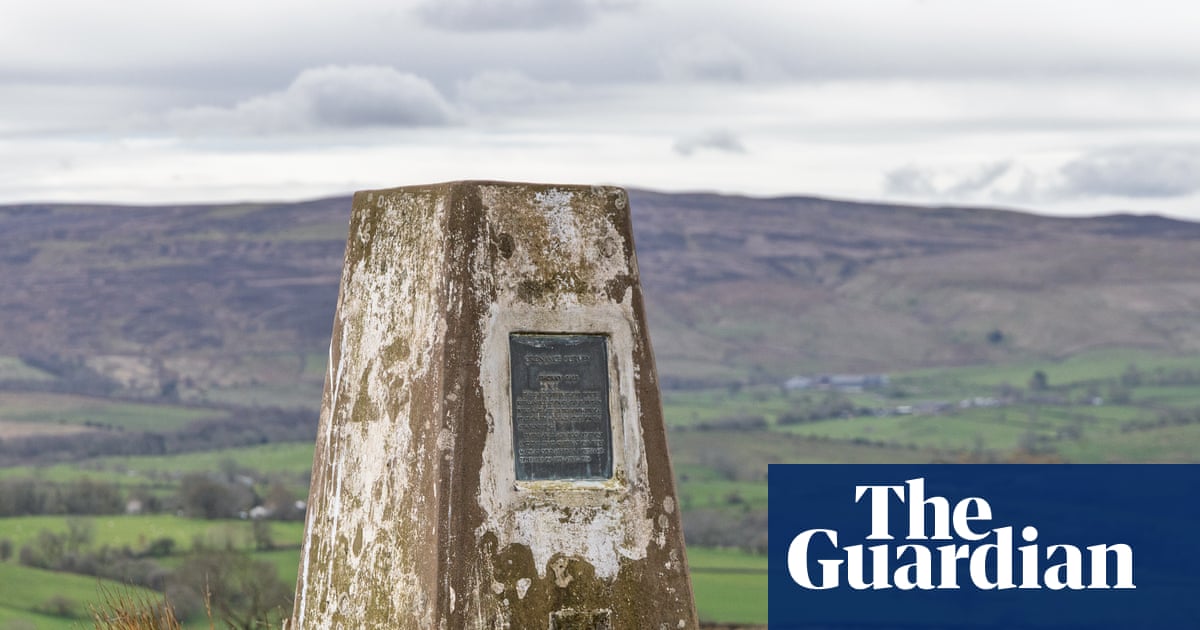

Advocates for heritage preservation are seeking to secure listing status for two concrete pillars that have been described as “modest obelisks of modernity in the countryside.”
These functional pillars, standing at 120 centimeters (approximately 4 feet), are part of a vast network of over 6,500 surveying markers that played a crucial role in the evolution of contemporary mapping techniques.
Although they have become largely obsolete due to advancements in GPS technology and drone usage, these pillars continue to serve as popular landmarks for hikers and have become central features in numerous group photographs and selfies. Additionally, they have inspired a niche hobby known as “trig-bagging,” where enthusiasts aim to visit every trig point.
The Twentieth Century Society (C20), a group dedicated to the conservation of modern architecture and design, has submitted a request for listing status for the first and last of these surveying posts ever utilized.
These two trig points mark the beginning and end of an extensive mapping initiative known as the Retriangulation of Great Britain. The first of these structures was erected 90 years ago this week in Cold Ashby, Northamptonshire, identified by the grid reference SP 64422 76588. The last observation was recorded on June 4, 1962, at Thorny Gale in Cumbria (NY 82516 13912). C20 has approached Historic England to grant both structures protection under Grade II-listed status.
Brigadier Martin Hotine, a former officer of the Royal Engineers and World War I veteran, designed the trig points while leading the retriangulation project for the Ordnance Survey (OS). Often referred to as Hotine Pillars, these tapered structures were equipped with brass plates for securing theodolites—precision instruments essential for accurate mapping of the British Isles—and included brass loops to fasten theodolites during windy conditions.
On clear days, it was possible to see at least two other trig points from any given location, facilitating the mapping of the nation through a triangulated network.
Unfortunately, many of these structures have been lost due to urban development, agricultural activities, and coastal erosion, and none have been listed to date. In the 1990s, the OS proposed the removal of unnecessary pillars to cut maintenance costs. However, following significant opposition from advocacy groups such as the Ramblers, the OS rescinded its demolition plan and instead passed maintenance responsibilities to local organizations. Thousands of these pillars remain as notable landmarks, particularly on elevated terrain, with the highest located atop Ben Nevis in Scotland.
C20’s application recognizes that while trig pillars have become “more or less obsolete,” they still serve as significant markers for walkers and symbolize the British countryside. The society contends that their cultural significance extends beyond their original purpose. Notably, American author Bill Bryson included trig points among his “favorite British items” in his book, The Road to Little Dribbling.
Additionally, they inspired the name and logo of the now-defunct indie record label Angular Recording Corporation, which was instrumental in launching several notable bands, including Bloc Party and the Long Blondes.
In their application conclusion, C20 stated, “These modern obelisks to modernity in the countryside are remnants from a nationwide surveying project of unprecedented scale. We urge Historic England to award this gem its deserved place on the national heritage list for England.”
Catherine Croft, director of the C20, remarked, “Long before the advent of GPS, satellite technology, and navigation applications on our smartphones, trig points served as the humble concrete pillars that mapped a nation. As we celebrate the 90th anniversary of the landmark Retriangulation of Great Britain, we recognized an opportunity to place a figurative pin in the map and have submitted the two most historically significant trig points—the first and last examples—for national listing. Standing atop a trig point in a brisk wind is an unmatched experience, and we hope these two concrete modern obelisks will soon gain recognition from the Department for Culture, Media and Sport.”