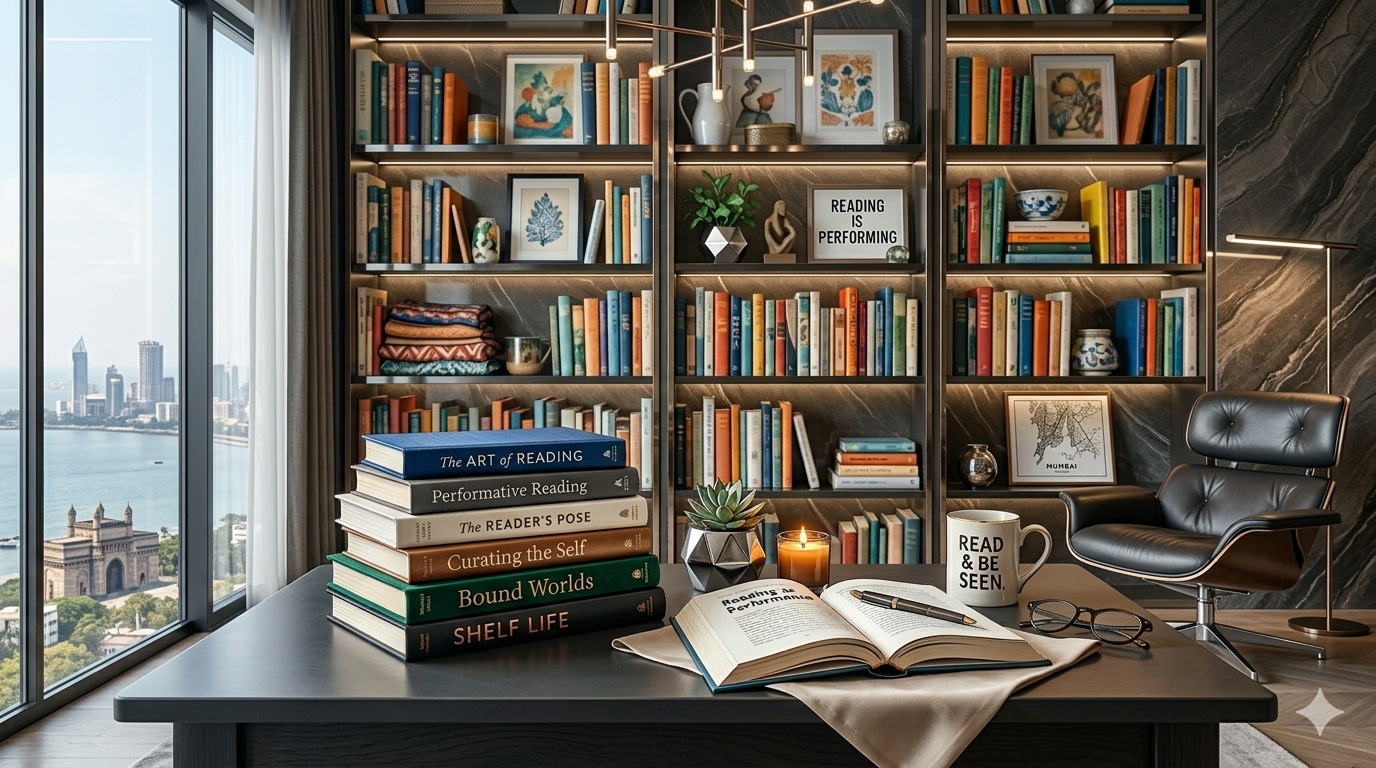

Books have become ubiquitous in modern living spaces, finding their place on floating shelves in new apartments, windowsills in cafes, and bedside tables belonging to those perpetually “in the middle of something.” They are artfully stacked on coffee tables, arranged on ledges, or nestled in corners alongside candles and trailing plants. While they create a visually appealing atmosphere and reflect a certain style and personality, guests often wonder if they are actually being read.
In homes and cafes across India, books that once served as vessels of knowledge and storytelling have found a new role as decorative elements. They not only enhance a space but also convey a specific aesthetic and complete the overall color scheme. The question of their actual usage seems secondary, as noted by Divya Kothari, a prominent interior designer based in Mumbai.
Kothari explains that her journey toward becoming a book stylist was unplanned; however, the nature of her work evolved as clients began to arrive at consultations equipped with Pinterest boards and images of bookshelves. “Books have integrated into every design conversation,” she states. “Clients typically ask for a designated corner in their homes that radiates aesthetic appeal.”
When discussing whether social media has influenced this trend, Kothari remarks, “With the introduction of Pinterest, it was primarily designers and professionals who were scrolling through it. Now, every client engages with Pinterest, bringing ideas for each corner of their home, including books.”
Instagram has intensified this trend as clients share images of other people’s homes and bookshelves, requesting designers to recreate those looks. Nevertheless, Kothari emphasizes that the demand for books is not solely for decorative purposes. “Some clients are avid readers, while others may not be. For those who don’t read, books serve as decorative items, yet they often end up reading a few titles.”
For clients who do read, their requests differ. “They express the need for a study room, but when we design these spaces, they emphasize creating a tranquil retreat within the home that seamlessly integrates with the overall design, rather than appearing as a separate area.” Thus, bookshelves can fulfill multiple roles beyond mere aesthetics.
At Bahrisons Booksellers, a cherished independent bookstore in Delhi, the dynamic between books as sources of knowledge and as visual enhancements is evident daily. “Indeed, social media has significantly influenced this trend,” says Sikendar Kumar Rai, the store’s owner. “People often seek books not just for reading but for display purposes.”
The types of books in demand for these decorative roles are specific: hardcover editions, leather-bound books, and visually substantial volumes that command attention even when untouched.
Whether this trend encourages new readers or merely reduces books to mere props remains ambiguous at Bahrisons. “There is a demand for books intended for display in showrooms and cafes, including coffee table and hardcover editions,” Rai observes.
A new type of customer has emerged, one who arrives equipped with a mood board. “Clients and interior designers come with precise color palettes and shelf dimensions in mind, selecting books accordingly,” Rai explains. Occasionally, there is also consideration for the compatibility of titles, acknowledging that the content still holds some significance, albeit subtly. Hardbound books are particularly desirable for their durability; they maintain their form and color over time, suggesting that decorative books must also be resilient.
At Reader’s Coffee House in Noida, the focus is primarily on the café, with books serving as a secondary element. “Most of the books on our shelves are donated, with a few newly acquired,” explains manager Paresh, who prefers to go by his first name. “We don’t have a strict selection process, but they blend seamlessly into the environment.” As more cafes start to function as reading venues, the aim is often less about building extensive libraries and more about allowing books to coexist with coffee and conversation.
Then there are those who find themselves in between the two extremes of being a dedicated reader and a mere aesthetic collector; a more relatable position. A student in Delhi shares her experience of owning complete series and trilogies lined up on her shelf, which brings her genuine satisfaction. “I used to be an avid reader, but due to my busy schedule, even seeing them on my shelf is sufficient for me right now. However, I aspire to return to my reading habits. Books not only provide an opportunity for reading but also enhance the design and ambiance of my space.”
This candid reflection requires no apology and perhaps should not. Life becomes more demanding, and time becomes scarce. The books remain on the shelf, patient and ready for whenever the urge to read returns.
Books have always represented more than their written content. A library once symbolized a particular status or aspiration. The Instagram bookshelf can be viewed as a contemporary equivalent of the refined Victorian library, showcasing intellectual identity to a modern audience. What has changed is the connection between the signal and the substance; the performance of intellectualism now exists independently from the practice of reading.