
Palestinians residing in Gaza express deep concerns that the international community has overlooked their plight amidst the ongoing conflict involving the United States, Israel, and Iran, which has broader implications for the Middle East.
Six months after a ceasefire came into effect in Gaza, many residents continue to endure harsh living conditions. The region has been battered by unusually heavy rainfall well into April, causing significant flooding in makeshift tent communities that shelter hundreds of thousands of individuals.
Despite the ceasefire agreement, Israeli airstrikes targeting alleged Hamas positions have persisted in recent weeks, as the Israeli military also conducts operations against Iranian forces and Hezbollah in Lebanon.
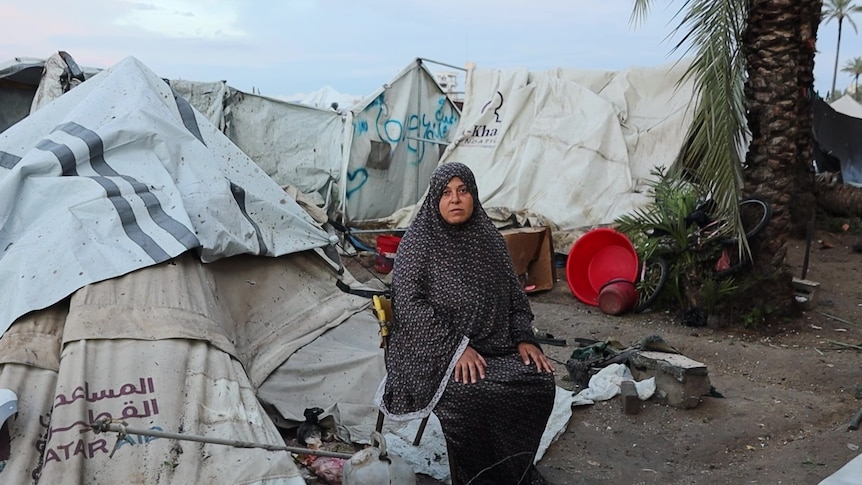
Reports indicate that several of these strikes have impacted tent camps and their surroundings. In the Al-Sit Amira tent camp, located south of Deir al-Balah in central Gaza, 46-year-old Rana Khdeir was searching for alternative accommodations after her fragile shelter was largely destroyed by an Israeli airstrike. “This illustrates that the conflict is far from over,” she remarked.
Hailing from Beit Lahiya in northern Gaza—a region that faced extensive destruction due to Israeli military efforts to establish a buffer zone—Ms. Khdeir expressed uncertainty about her family’s future. “I plan to spend the night in a neighboring tent with my husband and children until circumstances improve,” she stated. “The most distressing reality is that we feel forgotten.”
While ABC news cameras were on-site, an Israeli strike hit a nearby area, injuring local residents and demolishing temporary shelters.
Fatima Hamdona, 55, was busy repairing her tent after the heavy rains had soaked her family’s belongings. They had previously been displaced from Al Bureij camp in central Gaza. “Everything is drenched—our mattresses, clothes, and tent. We have no protection from the elements,” she lamented.
Ms. Hamdona’s husband lost his life in the conflict, and her son was injured, currently receiving treatment outside of Gaza. “This is no way to live. It feels as though Gaza has been forgotten, and no one cares about us,” she added.
Since the ceasefire was established, Israeli strikes have resulted in 765 fatalities and 2,140 injuries, with Israel maintaining that its operations are focused on Hamas militants, even as many victims include women, children, and the elderly.
According to economist Mohammad Abu-Jiyab, editor of the Gaza newspaper Al-Iqtisadiya, approximately 90 percent of Gaza’s population is currently living below the poverty threshold. He noted that the ongoing conflict has devastated much of the region’s economy, particularly impacting over 75 percent of the agricultural sector. “The situation has worsened, complicating the humanitarian crisis in Gaza,” he stated.
Abu-Jiyab observed a decrease in humanitarian aid and commercial goods, with rising prices evident in local markets. The Rafah crossing with Egypt, which serves as Gaza’s only border point not linked to Israel, was closed for two weeks at the beginning of the Iran conflict. This crossing had already been shut for nearly two years during the Gaza war and had just reopened shortly before the onset of hostilities with Iran.
Humanitarian organizations and health officials have raised alarms that the closure of Rafah endangers lives, particularly for those requiring medical evacuation. “More than 20,000 patients need treatment outside Gaza,” stated Khalil Dijran, a spokesperson for the health ministry in the territory. “Over 1,500 have died while waiting for two years, and about 4,500 children require urgent care.”
During Rafah’s closure, some medical evacuations were permitted through other crossings, particularly Kerem Shalom, which is under Israeli control, and medical cases have since resumed crossing the border. Dr. Dijran warned that without improvements, the situation would likely worsen, increasing the demand for medical care and straining an already fragile health system.
“Residents face dire conditions, especially in winter, as rain has contaminated shelters, creating an environment ripe for the spread of diseases,” he explained. “Hospitals are in a dire state, suffering from severe shortages of medication, medical supplies, and equipment.”
The Israeli Defense Forces’ agency responsible for coordinating services in Gaza, COGAT, has consistently refuted claims of restricting aid, asserting that sufficient supplies are reaching the territory. They reported that hundreds of trucks loaded with food and other essentials have been entering Gaza, despite additional restrictions imposed due to the conflict with Iran.
COGAT emphasized that during the ceasefire, substantial quantities of humanitarian assistance were delivered to Gaza, with food supplies reportedly quadrupling the UN’s estimated needs. Most of this aid has come through the Kerem Shalom crossing in southern Gaza, with some deliveries also made via the Zikim crossing in the north.
Meanwhile, the US President’s Board of Peace, created as part of the ceasefire negotiations, has convened only once since its establishment, prior to the outbreak of the Iran conflict. In the midst of the ongoing violence, the board’s Gaza representative, Nickolay Mladenov, informed the United Nations Security Council that a plan for resuming the ceasefire had been outlined, although progress remains uncertain.