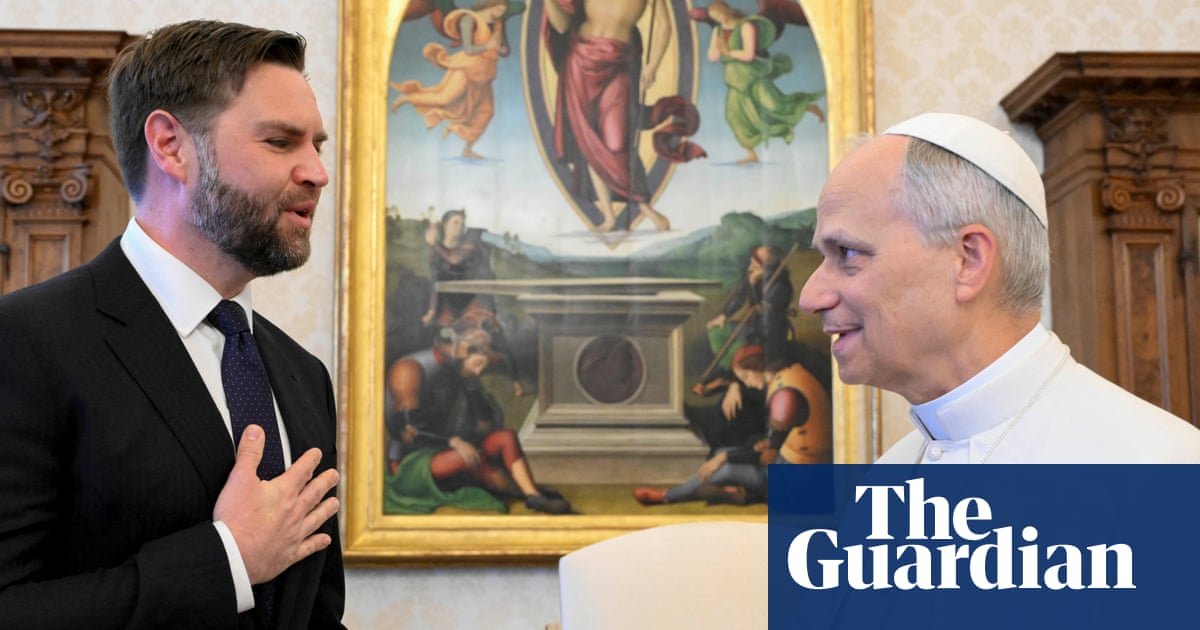

The stark difference in backgrounds between two prominent figures engaged in a debate over war and theology is notable.
On one hand is Pope Leo XIV, a groundbreaking leader as the first North American to serve as the head of the Catholic Church and the first member of the Augustinian order to hold this position. This week, he traveled to the contemporary Algerian city that was once the home of Saint Augustine. This visit marked a significant moment for Leo, who has dedicated much of his academic career to exploring Augustine’s philosophical contributions.
Conversely, JD Vance, the Vice President of the United States, represents a contrasting perspective. A recent convert to Catholicism, Vance lacks an academic background in the historical evolution of the Church’s teachings.
The crux of their disagreement centers on Augustine’s formulation of the “just war” theory, a concept that emerged after centuries during which early Christian doctrine largely opposed war and violence, even in cases of self-defense. This theory remains a vital component of Western philosophical thought, having been addressed by numerous philosophers, legal experts, and theologians throughout history.
This debate is part of a broader controversy ignited by the policies of the Trump administration, which have attempted to infuse the U.S. military actions against Iran with a confusing religious fervor.
In a particularly surreal moment, the U.S. President shared a social media image depicting himself as a Christ-like figure performing miracles amid aerial assaults and fantastical warriors.
Meanwhile, Defense Secretary Pete Hegseth has presented himself as a modern-day crusader, advocating for what he deems righteous violence.
In a series of statements last month, Pope Leo asserted that Christ’s teachings fundamentally oppose war, emphasizing that God does not heed the prayers of those who engage in warfare and instead turns away from them.
His remarks have grown increasingly direct, particularly in response to Trump’s alarming declaration on April 7 that “a whole civilization will die tonight” if Iran did not reach an agreement with the U.S. Leo described such threats as “truly unacceptable” and argued that they contravene international law.
Vance responded to these comments during an event for the conservative organization Turning Point USA at the University of Georgia on April 14. He challenged the Pope’s assertion that God does not support those who use the sword, referencing over a millennium of just war theory and citing the actions of U.S. troops who liberated France from the Nazis and rescued Holocaust survivors.
Vance emphasized the importance of the Pope being cautious when discussing theological matters, stating, “If you’re going to opine on matters of theology, you’ve got to be careful.” His comments were met with backlash on social media, where critics accused him of “popesplaining” theology.
Augustine himself posited that the responsibility for waging war lies with the state, arguing that a just war could be deemed valid if pursued with “right intention” and aimed at restoring peace.
He maintained that leaders who initiate war should act as just judges, ensuring the protection of the innocent, while motivations rooted in vengeance or greed would negate any claim to justness. These principles articulated by Augustine and later thinkers continue to inform the legal standards surrounding conflict.
In an interview with the Catholic Standard in March, Cardinal Robert McElroy from Washington, D.C., stated that the U.S. and Israeli actions against Iran did not meet the just war criteria. “You cannot satisfy the just war tradition’s criterion of right intention if you do not have a clear intention,” he remarked.
On Wednesday, Bishop James Massa, who chairs the committee on doctrine for the U.S. Conference of Catholic Bishops, clarified that Leo’s statements represent not merely the Pope’s personal views but reflect established Catholic doctrine as outlined in the catechism.
While many have expressed outrage over both Trump’s portrayal of himself as a Christ-like figure and the criticisms aimed at the Pope, the dispute has also drawn in staunch defenders of Trump, such as House Speaker Mike Johnson. Johnson, a Southern Baptist, echoed Vance’s sentiments, indicating confusion about the Pope’s point.
Others, like conservative Catholic columnist Ross Douthat of the New York Times, have found themselves in a delicate position, lamenting that the Church often appears antagonistic towards conservatives while acknowledging that the Trump administration’s rationale for the conflict with Iran lacks clarity and consistency.
“Is the war just, or is it not?” Douthat questioned, presenting his own arguments for its potential justness. “The administration simply has not made a coherent and consistent case for the justice of the conflict.”