
Every weekday before sunrise, Oluwatobi Ogundipe departs from his modest apartment in Sango Ota, an industrial area in Ogun State, embarking on a four-hour journey to his workplace in the skyscrapers of Lagos Island.
Even though Ogundipe, a 32-year-old product manager, is employed in one of Nigeria’s burgeoning tech industries, he finds it financially impossible to live closer to his job.
“In 2023, I discovered a self-contained room on Lagos Island, near my office, that had its own bathroom and kitchen, priced at ₦900,000 [approximately £490] annually. Once I accounted for agency and agreement fees, the total cost nearly doubled. It simply wasn’t feasible for me,” he explains. “After considering various alternatives, I ultimately opted to relocate to Sango Ota, where rental prices are more manageable.”
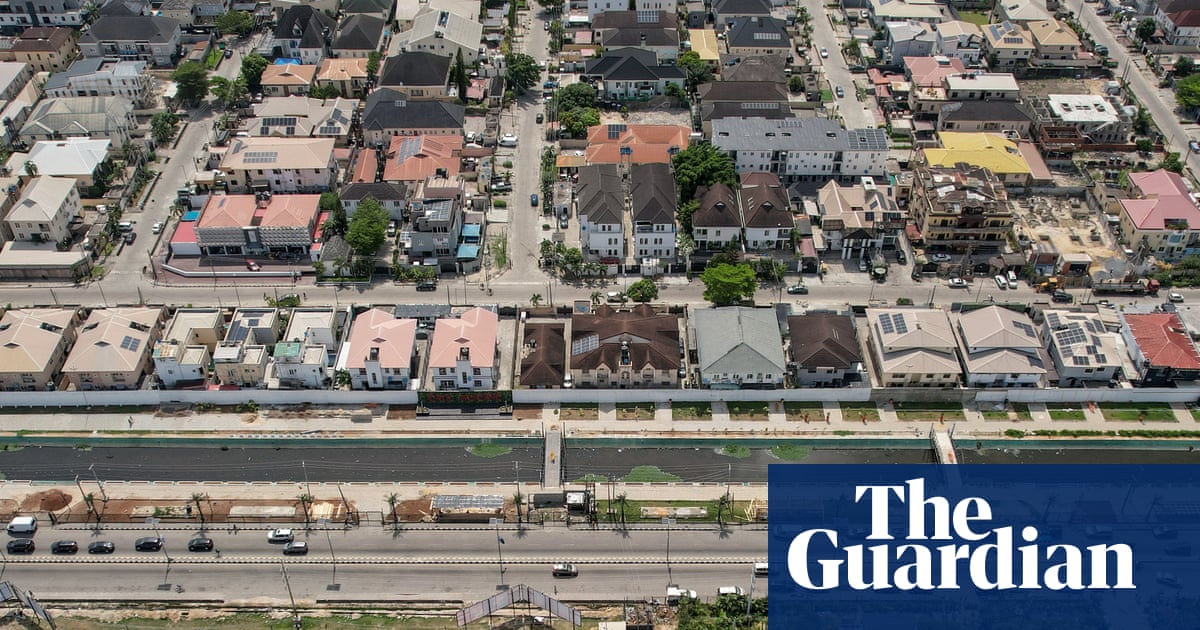
Stories like Ogundipe’s are widespread in the vast city of Lagos. As one of Africa’s leading financial, cultural, and entertainment hubs, Lagos is known for its lively atmosphere and nightlife, earning it the title of the city that never sleeps. It is the most populous city on the continent after Cairo, with an estimated population of 22 million, according to local government figures. However, the very energy that fuels its expansion is also straining the housing market to its limits.
Obafemi Hamzat, the deputy governor of the state, notes that Lagos is experiencing ongoing migration pressure, with around 6,000 people moving in and 3,000 departing daily. This influx places immense stress on the housing supply.
Rental prices in Lagos have skyrocketed, far outpacing wage increases. For instance, flats on the mainland that rented for about ₦500,000 two years ago now command up to ₦2.5 million annually. Tenants on Lagos Island report that rents have tripled, while the national minimum wage stands at ₦840,000 per year.
“This is a significant concern,” states Emmanuel Joseph, a real estate agent in Lagos. “Even if individuals saved every naira they earned, they still cannot afford a ₦2 million apartment. This is why we are increasingly seeing people share living spaces just to make ends meet.”
For Ogundipe and others in similar situations, this reality translates into a daily battle with affordability and basic necessities. “You endure traffic for four to five hours, and before long, your legs begin to feel numb. Sitting for such extended periods without stretching has become a necessary skill for me,” he shares. “Sometimes when I disembark from the bus, I feel as if I can barely feel my legs.”
Ayodeji Monsuru, a civil servant and father of two, faces comparable challenges. Employed in Maryland, a central area of the mainland, he resides in Ijaiye, one of the city’s outer districts. He rises before dawn each day for a commute that often surpasses two hours.
“I moved from New Oko Oba [in northern Lagos] two years ago because I could not cope with the rent hike from ₦300,000 to ₦500,000,” he recounts. “It seemed like every landlord in Lagos had collectively decided to raise their rents at the same time.”
Monsuru earns around ₦240,000 monthly but allocates ₦3,500 weekly for transportation to his job. He observes that escalating housing expenses are driving professionals away from the city center, and if this trend persists, he may consider leaving entirely.
“Sometimes I question whether working in the city is worthwhile,” he reflects.
Urban management specialists assert that these challenges are indicative of a more extensive structural crisis.
Professor Taibat Lawanson, an expert in urban management and governance at the University of Lagos, reveals that Lagos is facing a housing deficit of over 3.4 million units. “The city’s population is expanding at a rate that outpaces housing availability, forcing many to seek refuge in more affordable areas, often by sharing accommodations or resorting to informal living situations,” she explains.
“We’ve observed various coping strategies: some individuals sleep in their offices, while others spend weekdays in Lagos and return to their families outside the city on weekends.”
However, the issue of supply shortages is only part of the narrative. In several regions, including the UK, housing experts note that the lack of affordable homes is exacerbated by private developers focusing on high-end projects instead of affordable options.
A similar pattern is emerging in Lagos, where rising construction expenses, escalating urban land costs, limited housing financing, and inadequate incentives for affordable housing are compelling developers to concentrate on luxury projects rather than budget-friendly options.
“Lagos is a land-scarce city, lacking sufficient space for construction; its economic growth is attracting investors to prioritize premium housing,” Lawanson points out, “since developing affordable homes is significantly less lucrative.”
This shift has led to a surge in luxury apartments, even as many struggle to find basic housing.
Emmanuel highlights the increasing trend of short-term rentals. “Many landlords are converting their properties into short-let accommodations,” he observes. “They can earn considerably more from short-term guests than from conventional long-term renters.”
Platforms like Airbnb have further facilitated this trend, allowing property owners to market their spaces directly to tourists and business visitors.
One landlord in the Lekki suburb discusses the financial benefits of this shift: “The concept of short lets is that you can earn as much in a week or month as you would from a long-term lease. For us, it’s simply a business decision.”
Nevertheless, this business approach exacerbates the housing shortage.
“When residences are transformed into short-term rentals, there are fewer units accessible for long-term tenants,” Lawanson explains. “This scarcity drives rental prices even higher.”
Barakat Odunuga-Bakare, housing advisor to the Lagos state governor, did not respond to the Guardian’s request for comment.
For the time being, residents of Lagos are adapting to these circumstances. Each morning, thousands undertake journeys similar to Ogundipe’s, navigating the city’s notorious traffic as they travel from distant suburbs and neighboring states into Africa’s most vibrant metropolis.
“We all come to Lagos in pursuit of something,” he remarks. “But these days, it feels as though the city is gradually pushing us away.”