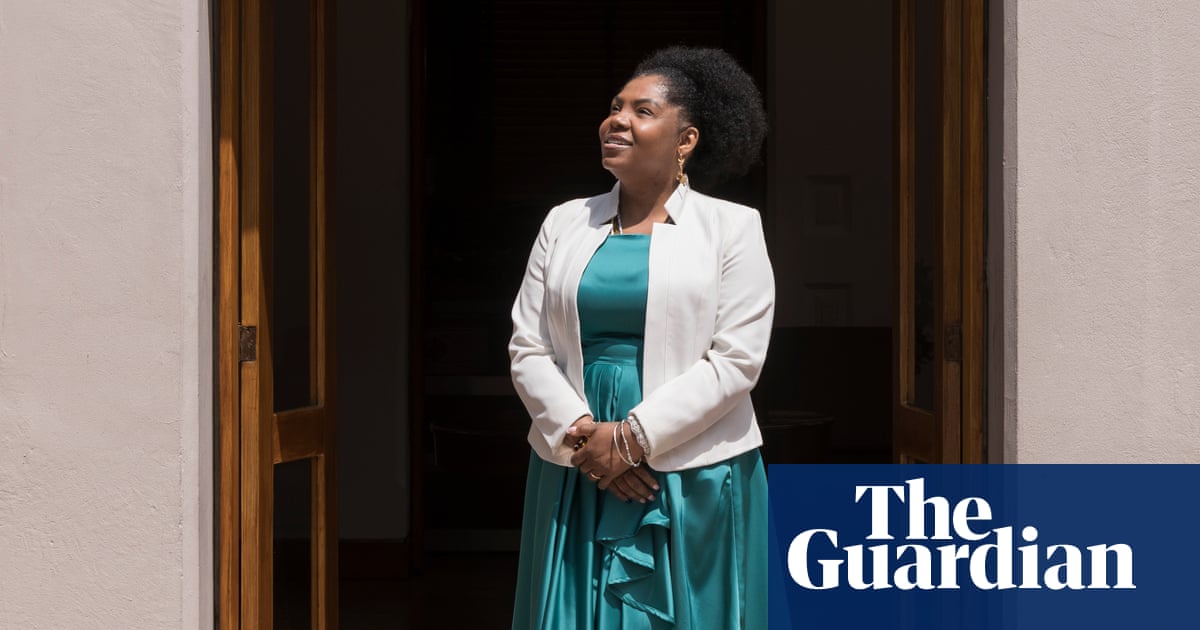

In the heart of Bogotá, Colombia’s capital, a collection of portraits at the official residence of the vice-president features the likenesses of all past vice-presidents since the nation established itself as a republic in 1886. Notably, all of these portraits depict white individuals.
This August, when the current president and vice-president conclude their terms, the wall will include the image of Francia Márquez, a groundbreaking figure who will be the first Afro-Colombian to be represented among vice-presidents. At 44 years old, Márquez is also the first Black woman to hold this position in a country where at least 10% of the population identifies as Afro-descendant.
Having been elected in 2022 alongside the left-leaning president Gustavo Petro, Márquez joins the ranks of just three Black women who have served as vice-presidents in the Americas, following Epsy Campbell Barr in Costa Rica in 2018 and Kamala Harris in the United States in 2021.
Márquez points out some parallels between her experience and those of her counterparts. “The three of us faced barriers that prevented us from taking on significant roles within our administrations. We have encountered systemic racism, regardless of whether a government is right-leaning or left-leaning,” she stated in an interview with the Guardian. She noted that Harris was sidelined by President Joe Biden, which she believes contributed to her defeat in the 2024 election.
In a candid discussion at her official residence, Márquez addressed the tensions in her relationship with President Petro, revealing that their communication has been minimal for over a year. She also spoke about the racism she has encountered throughout her four years in office, both from within the government and from outside sources. “The Colombian state embodies racism,” she asserted.
Born in the Afro-descendant mining community of Yolombó, Cauca, a region heavily impacted by Colombia’s long-standing armed conflict, Márquez became an activist at just 13 years old when a dam project threatened her community’s livelihood. In 2014, she led a group of around 80 Black women on a 350-mile march to the capital, known as the March of the Turbans, advocating for an end to illegal mining that was polluting local rivers and displacing communities.
Her efforts earned her the prestigious Goldman Environmental Prize in 2018, and although she ran unsuccessfully for Congress shortly thereafter, she later announced her candidacy for the presidency. Despite her limited political experience, she garnered 783,000 votes in a primary, finishing second to Petro, who subsequently invited her to be his running mate.
The duo’s victory marked a significant moment in Colombia’s political landscape, with Petro becoming the country’s first left-leaning president. Political analyst Ana María Ospina Pedraza remarked on this milestone, stating it represented a historic achievement for the representation of Afro-descendant communities in Colombia, which have been historically marginalized.
However, Ospina Pedraza also noted that Márquez’s leadership did not meet initial expectations. Márquez described her four years in office as “very challenging,” particularly as a Black woman in a nation characterized by conservative and racist attitudes.
She has faced racist treatment from the media, which has depicted her in derogatory ways, and has experienced intense scrutiny regarding her travel expenses as vice-president. Criticisms arose when she used a helicopter for safety reasons to travel to a private residence in Cali, as well as during her trips to African nations aimed at promoting Colombian exports, which some media outlets derogatorily labeled a “safari.”
Moreover, Márquez has encountered racism within the government itself. One of her initial initiatives was to diversify the vice-presidential staff. She recounted experiences where officials implied that Afro-descendant employees only held their positions due to her presence, suggesting they did not merit their roles. “Such comments are deeply hurtful,” she said.
Online harassment has also been a challenge for Márquez. In March, a judge cleared one of her harassers, stating that although the individual had referred to her as a “primate” in a social media post, it could not be proven that the comment was intended to incite violence or discrimination. Márquez is currently appealing this decision.
As she approaches the end of her term, speculation arises regarding her potential bid for the presidency, especially since the constitutional limitation on re-election does not apply to the vice-president. However, Márquez has indicated that she will not run for the highest office.
While she attributes her decision primarily to a pledge to serve only until the end of her term, she admits to feeling that she has not accomplished as much as she had hoped. Nevertheless, she does not hold herself accountable for this shortfall.
“Sadly, my leadership as a Black woman has posed a threat to many, preventing me from achieving more. I have heard concerns expressing that empowering Francia Márquez could lead to her presidency. This fear has resulted in my not being given the necessary resources to succeed,” she explained.
A central issue in her conflict with President Petro revolves around the creation of the ministry of equality, a promise made during his campaign. Márquez shared that her first two years were spent grappling with insufficient funding and the bureaucratic hurdles of establishing a ministry “from scratch.” Just as she was ready to present results, she claimed she was removed from her position.