
Australia is taking significant steps to keep up with the rapid transformation that drones are bringing to modern military operations.
Richard Marles, the Defence Minister, emphasized that recent conflicts in Ukraine and the Middle East have highlighted how drones can provide a substantial asymmetric advantage against larger and more costly military platforms.
“Autonomous systems have become pivotal in the conduct of warfare,” he stated.
The government has unveiled plans to invest between $12 billion and $15 billion in drone and counter-drone technologies over the next ten years, marking an increase of $2 billion to $5 billion since the unveiling of the 2024 National Defence Strategy.
At the core of the Defence Department’s drone initiatives are the prominent Ghost Bat and Ghost Shark programs, both of which represent larger uncrewed military systems. Approximately $2.2 billion to $3.1 billion will be allocated to smaller drone technologies.
This article provides an overview of these high-profile technologies and discusses whether experts believe Australia is moving in the right direction.
The Ghost Bat, as its name indicates, is designed for aerial operations. Developed for the Royal Australian Air Force (RAAF), this autonomous drone was initially introduced in 2019 under the name Loyal Wingman. The updated title reflects the Ghost Bat’s nature as an Australian native mammal known for its cooperative hunting behavior, as noted by Boeing.
The Defence Department has identified the Ghost Bat as the first military aircraft to be designed and produced in Australia in over half a century. The project has incurred costs of around $2.3 billion since its inception, including a recent $1.4 billion investment aimed at accelerating the acquisition of six fully operational units.
With a range exceeding 3,700 kilometers, the Ghost Bat is engineered to operate alongside piloted aircraft, providing protection and support to traditional military assets like F-35 fighter jets in contested areas.
Video footage from the ABC has showcased the Ghost Bat undergoing testing in a location that has not been disclosed. Marcus Hellyer, the head of research at the defense think tank Strategic Analysis Australia, expressed that having uncrewed drones like the Ghost Bat escorting high-value jets would be advantageous. “Given that F-35s cost around US$150 million each, any enhancement to our operational effectiveness is welcome,” he commented.
The government has categorized the Ghost Bat as one of its “low-cost, expendable” systems. However, Dr. Hellyer cautioned that these drones are still relatively expensive compared to the mass-produced, low-cost drones utilized in other global conflicts, with each Ghost Bat reportedly costing between $12 million and $15 million.
“Thus, we aren’t exactly discussing the kind of mass-producible technology seen in Ukraine and the Middle East,” he remarked.
The Ghost Bat is capable of performing a variety of missions, including intelligence, surveillance, reconnaissance, electronic warfare, and strike operations. It can carry adaptable payloads that can be modified for specific missions.
In total, approximately $8 billion will be designated for uncrewed aerial systems.
Another remotely piloted aircraft receiving investment is the MQ-4C Triton, developed in the United States. This larger drone boasts a range of about 15,000 kilometers and is primarily utilized for maritime patrol, benefiting from its ability to remain airborne longer than traditional piloted aircraft.
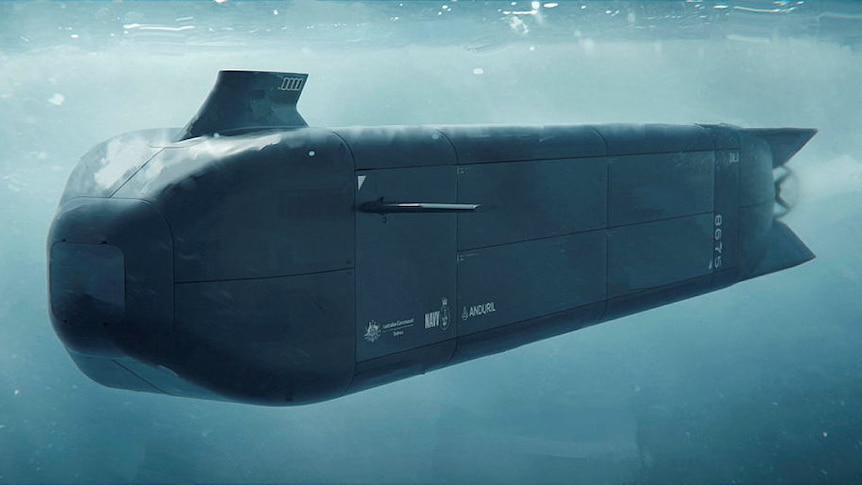
On the underwater front, the Ghost Shark is classified as an extra-large autonomous underwater vehicle (XLAUV) and is designed to operate in maritime environments. However, specific details regarding its size, range, speed, and endurance have not been publicly disclosed. Jennifer Parker, a former naval officer and maritime security expert at the Australian National University’s National Security College, explained that the lack of information is intentional to keep its capabilities hidden from potential adversaries.
The development of the Ghost Shark commenced in Australia in 2022 for the Royal Australian Navy, with an investment of $1.7 billion announced last year for a fleet of these underwater drones, although the exact number to be acquired has not been specified.
Equipped for intelligence, surveillance, reconnaissance, and strike missions, the Ghost Shark can also carry various payloads that can be easily reconfigured, as noted by the manufacturer, Anduril. While the specific types of weaponry have not been disclosed, it is assumed that the Ghost Shark can deploy torpedoes, giving it the capability to engage ships and submarines.
Parker believes that these drones will enhance the navy’s operational capabilities. While they will not replace crewed submarines, they will expand the range of tools available for underwater surveillance. “Investing in larger uncrewed underwater systems like the Ghost Shark is a strategic decision,” she stated. “They provide Australia with greater reach and endurance in maritime operations without the accompanying costs and risks of deploying crewed submarines.”
Over the next decade, approximately $4.8 billion to $5.8 billion will be allocated to developing autonomous and uncrewed underwater warfare capabilities.
On a smaller scale, the navy has been in the process of acquiring numerous additional drones…