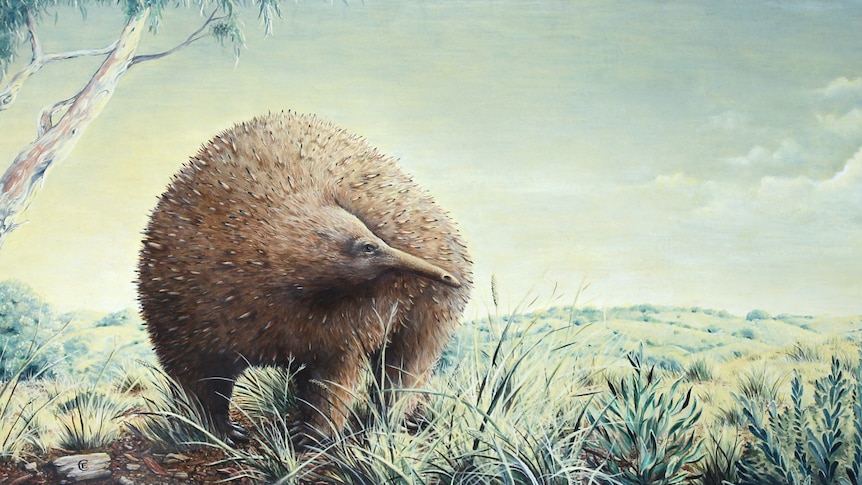

Researchers have utilized a fossil discovered in a Gippsland cave nearly 119 years ago to demonstrate that giant echidnas inhabited Victoria during the Ice Age. This significant finding enhances our understanding of the region’s ancient megafauna and fills a crucial gap in the known distribution of the species.
The fossil, a partial skull of the extinct giant echidna Megalibgwilia owenii, indicates that these creatures once roamed alongside some of Australia’s most remarkable megafauna. It was rediscovered in the collections of Museums Victoria, where it has been stored since its initial discovery in 1907 at Foul Air Cave, located over four hours east of Melbourne.
Tim Ziegler, the vertebrate palaeontology collection manager at Museums Victoria, emphasized the importance of this discovery in both revisiting and revising our historical understanding of the region. “It feels really special to do the fundamental work of building our knowledge and our understanding of just what Victoria was in deep time,” Dr. Ziegler remarked.
This identification marks the first confirmed evidence of the giant echidna’s existence in Victoria, bridging a distance of more than 1,000 kilometers that previously separated known fossil sites in South Australia and New South Wales. “But until now, you know, this is a missing piece of the puzzle,” Dr. Ziegler explained. “And in fact, just this one fossil, preserved by random chance in a pitfall trap and then discovered almost by random chance as well — it fills a gap in this long-beaked echidna’s range across the entire continent.”
During the Pleistocene epoch, tens of thousands of years ago, this now-extinct echidna could reach lengths of up to a meter and weigh as much as 15 kilograms, comparable to a small child. Its long, straight beak was adapted for digging through hard soils in search of insects. The presence of this species adds to a growing understanding of the diverse and vastly different landscape of Gippsland, which was once inhabited by enormous marsupials and formidable predators.
According to Dr. Ziegler, the area surrounding the Buchan Caves was once home to large marsupials weighing more than a ton and predatory creatures akin to jaguars, none of which have living relatives today. The limestone caves, situated on Krauatungalung Country near Buchan, are recognized as a rich fossil site, yet researchers believe that their full narrative is still being uncovered.
“It’s a very special place; the caves at Buchan are like a natural time capsule for these skeletal remains,” Dr. Ziegler stated. “It’s one of the most diverse and abundant fossil sites in caves in southeastern Australia.”
The rediscovery of the fossil was facilitated by modern techniques such as 3D scanning and detailed anatomical comparisons, but its origins date back to early 20th-century expeditions when naturalists first explored the cave system. Dr. Ziegler finds value in the connection between past and present, noting, “The special thing for me as well, working in a place like Buchan, is that the history is so important too.”
This discovery underscores the ongoing scientific significance of museum collections, where specimens gathered over generations can provide new insights when revisited. “Nothing is ever forgotten in a museum collection,” Dr. Ziegler remarked. “But it’s our job to bring that meaning back out again and return it to the community.”
Researchers anticipate that this finding may lead to renewed efforts to investigate both historic collections and unexplored cave systems, with the aim of uncovering additional evidence of the giant echidna’s existence. “So we’re really filling in the picture, finding pieces of the jigsaw to rebuild this Ice Age megafauna of our past,” Dr. Ziegler added.
With much of Victoria’s fossil record still largely unexplored, he noted that the next significant discovery could emerge from virtually any location, whether it be deep underground, within dusty archives, or hidden in plain sight, just as this fossil was for over a century.