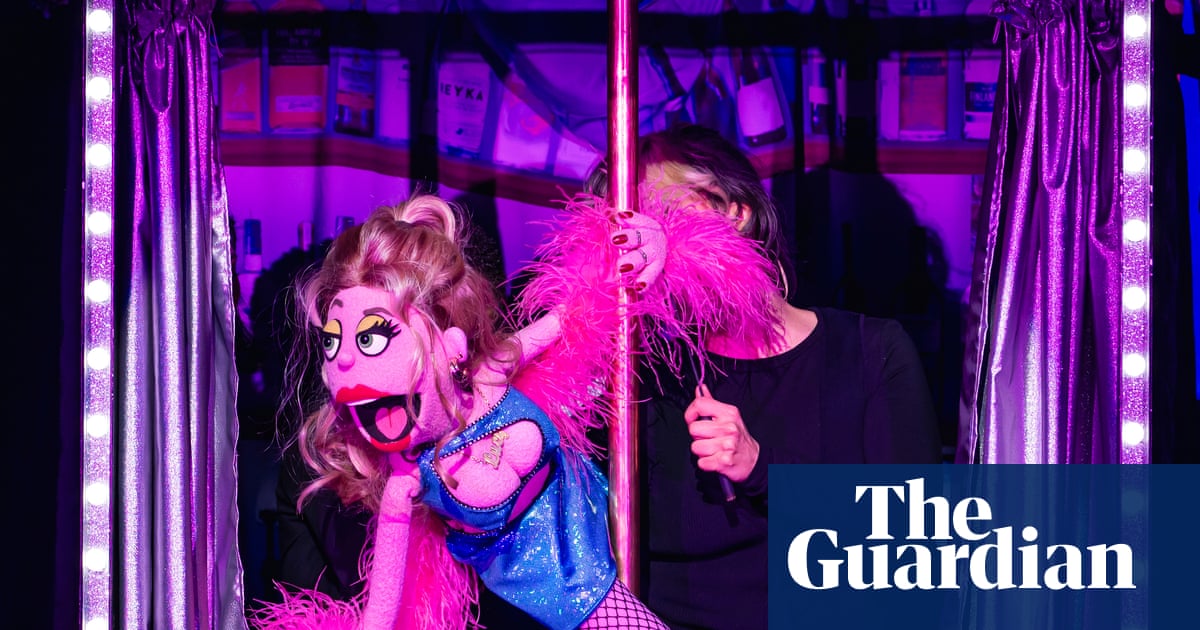

Rehearsals for a West End musical often come with their own set of challenges, but today’s issues are particularly unique, centering around a well-known performer’s lack of rigidity. Actor Noah Harrison expresses frustration during rehearsals, commenting, “This one’s too floppy,” as he struggles to execute the choreography with his dance partner, which is, amusingly, a felt puppet. The production team decides it’s time to replace this soft character with a more robust alternative, and there is no shortage of options, with numerous Sesame Street-style puppets lining the rehearsal space, all waiting for their moment to shine.
The production in question is Avenue Q, the acclaimed musical that transitioned from Broadway to London, featuring music by Robert Lopez and Jeff Marx, alongside a book by Jeff Whitty. This revival marks the 20th anniversary of its debut in the West End. Upon its initial release, Avenue Q’s combination of colorful puppets, relatable adult themes such as sexuality, racism, housing issues, and existential angst, along with its bold musical numbers, was groundbreaking. The show received several Tony Awards, including Best Musical, Best Book, and Best Score. Now, as the audience it originally targeted has matured, it presents an opportunity for a new generation to engage with its narrative.
Director Jason Moore, who originally directed the show two decades ago, returns to the helm at the age of 55. “It’s unusual for a director to revisit a project they worked on previously,” he notes, reflecting on his journey from a young up-and-coming director to his current role.
This revival is being described as “a love letter to the original,” suggesting that it offers something beyond a mere re-staging. “It’s not a reinterpretation,” Moore emphasizes, adding that he has no intention of adopting a radically different approach like that of renowned theater director Ivo van Hove. Instead, he sees this revival as a chance to make necessary adjustments to the show.
One change that might come to mind is the inclusion of the character Gary Coleman, a nod to the star of the 1980s sitcom Diff’rent Strokes, which may be lost on younger audiences. However, Coleman remains a part of the cast, with additional context provided for modern viewers. The updates Moore refers to primarily concern the show’s scale and technical execution, which have been enhanced, as well as its cultural sensitivity, an area that will be addressed further.
For this revival, Moore sought specific qualities in his young cast, stating, “One of Avenue Q’s core elements is its sense of innocence. I look for actors who possess that hopeful, expectant quality typical of their early twenties.” He also emphasized the importance of puppeteering skills, acknowledging that many traditional acting instincts do not translate to this unique form of performance.
Actor Emily Benjamin, who was once a teenage fan of Avenue Q and later played Sally Bowles in the West End, is now performing a poignant ballad as Kate Monster, a puppet character who is heartbroken after being dumped by Princeton, the show’s protagonist. “Puppetry requires a sort of ego death for an actor,” Benjamin explains. “You have to set aside the desire to be the focal point of attention.” Nonetheless, she sees advantages in this approach, stating that having a puppet to focus on alleviates her anxiety about singing, allowing her to perform with greater ease.
Puppet director Iestyn Evans describes the unique style of puppetry required for Avenue Q, which brings television-style animation to the stage, with the puppeteers visible to the audience. “You have puppet characters, humans operating them, and humans interacting with both,” he outlines. This complexity is further compounded by lyrics and attitudes that may not align with contemporary sensibilities, a concern raised by Benjamin, who notes that discussions have taken place among the cast regarding songs like “Everyone’s a Little Bit Racist” and “If You Were Gay.” Both she and Moore acknowledge the show’s underlying good intentions while recognizing that audience sensitivities have evolved, necessitating some adjustments in response to modern audiences.
Moore remains optimistic about the musical’s continued relevance, stating, “Young people are always searching for meaning in their lives. The themes of how to find purpose are timeless.” The question remains: can the antics of these puppets, whether floppy or otherwise, inspire a new generation to engage with these themes?
“They might just be simple cloth creations,” Benjamin concludes, “but often, people can empathize more readily with an inanimate character than with a human being sharing a similar story.”
Avenue Q is currently showing at the Shaftesbury Theatre in London, running until August 29.