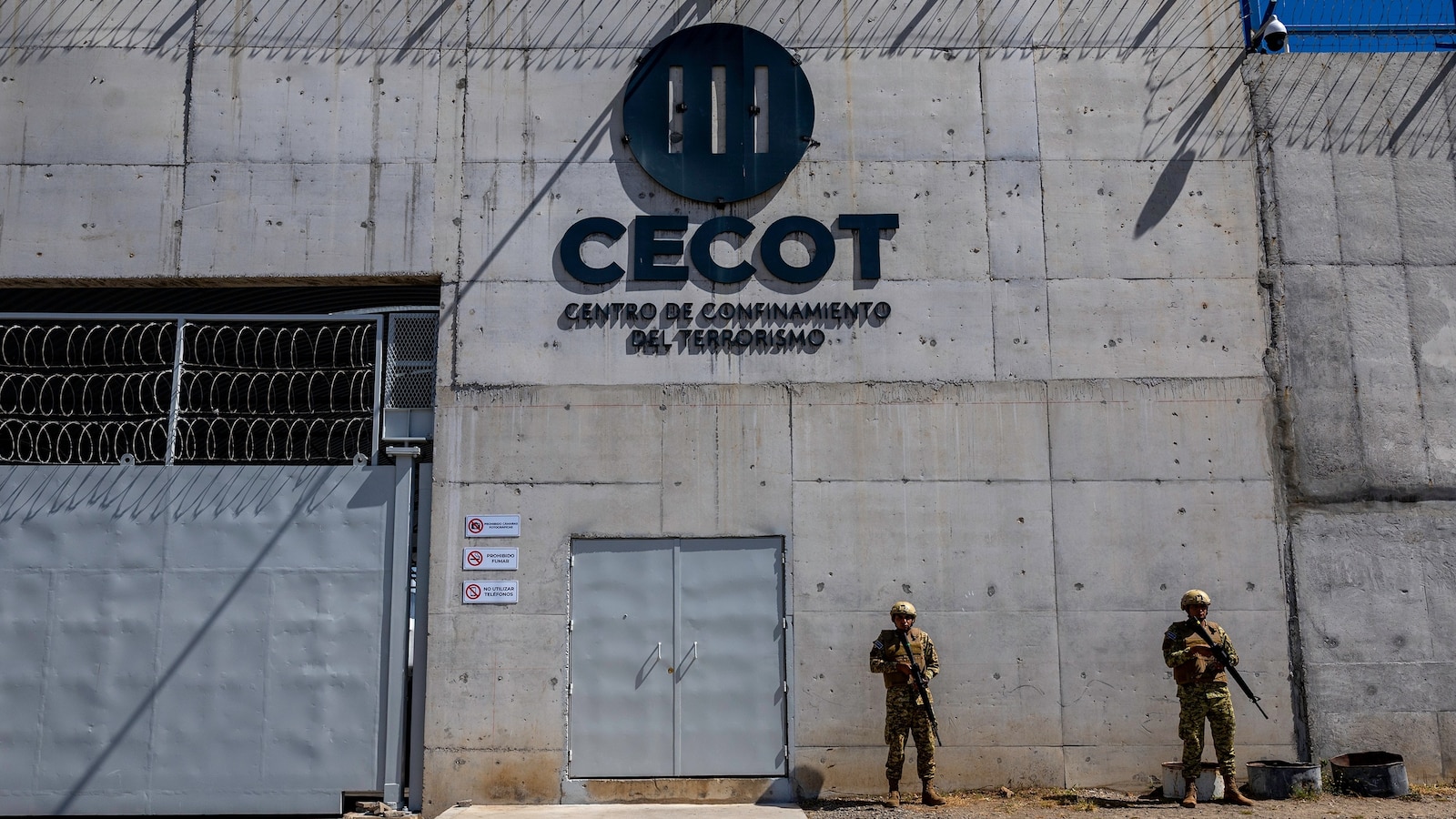

A federal appeals court has put a stop to a criminal contempt investigation involving former Homeland Security Secretary Kristi Noem and other officials, related to the deportation of over 200 Venezuelans to El Salvador’s CECOT mega-prison last year. This marks the second occasion within a year that the inquiry has been suspended.
A split panel from the D.C. Circuit Court of Appeals decided to terminate the inquiry, stating that the investigation into whether these officials intentionally violated a court order during the deportations “intrudes on the independence” of the executive branch.
In March 2025, the Trump administration had cited the Alien Enemies Act, a 18th-century wartime statute, to justify the deportation of two flights filled with suspected gang members. They claimed that the Venezuelan gang Tren de Aragua operates as a “hybrid criminal state” that poses a threat to the United States.
U.S. District Judge James Boasberg had issued a temporary restraining order, instructing that the planes be redirected. However, attorneys from the Justice Department argued that his verbal instructions were inadequate, leading to the deportations occurring as scheduled.
Following this, Judge Boasberg initiated contempt proceedings against the government for allegedly ignoring his order and determined that “probable cause exists to find the government in criminal contempt.” However, the same appeals court had previously halted this inquiry last year.
When Judge Boasberg sought to proceed with his investigation within the framework allowed by the court’s previous order, the Trump administration filed an interlocutory appeal aimed at stopping the investigation entirely.
In the order issued on Tuesday, Judge Neomi Rao, one of the two judges appointed by Trump on the panel that favored the government, stated, “The district court seeks to investigate high-level Executive Branch discussions regarding national security and diplomatic issues.” She criticized the proceedings as a clear misuse of discretion, noting that the district court’s order did not specifically address the transfer of custody of the plaintiffs and thus lacked the necessary clarity to justify criminal contempt based on that transfer.
Judge J. Michelle Childs dissented, arguing that Judge Boasberg should be allowed to conduct fundamental fact-finding regarding the deportations.
She emphasized that while there may be valid concerns over an inquiry into the actions of potential contemnors who might have disregarded a court order, it does not necessitate that the court intervene to terminate a criminal case before it commences, even if it involves the Executive Branch.
In a strongly worded dissent, she asserted that “the fate of our democratic republic” hinges on the courts’ ability to investigate and penalize contempt effectively.
She cautioned, “Without the contempt power, the rule of law is merely an illusion, a concept built on unstable foundations.”
Lee Gelernt, the lead attorney for the Venezuelan nationals, remarked, “This ruling is a setback for the rule of law. Our legal system relies on the executive branch, including the president, adhering to court orders. In this situation, it is clear that the Trump administration deliberately flouted the court’s order.”
Ultimately, the Venezuelan individuals were returned to their home country from CECOT in a prisoner exchange last July.
This report includes contributions from Armando Garcia of ABC News.