
For a segment of the pop music audience, adoration for divas often entails a willingness to embrace their particular brand of eccentricity. Thus, when Anne Hathaway, portraying the lead character in David Lowery’s film Mother Mary, asserts that her latest single “Spooky Action” explores Einstein’s concept of a “transubstantiation of feelings,” I dismissed the snickers from those seated nearby. It reminded me of the times Lady Gaga spoke about her art in terms reminiscent of a reverse Warholian explosion—a pop icon unafraid to engage with lofty, abstract ideas. However, my initial goodwill diminished as I recognized that both the character of Mother Mary and the film itself lacked a vital trait essential for any contemporary pop star: self-awareness.
Mother Mary, once a celebrated music figure, is now striving for a resurgence following an enigmatic incident that has sidelined her career. She appears to be tormented and is facing a fashion crisis, struggling to find an outfit for her upcoming performance. Just three days before her pivotal show, she arrives at the gothic estate of fashion designer Sam Anselm (played with flair by Michaela Coel), drenched from the rain and looking disheveled, pleading for a costume that “feels like me.” Sam has moved on from their past collaboration and possibly their romantic involvement, and she harbors a deep disdain for Mary. “You are a carcinogen, you are a tumor,” Sam declares in an amusingly foreboding voiceover, stating that “the bile is rising.”
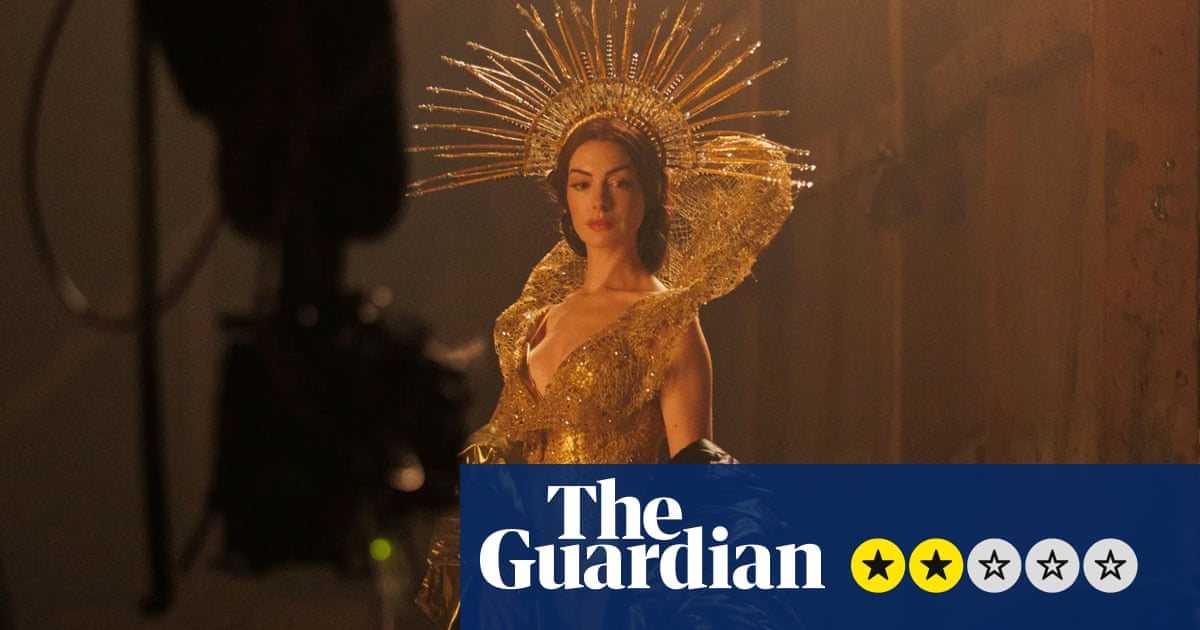
Despite her animosity, Sam feels an inexplicable attraction to Mary and agrees to design a new stage outfit. Amid a whirlwind of fabric and a few deft cuts, she begins to create a look for Mary from her stash of chiffon hidden away in a rundown barn. Mary is open to any idea except for the color red, as she is plagued by a demon associated with that hue. This sets the stage for a bizarre yet visually striking two-hour journey filled with grand performances, unsettling body horror, and captivating visuals that blend surrealism reminiscent of Dalí with the polished aesthetics of contemporary pop concerts.
Hathaway’s previous foray into musical cinema, Les Misérables in 2012, earned her an Academy Award. While it’s unlikely that similar accolades will come to Lowery’s often perplexing stylistic endeavor, she convincingly embodies the pop sensation in flashback sequences, engaging in slick choreography with dynamic backup dancers under blue lighting for a serpentine performance of the FKA twigs-penned “My Mouth Is Lonely For You.” The film’s soundtrack also features contributions from Charli XCX and Jack Antonoff. Given that much of the film centers on the tense dialogue between Mary and Sam in the designer’s “Miss Havisham”-esque barn, a significant portion of the reported $100 million budget appears to have been allocated to the extravagant concert-style scenes. When compared to recent films like Trap and Smile 2, which also attempted to showcase pop concert elements, Mother Mary stands out in terms of its theatricality.
While Hathaway shines in her more ostentatious role, Coel’s portrayal of Sam captivates with its subtlety. Her character exudes a distant, icy demeanor akin to the Dickensian figure she references. Like Mary, Sam’s dialogue is laden with philosophical undertones, but she delivers the most humorous lines and navigates the bleakness of Lowery’s screenplay with wit. This serves as a necessary counterbalance to Hathaway’s earnest interpretation of Mother Mary, which often feels overly dramatic. The script does not provide much for Hathaway to work with; at one point, when Sam inquires if Mary wants to “look like a knife,” Mary retorts, “I want to have a point,” prompting one to wonder if Lowery himself ever contemplated a similar question.
It is refreshing when the narrative shifts focus from Mary and Sam’s introspective exchanges to the supporting cast. FKA twigs immerses herself in a quasi-erotic dance with Mary during a surreal flashback involving a Ouija board, while Sian Clifford, known for her role in Fleabag, delivers comedic reactions as Mary’s frantic manager. Other well-known cast members, however, are underutilized: Hunter Schafer’s role feels unnecessary, and Kaia Gerber is given limited opportunities to showcase the comedic timing she displayed in Bottoms.
Adding to the disappointment is the film’s tendency to sidestep more profound themes that could have enriched its narrative. Marketed as a “psychosexual pop thriller,” it exhibits a surprising reticence regarding its central queer relationship, appearing almost prudish in an era that celebrates sapphic representation. Additionally, one may ponder the personal experiences that shaped Sam’s character, who is described as working-class in production notes but speaks with an aristocratic accent, viewing fashion as a form of protective armor akin to Joan of Arc’s. A more astute film might have explored the parallels between Hathaway the actress and Mother Mary the pop icon, delving into how years of fame can impact one’s mental health.
Lowery’s film has moments of brilliance, yet many viewers will recognize his influences too readily. A sweeping backstage shot of Mary between performances echoes a scene from The Cook, the Thief, His Wife & Her Lover, a questionable reference for a film that falls short of Peter Greenaway’s masterful artistry. Furthermore, an early sequence featuring alternating close-ups of the leads feels overtly reminiscent of the iconic scenes between Liv Ullmann and Bibi Andersson in Persona, highlighting that Lowery is not in the same league as Bergman.
As my viewing concluded, I overheard a fellow attendee characterize Mother Mary as a remarkable “gay g…”