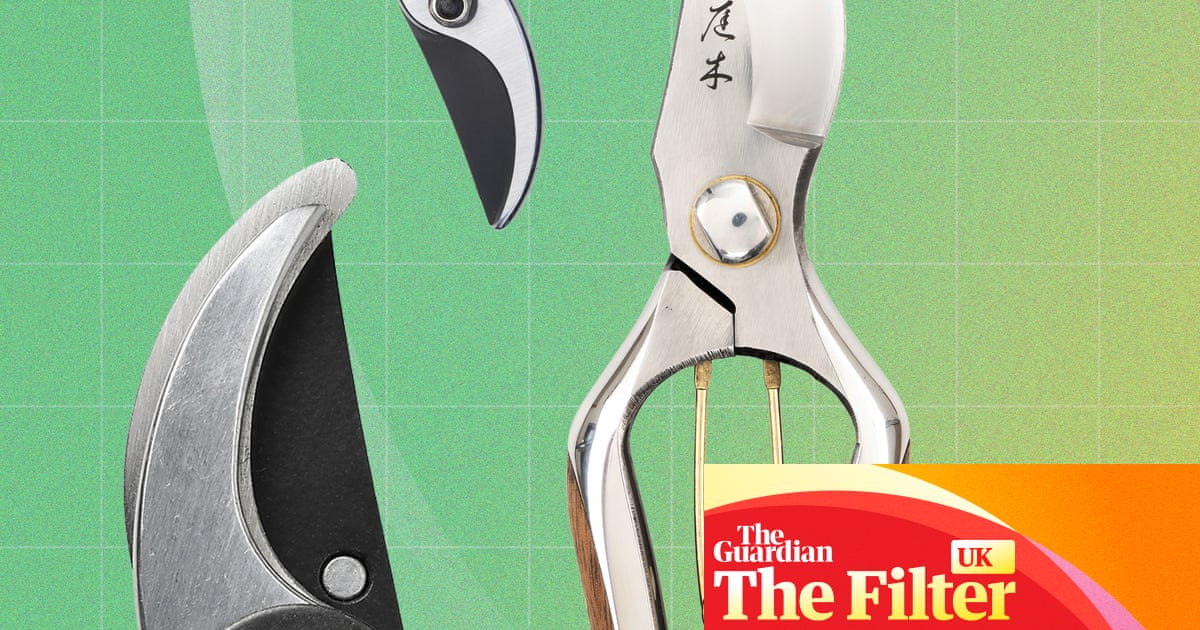

Secateurs are regarded as the most essential tool in a gardener’s collection, akin to the importance of a trowel for bricklayers. As time goes on, these tools become familiar and comfortable, fitting naturally in the hand and proving invaluable for various gardening tasks, such as pruning shrubs, trimming perennials, cutting twine, and preparing floral arrangements.
Our journalism at The Guardian operates independently. If you purchase through an affiliate link, we may receive a commission. Find out more.
Secateurs primarily come in two varieties: bypass and anvil. This article focuses on the bypass type. When properly maintained, a high-quality pair can last for many years, leading gardeners to develop strong preferences for specific models.
Last year, I tested a variety of bypass secateurs in my garden for the Filter and later donated them to the Garden Museum in London, where they have been put to good use by volunteers in the museum’s gardens. As the head gardener, I took the opportunity this spring to perform an annual maintenance check, which included a thorough cleaning, sharpening, and evaluation of each pair’s durability and functionality. After scrubbing them with soapy water and a stiff brush, I dried and wiped them down, then applied Niwaki’s Mini Clean Mate to remove rust and sap, sharpened the blades using a whetstone, and lubricated them with WD-40.
So, how did they perform? The pair I designated as the best overall—Burgon & Ball’s RHS-endorsed secateurs—have shown remarkable resilience. They are easy to clean, and their sturdy structure exhibits minimal signs of wear. The Okatsune 103 secateurs, while showing some discoloration from dirt buildup, continue to cut as smoothly as when they were new. The lock mechanism on the Spear & Jackson Razorsharp Advantage secateurs required some cleaning and oiling to restore its smooth operation, but it remains intact, and the blade is notably sharp.
This spring, I assessed an additional seven pairs to complement the twelve I evaluated the previous year. Below are the ten best secateurs from my findings:
- Best overall: Burgon & Ball bypass secateurs
- Best for tough stems: Felco Model 2
- Best budget option: Spear & Jackson Razorsharp Advantage bypass secateurs
- Best for comfort: Darlac compact plus pruner
- Best for repetitive use: Felco Model 7 with rotating handle
- Best premium choice: Niwaki Kurumi pruners
With nearly twenty years of experience as a professional gardener, I have utilized secateurs for a wide range of tasks, from intricate pruning to more unconventional uses like opening paint cans. I understand the demands placed on these tools and what features contribute to their durability. My role as head gardener at the Garden Museum involves various responsibilities, including shaping shrubs and preparing flowers for indoor displays.
With the arrival of spring, it was time to prune perennials and grasses in anticipation of new growth. I began with smaller tasks, clearing away old aster stems, unattractive libertia leaves, and brittle tufts of purple moor-grass.
When choosing secateurs, factors such as cost, ease of maintenance, and aesthetics are important, but I prioritize four key features:
The first is sharpness. A common source of frustration with secateurs is their inability to cleanly cut through delicate plant materials like slender flower stems or the fibrous textures of ornamental grasses. The second factor is their capacity to cut through thicker stems, such as small branches from shrubs, roses, or the tough stalk of a sunflower. This depends on both the blade and the overall design of the secateurs, which I tested against various hardy materials in my garden.
Comfort is the third consideration; the handles play a crucial role. The grip’s feel is influenced by the material, whether it’s plastic, rubber, or metal, and comfort is further determined by the shape and thickness of the handles.
The fourth feature is the locking mechanism. An easily operable locking system is essential to prevent accidental injuries from open blades, which can pose a hazard if knocked against or if a finger gets caught. Most secateurs are designed with a thumb-operated catch, although some models may have a latch at the base of the handles. The convenience of a reliable lock is significant, as it is frequently engaged between cuts.
I also considered visibility as an additional factor; secateurs can easily be misplaced when set down or carelessly stored. Bright colors can aid in locating them, so I had my six-year-old assist in a playful test of losing each pair around the garden, all under careful supervision. My wife timed how long it took me to find each one.
Despite its alloy handles and carbon-steel blade, I was surprised to find that Burgon & Ball’s secateurs, which are endorsed by the Royal Horticultural Society, outperformed others in my tests. They are sharp, durable, comfortable, and attractively priced, positioning them well among premium options.
What stands out about these secateurs is their seemingly ordinary appearance, which resembles many other brands with their long shafts, rotating thumb clasps, volute springs, and contoured handles. However, the craftsmanship is exceptional: in the hand, they feel lightweight, well-balanced, and comfortable, while the blade efficiently cuts through dense grass and larger stems. For materials over 2cm in diameter, some force may be necessary, or one might consider using a lopper instead.