
The increasing population of feral cats in outback Queensland has led local councils to implement bounty programs aimed at controlling their numbers. These initiatives, however, have prompted calls for financial assistance from both state and federal governments, as local resources dwindle. Experts caution that these bounty schemes may not yield the desired results that councils anticipate.
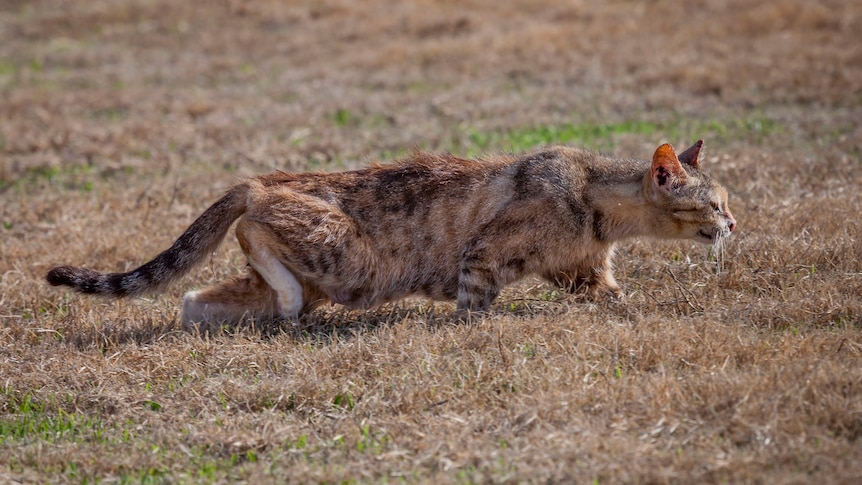
As one drives through the remote areas of Queensland, a fleeting figure crosses the headlights—too fast to be a wallaby, it is likely one of the nearly one million feral cats estimated to inhabit the state. Following a rat plague two years ago, feral cat numbers have surged, prompting more councils to consider bounties as a control measure.
In the Richmond shire, situated approximately 400 kilometers east of Mount Isa, the introduction of a $10 bounty last August has led to the culling of 6,000 feral cats in just four months. Mayor John Wharton remarked on the unprecedented scale of this issue, noting that previous annual totals were far lower.
“In earlier years, we might have managed a couple of thousand cats a year, but to achieve that in just four months is astonishing,” he stated, asserting the success of the bounty program, which is entirely funded by the Richmond council. Wharton expressed a desire to see how other levels of government plan to address the feral cat crisis, emphasizing the detrimental impact these animals have on local wildlife.
Other councils, including Cloncurry, Etheridge, Mount Isa, and Boulia, have also adopted similar bounty programs, offering rewards that range from $10 to $25 per cat. The Threatened Species Recovery Hub reports that feral cats annually kill 3.2 million mammals and 1.2 million birds across Australia, in addition to carrying diseases that pose risks to both humans and livestock.
Matt Fontaine, a macropod harvester from Julia Creek, noted that he has witnessed feral cats preying on endangered species, such as the Julia Creek dunnart. Fontaine recounted an incident where he saw a cat with a dunnart in its mouth, highlighting the urgent need for action.
Fontaine stated that in optimal conditions, he could observe up to 800 cats in a single night. However, without a bounty, he finds it financially impractical to hunt them, as the costs associated with fuel and ammunition are significant.
In 2024, the federal government unveiled a national strategy aimed at curbing extinctions caused by feral cats, focusing on protecting at-risk species and facilitating pet desexing and micro-chipping. Nevertheless, Mount Isa councillor James Coghlan expressed skepticism about the effectiveness of this approach, emphasizing that it places an unreasonable burden on local councils to tackle a problem of national magnitude.
While a spokesperson for Queensland’s Primary Industries Minister Tony Perrett refrained from confirming whether a state-funded bounty is under consideration, they indicated that “all options are on the table.” Conversely, a representative from the federal Department of Climate Change, Energy, the Environment and Water expressed that bounties are not a viable solution, advocating instead for a strategic approach that concentrates on protecting vulnerable species rather than merely reducing feral cat numbers.
Threatened Species Commissioner Fiona Fraser noted that, rather than funding local government initiatives, the federal government has invested significantly in programs designed to save native species and preserve natural heritage.
Research has cast doubt on the effectiveness of bounties; a 2016 report from the Natural Resource Commission and a 2017 study by The Wildlife Society indicated that these programs have minimal impact on overall feral cat populations. Ecologist John Woinarski from Charles Darwin University stated that historically, bounties have proven ineffective, and while recreational hunting may help mitigate cat impacts under certain conditions, uncoordinated and sporadic efforts will not lead to improved outcomes for wildlife.