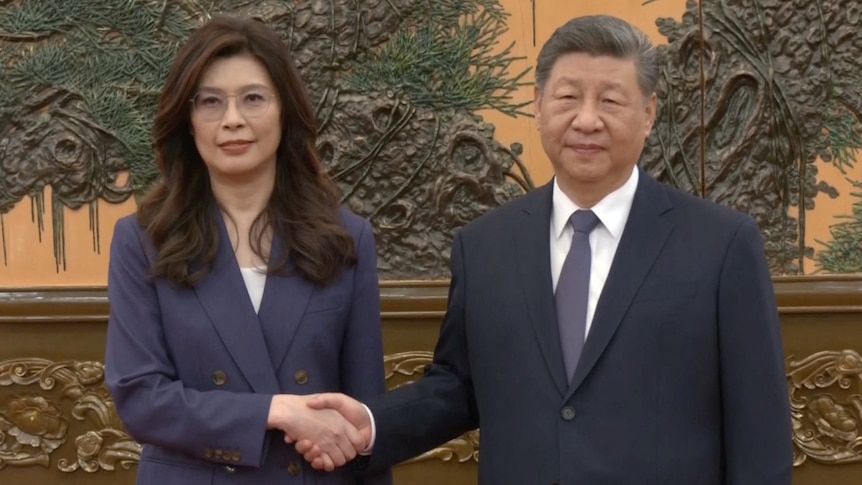

This week, two significant events occurred in China that have not been witnessed in a decade. The leader of Taiwan’s opposition party, Cheng Li-wun, made a visit to the mainland and had a meeting with President Xi Jinping. This encounter comes at a pivotal moment for cross-strait relations as it precedes an anticipated meeting between U.S. President Donald Trump and his Chinese counterpart in May, amidst a stalled defense funding proposal in Taiwan’s parliament.
Cheng’s visit also arrives before local elections in Taiwan later this year, which could influence the presidential election scheduled for 2028. Cheng, who has a background as a talk show host and previously served as a member of the ruling Democratic Progressive Party (DPP), was elected chair of the Kuomintang (KMT) party late last year, a move that was quickly welcomed by Xi Jinping. However, her tenure has not been without controversy, as she has made statements attributing the war in Ukraine to NATO and has characterized Russian President Vladimir Putin as a democratically elected leader rather than a dictator.
In the 1990s, Cheng advocated for Taiwan’s independence from China, but by the early 2000s, she had shifted her position to oppose this stance completely. Cheng has maintained this perspective ever since. Upon her arrival in Nanjing, she articulated that the purpose of her visit was to demonstrate to the world that Taiwan is not the only entity seeking peace. “I believe that through this journey for peace, everyone is even more eager to see the sincerity and determination of the CPC Central Committee to use peaceful dialogue and exchange to resolve all possible differences between the two sides,” she stated.
Cheng also emphasized the bipartisan agreement on the 1992 Consensus during her visit. This framework suggests that both Taiwan and China acknowledge the existence of “one China,” although the practical implications are much more complicated. Beijing views Taiwan as a province of China, while Taiwan functions as an independent democracy. The ruling DPP is committed to Taiwan’s independence but has not engaged diplomatically with China since 2016. Meanwhile, Beijing has labeled Taiwan’s President Lai Ching-te as a “separatist,” accusing him of wanting to transform Taiwan into a “powder keg.” Neither government recognizes the other officially.
Cheng’s visit marks the first time in ten years that a sitting Taiwanese opposition leader has traveled to China. She expressed her hope that the trip would “plant seeds of peace” and urged for collaboration to “avoid war.” During her meeting with Xi, she suggested that both sides should rise above political disputes and seek a systemic solution to prevent conflicts, aspiring for the Taiwan Strait to become a model for peaceful conflict resolution globally.
In response, President Xi expressed confidence that the people of both sides would achieve unity. “The general trend of compatriots on both sides of the strait getting closer, edging nearer and becoming united will not change. This is an inevitable part of history,” he remarked, adding that all individuals across the strait are Chinese and share a familial desire for peace, development, and cooperation.
Experts suggest that Cheng’s visit has been in the works for years. KMT members have regularly traveled to China, including a meeting between Xi and former Taiwanese President Ma Ying-jeou in 2023. Cheng’s trip comes shortly after the KMT blocked a substantial $40 billion defense budget aimed at enabling Taiwan to procure American weapons for self-defense against potential Chinese aggression. The KMT opposes the package, arguing that Taiwan cannot afford it.
The issue of U.S. support for Taiwan remains contentious, with Xi cautioning Trump in February about the need for the U.S. to manage arms sales carefully. A delegation of U.S. senators has visited Taiwan to encourage the passage of the defense budget, which is currently stalled in the opposition-controlled parliament.
Mark Harrison, a political expert from the University of Tasmania, noted that the timing of Cheng’s visit is strategic. “Beijing’s goal is to isolate Taiwan from the U.S., and they will likely use Cheng’s visit to further this agenda,” he commented. He suggested that Beijing might attempt to convey a message to the U.S. regarding the willingness of certain Taiwanese political factions to negotiate, thereby questioning the necessity of U.S. commitments to Taiwan. While such arguments may not significantly alter U.S. policy, they could be leveraged in discussions to reduce American commitments.
Wen-Ti Sung, a fellow at the Atlantic Council’s Global China Hub, indicated that Cheng’s visit might help alleviate tensions regarding U.S. arms sales to Taiwan ahead of Trump’s meeting with Xi. He suggested that it could pave the way for Beijing to host a summit with Trump focused on shared business interests rather than geopolitical conflicts. “Beijing would much rather engage with Trump the businessman than Trump the geopolitical strategist,” he noted.
Furthermore, this visit takes place just before Taiwan’s local elections at the end of the year, which could have implications for the upcoming presidential race in 2028. Harrison pointed out that Beijing would likely view Cheng’s visit as an opportunity to undermine Taiwan’s elected government and intervene in the island’s political dynamics.