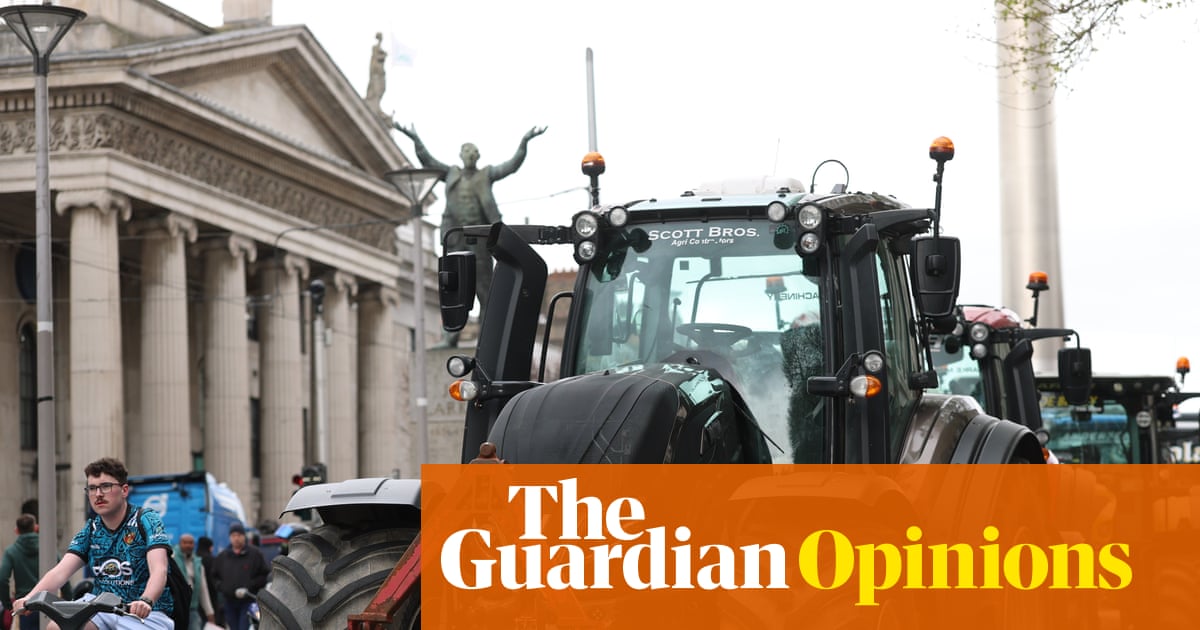

Seated in a bright lime green CLAAS tractor, a young man named Dylan shared that he was the second tractor to reach O’Connell Street, the primary thoroughfare in Dublin, for a series of fuel protests that would paralyze Ireland for nearly a week. The tractor ahead of him, owned by his employer, displayed a message stating “No Farms, No Food.” The 19-year-old, an agricultural contract worker, was accompanied by two friends, aged 16 and 17, who came out to support him. Dylan had spent several nights in the tractor, enduring the frigid April temperatures, alongside numerous farmers, fishermen, and truck drivers whose vehicles lined both sides of the street.
“It’s profit over people,” Dylan remarked, reflecting on the grievances of protesters regarding the government imposing a 60% tax and duty on fuel amidst a crisis. “This impacts everyone—it’s affecting our businesses, and it’s affecting you if you own a car or need to heat your home. If we don’t get a resolution, it will ultimately raise food prices, making essentials unaffordable for many.”
The ongoing conflict in Iran, which the Irish president has rightly condemned as illegal, shows no signs of resolution. The consequent surge in oil prices has highlighted Ireland’s critical reliance on fossil fuels, road transport, and an unstable global supply chain, revealing the shortcomings of successive governments in planning for a transition to renewable energy.
Over the course of six days, fuel protesters obstructed motorways and ports, and laid siege to Ireland’s sole oil refinery in County Cork, as well as fuel depots in Limerick and Galway. By Friday, petrol stations began to run out of fuel. While government officials condemned the protests as “incorrect” and a threat to national security—prompting the justice minister to suggest military intervention—what I observed on the streets of Dublin was largely solidarity and support. A local woman arrived with sandwiches, encouraging the young protesters to “keep going.” A recent poll indicated that 56% of the public sympathized with the demonstrators.
O’Connell Street is named after Daniel O’Connell, a 19th-century nationalist recognized as “the liberator,” who organized large-scale protests advocating for peaceful reform. Tractors adorned with tricolors were parked outside buildings still bearing the marks of bullets from the 1916 Easter Rising against British rule, an act of direct action that was initially met with public disapproval due to its disruptive nature. One truck displayed a coffin painted with “RIP Ireland,” with placards in its front window announcing “Easter 2026.”
Yet, I listened to a caller on a national radio station who acknowledged the struggles people were facing—having difficulty heating their homes or worrying about their futures—but suggested that protests should adopt a less disruptive approach, such as occupying just one lane of a road. Others raised valid concerns about vulnerable individuals unable to reach critical medical appointments due to the blockades. However, the protest gained attention and made international headlines precisely because of its direct actions. The notion that grassroots protests must be passive and led by “recognized” organizations, or that they should always present clear and coherent goals, reflects a limited understanding of democratic expression.
In the early hours of Sunday, as mounted police and riot units approached, the protesters agreed to vacate O’Connell Street peacefully. After several days of silence towards the demonstrators, the government announced concessions totaling €500 million, in addition to a previous package of €250 million, which included reductions in excise duty and possible postponement of a carbon tax increase. The impact of direct action was evident.
A no-confidence vote scheduled for Tuesday is unlikely to result in the ousting of the coalition government formed by the center-right parties Fianna Fáil and Fine Gael, despite increasing criticism regarding their handling of the crisis. The young tractor operator I spoke with was not eligible to vote in the last general election. However, neither he nor anyone else I met at the protest held any faith in political parties.
It is not surprising that, amid a growing distrust in political institutions and traditional representative groups, grassroots protests—driven by desperation over a 20% increase in fuel prices in just a month—were further complicated by online agitators and misinformation. Government policies have exacerbated inequality during a period of unprecedented wealth in Ireland, creating fertile ground for far-right elements that blame migrants and refugees for a housing crisis and the rising cost of living, which stem from failures to ensure that basic needs are affordable.
At the Dublin fuel protest, some speakers were known for promoting anti-immigrant conspiracy theories and misogynistic, violent rhetoric, including calls for Irish women to “breed” more. It was revealed that one spokesperson for the protest had prior convictions for animal cruelty and neglect.
The Muslim Sisters of Éire, an organization providing meals for the homeless on O’Connell Street for many years, reported being told to “go home” by individuals waving Irish flags who claimed that the country was “only for the Irish.” While they expressed continued support for the goals of the fuel protesters, they noted that this was the most “xenophobic rhetoric” they had encountered in their years of service.
However, to overlook the legitimate concerns of countless workers fearing for their livelihoods because of those attempting to exploit the situation is to play into the hands of those seeking to gain power through division.
“How can we be far-right?” Dylan questioned. For him, the protest was “strictly about fuel prices.” Yet, he witnessed attempts to hijack the movement, with an anti-immigrant demonstration causing him and others to feel “unsafe, worrying that the police would turn against us when it had nothing to do with our cause.” The dehumanization of people in such circumstances is concerning.